Imphal territorial integrity rally amid ethnic conflict in Manipur
Source:The Hindu ↗
Why It Matters
The continuing ethnic conflict in Manipur is a prime case study for GS3 internal security, reflecting the deep-rooted ethnic faultlines and administrative challenges in Northeast India. It also intersects with GS2 Polity, showcasing the breakdown of constitutional machinery leading to President's Rule (Article 356), and GS1 Indian Society regarding regionalism and identity-based demands for separate statehood.
Summary
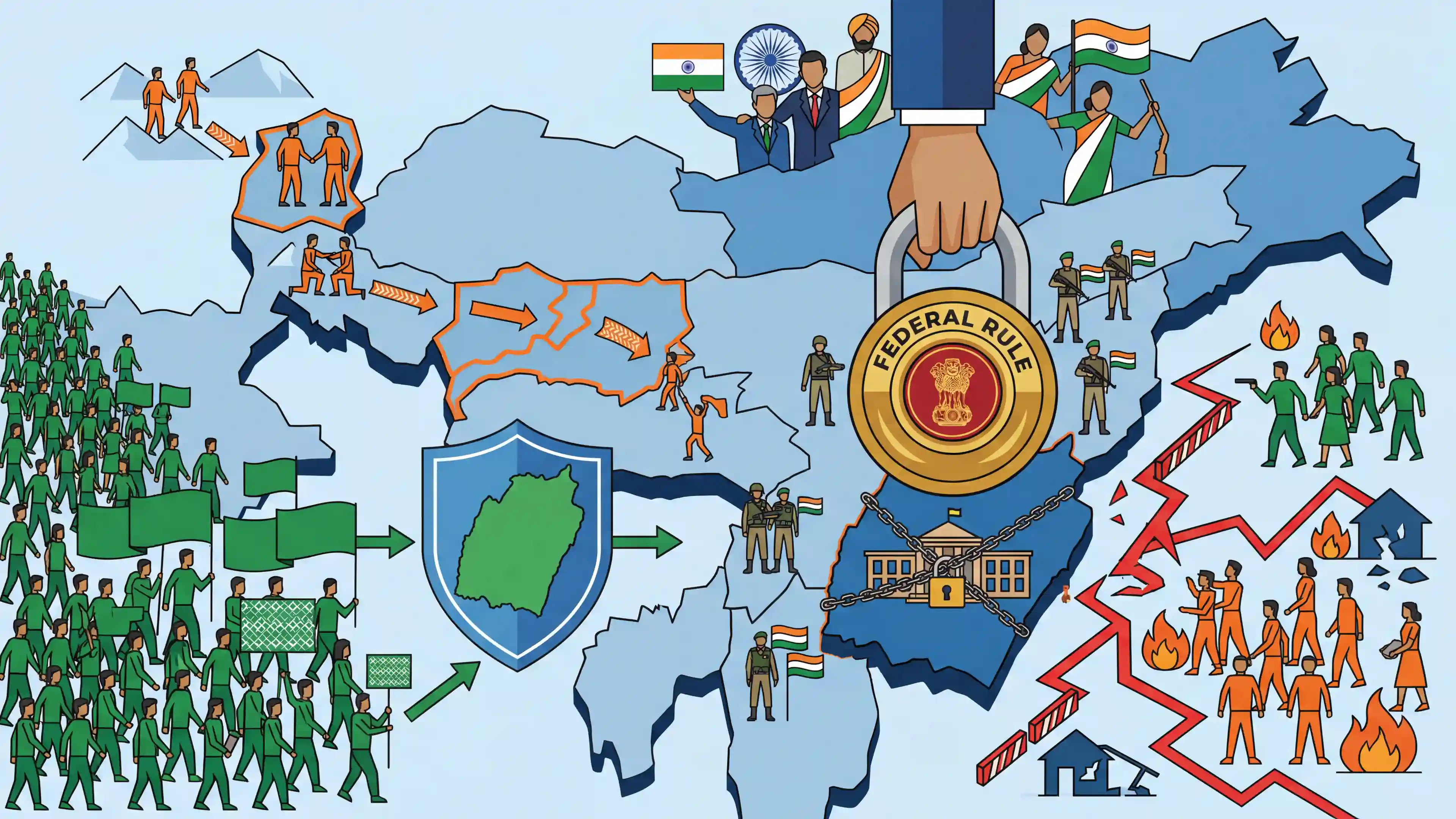
Thousands participated in the "Save Manipur" rally in Imphal, organized by the civil society umbrella body COCOMI, to demand the protection of the state's territorial and administrative integrity. The rally acts as a counter to the Kuki-Zo community's demands for a separate administration, a rift stemming from the ethnic violence that erupted in May 2023. The situation has resulted in severe internal security challenges, leading to the imposition of President's Rule in Manipur since February 2025.
Key Points
- A massive "Save Manipur" rally was organized by COCOMI in Imphal to assert that the state's territorial and administrative integrity cannot be divided.
- The rally responds to ongoing demands by Kuki-Zo groups for a separate administrative mechanism amidst ethnic conflict.
- Ethnic violence between the valley-majority Meiteis and hill-dwelling Kuki-Zo groups has claimed over 260 lives since May 2023.
- Manipur has been governed under President's Rule since February 2025.
- Participants in the rally included members from various communities such as Meiteis, Nagas, Muslims, and non-Manipuris.
Important Terms
Article 356 (President's Rule)

Constitutional provision allowing the Union government to take control of a state's administration if the constitutional machinery fails, placing it under the President's direct rule via the Governor.
UPSC context
GS II: Polity & Federalism. Tests understanding of emergency provisions, Centre-State relations, and judicial review (S.R. Bommai case).
COCOMI (Coordinating Committee on Manipur Integrity)
An umbrella body of Meitei civil society organizations formed in 2019 to safeguard Manipur's territorial and administrative integrity, particularly against demands for separate statehood or autonomy for hill tribes.
UPSC context
GS III: Internal Security. Tests awareness of non-state actors, civil society's role in ethnic conflicts, and North-East security dynamics.
Separate Administration Demand
The demand by Kuki-Zo communities for a Union Territory with a legislature, citing an 'existential threat' and the impossibility of coexistence with the Meitei community following the 2023 ethnic violence.
UPSC context
GS II/III: State Reorganization & Internal Security. Tests Article 3 (Parliament's power to create states) and identity politics in federalism.
Suspension of Operations (SoO) Pact
A 2008 tripartite ceasefire agreement between the Centre, Manipur government, and Kuki insurgent groups, aimed at facilitating peace talks by confining armed cadres to designated, monitored camps.
UPSC context
GS III: Internal Security. Tests knowledge of peace-making mechanisms and the management of insurgency in the North-East.
Article 371C
A special constitutional provision for Manipur that empowers the President to constitute a committee of the State Legislature comprising members from the 'Hill Areas' to protect tribal interests.
UPSC context
GS II: Polity. Focuses on special provisions for states and asymmetrical federalism in India's constitutional framework.
Ethnic Conflict (Manipur)
A prolonged clash (starting May 2023) between the Meitei and Kuki-Zo communities over land, political representation, and Scheduled Tribe (ST) status, leading to severe internal security challenges.
UPSC context
GS III: Internal Security. Evaluates analysis of ethnic fault lines, demographic shifts, and the impact of identity-based violence on national security.
Prelims Trap
"Manipur's tribal hill areas are governed autonomously under the Sixth Schedule of the Constitution."
Manipur is NOT a Sixth Schedule state. Its tribal hill areas are administered via Hill Area Committees created under Article 371C.
Static Concepts Connected
How are the hill areas in Manipur constitutionally protected?
- Article 371C: Provides for the creation of Hill Area Committees comprising MLAs elected from the state's hill regions.
- Governor's responsibility: The Governor is entrusted with special responsibility for hill areas and must submit annual administrative reports to the President.
- Not Sixth Schedule: Unlike Assam, Meghalaya, Tripura, and Mizoram, Manipur's tribal areas are not covered under the Sixth Schedule.
What are the constitutional parameters for President's Rule (Article 356)?
- Grounds for imposition: Invoked when a state's constitutional machinery fails, based either on a Governor's report or the President's own assessment.
- Parliamentary approval: The proclamation must be approved by both Houses of Parliament within two months of its issuance.
- Maximum duration: Can be extended up to three years, but extensions beyond one year require Election Commission certification of difficulties holding polls.
Cross-Topic Patterns
Article 3 vs separate administration
Kuki-Zo demands for a Union Territory with a legislature (Article 239A) connect directly to Parliament's unilateral power to alter state boundaries and create UTs under Article 3.
Internal Security + Topography
The "valley vs hill" ethnic divide illustrates how topography dictates demographic isolation and internal security challenges, a recurring theme in GS-3.

A multi-statement question in 2026 will likely contrast Manipur's Article 371C Hill Area Committees with the Sixth Schedule.
Linked PYQs · 3
Linked PYQs · 3
- 2017MainsGS3
The North-East region of India has been infested with insurgency for a very long time. Analyze the major reasons for the survival of armed insurgency in this region.
- 2023MainsGS2
Account for the legal and political factors responsible for the reduced frequency of using Article 356 by the Union Governments since mid 1990s.
- 2013MainsGS1
Growing feeling of regionalism is an important factor in generation of demand for a separate State. Discuss.
