Lawyers Demand Gujarat High Court Bench In Rajkot
Source:deshgujarat ↗
આ શા માટે મહત્વનું છે
The establishment of High Court benches away from the principal seat touches upon core constitutional principles, including Article 39A (Equal Justice and Free Legal Aid) and the structural organization of the judiciary under Articles 214-231. It highlights the administrative challenges of judicial pendency and the need for geographic decentralization to ensure accessible justice.
સારાંશ
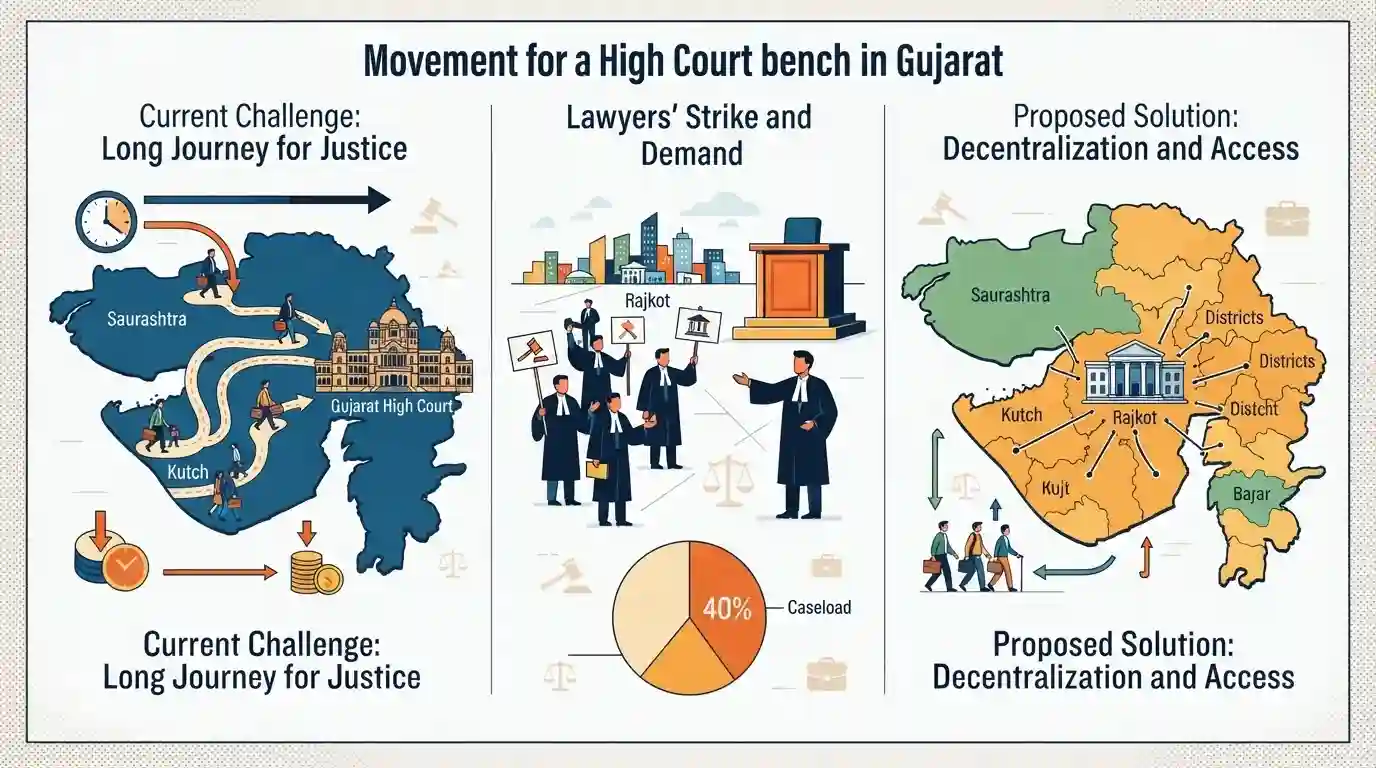
Lawyers in Gujarat's Saurashtra and Kutch regions held a one-day strike to intensify their demand for a Gujarat High Court bench in Rajkot. Arguing that the region accounts for nearly 40% of the High Court's caseload, proponents state that a local bench would drastically improve access to justice by making it faster and more affordable for residents of 11 districts. The movement cites precedents in other states that successfully operate multiple High Court benches to decentralize the judiciary.
મુખ્ય મુદ્દા
- Lawyers from Saurashtra and Kutch observed a one-day strike demanding the establishment of a Gujarat High Court bench in Rajkot.
- Advocates highlight that the region comprises 11 districts and over 5,000 villages, contributing nearly 40% of the cases filed in the Gujarat High Court.
- A Rajkot bench is proposed to make justice more affordable, accessible, and speedy, while reducing the burden on the principal seat in Ahmedabad.
- The demand is bolstered by examples of other large states like Madhya Pradesh, Rajasthan, West Bengal, and Karnataka, which operate multiple High Court benches.
મહત્વપૂર્ણ શબ્દો
Rajkot Bar Association

A voluntary professional organization of legal practitioners in Rajkot, Gujarat, actively leading collective advocacy for decentralized judicial infrastructure, specifically demanding a permanent High Court bench in Rajkot.
UPSC context
GS Paper II (Polity): Tests civil society pressure groups, regional demands for decentralization, and constitutional access to justice.
High Court Bench
A regional division or permanent seat of a High Court established away from its principal seat to decentralize the judiciary and provide accessible, cost-effective justice to distant regions.
UPSC context
GS Paper II (Polity): Tests judicial decentralization, access to justice under Article 21, and the role of the executive in establishing benches.
Gujarat High Court
The apex judicial institution of Gujarat state, established in 1960 under the Bombay Re-organisation Act. It supervises the administration of justice and subordinate courts throughout Gujarat from its principal seat in Ahmedabad.
UPSC context
GS Paper II (Polity): Important for topics covering structure, organization, and jurisdiction of state judiciary and constitutional provisions under Article 214.
Gujarat Bar Association
A professional body representing lawyers in Gujarat that advocates for the interests of the legal fraternity, champions judicial independence, and participates in state-wide legal welfare and reform programs.
UPSC context
GS Paper II (Polity): Relevant for civil society, pressure groups, and their influence on judicial policy and public interest issues.
Bar Council of India
A statutory body created under the Advocates Act, 1961, that regulates the legal profession and sets standards for legal education, professional conduct, and disciplinary jurisdiction across India.
UPSC context
GS Paper II (Polity & Governance): Relevant for statutory bodies, judicial administration, and professional regulatory standards in the legal system.
પ્રિલિમ્સ ટ્રેપ
The State Legislature has the power to enact laws establishing regional High Court benches.
The constitution and organization of High Courts fall exclusively under the Union List (Entry 78). Benches are established by the President, not State laws.
સંલગ્ન સ્થિર ખ્યાલો
How is a new regional High Court bench established?
- Union List: Parliament holds exclusive legislative power over the constitution and organization of High Courts (Entry 78).
- Presidential Order: Under Section 51(2) of the States Reorganisation Act, 1956, the President establishes permanent benches.
- Proposal Procedure: The State Government proposes and funds it, but requires explicit consent from the Governor and the High Court Chief Justice.
What is the Jaswant Singh Commission (1981) related to?
- Core Mandate: Formulated benchmark criteria for establishing High Court benches away from their principal seats.
- Key Criteria: Requires high case pendency, distinct regional characteristics, large population, and significant travel distance for litigants.
આંતર-વિષય પેટર્ન
Physical Benches vs. e-Courts
Demands for localized physical benches are increasingly juxtaposed against the Supreme Court's push for virtual hearings and e-Courts Phase III to democratize justice access.
Federalism in Judicial Admin
Establishing a bench requires tripartite synergy: the State funds it, the High Court Chief Justice consents, and the Union (President) passes the final order.

Expect a Prelims question testing if State Legislatures can create HC benches (they cannot; it requires Union List Entry 78 + President).
સંલગ્ન PYQ · 4
સંલગ્ન PYQ · 4
- 2020GPSC_PRELIMSGS1
Which of the following are provided under the States Reorganization Act, 1956? 1. Inter-State Council 2. Delimitation of constituencies by the Delimitation Commission 3. High Courts for the newly created states
- 2024GPSC_PRELIMSGS1
Consider the following statements. 1. Access to justice for the weaker sections of the society is a constitutional mandate to ensure fair treatment under Indian legal system. 2. Legal Services Authorities Act, 1987, was enacted by Parliament to organise Lok Adalats outside the formal adjudicatory system, to address the problems of crowded cases. 3. Equal justice and free legal aid is one of the Directive Principles of State Policy (DPSP) under the Indian Constitution Which of the above statements is/are correct?
- 2025GPSC_PRELIMSGS1
Which of the following statements correctly describe the structure of the Indian Judiciary? 1. The Supreme Court of India was established under Article 124 of the Constitution. 2. The High Courts in India function under Articles 214-231 of the Constitution. 3. The Chief Justice of India (CJI) is appointed by the President of India in consultation with the Council of Ministers. 4. The National Judicial Appointments Commission (NJAC) was struck down by the Supreme Court in 2015 for violating judicial independence. Select the correct answer using the codes below:
- 2024GPSC_PRELIMSGS1
Consider the following statements: 1. The Supreme Court of India can sit only in Delhi. 2. The Supreme Court of India can sit in places other than Delhi which the Chief Justice of India may appoint with the approval of the President. 3. The Parliament may make provisions for conferring supplementary powers upon the Supreme Court. Which of the statements given above is/are correct?
