Saudi Labor Policy Shift and Economic Diversification
Source:Indian Express ↗
Why It Matters
Understanding the economic restructuring of Saudi Arabia (Vision 2030) and the shifting labor policies (Saudisation) is crucial for Indian diaspora prospects and India's broader strategic, energy, and economic relations with West Asia.
Summary
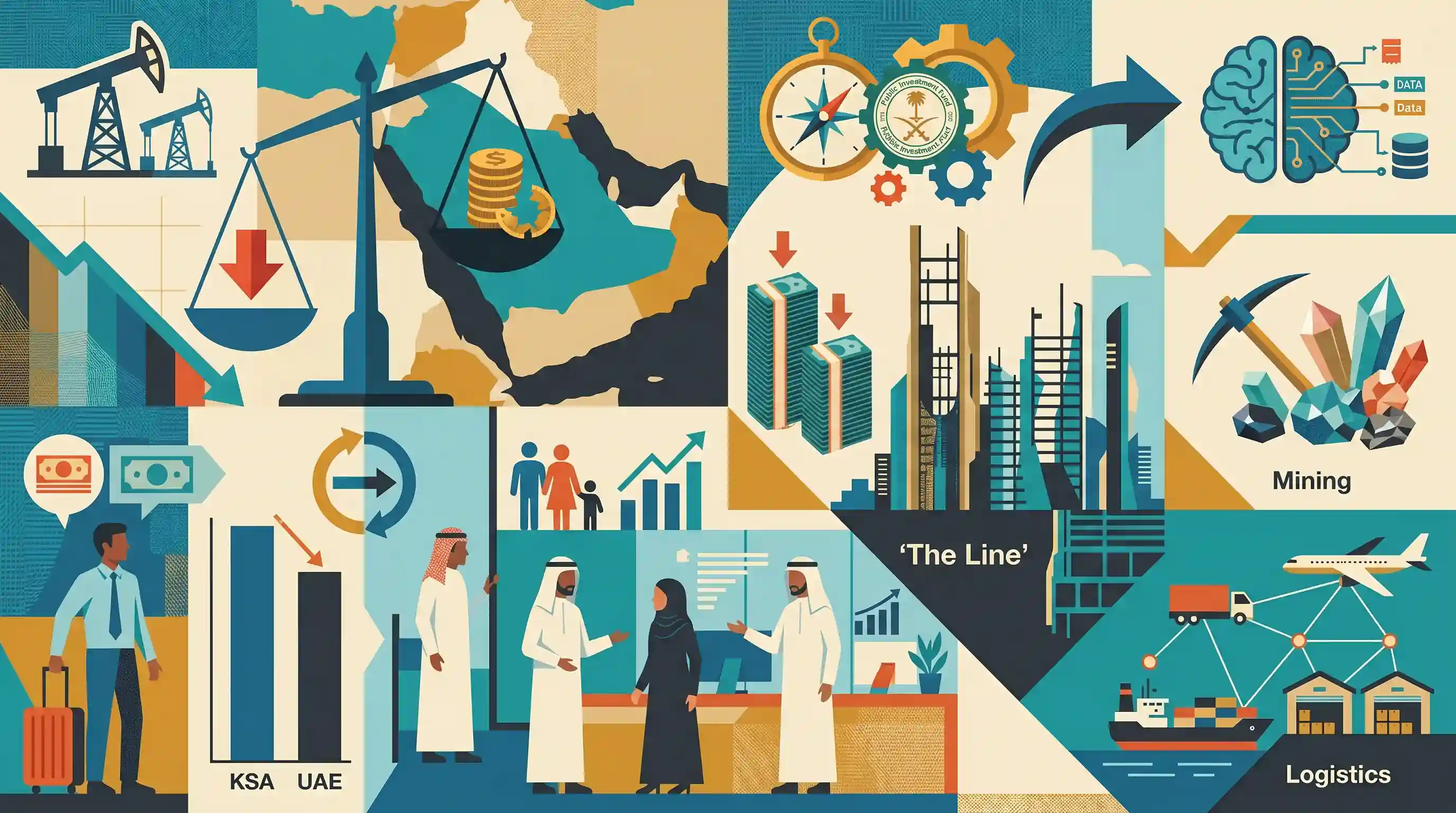
Saudi Arabia is significantly reducing the massive salary premiums it previously offered to attract foreign talent, signaling a shift in its economic diversification strategy. Driven by lower global oil prices, a widening fiscal deficit, and a strategic review by the Public Investment Fund (PIF), the Kingdom is pivoting away from costly real estate megaprojects like NEOM towards AI, mining, and logistics. Concurrently, labor market reforms dubbed 'Saudisation' aim to boost local employment in the private sector. This fiscal rationalization narrows the compensation gap with neighboring UAE, altering the regional dynamics for expatriate workers and highlighting the challenges in transitioning away from a hydrocarbon-dependent economy under the 'Vision 2030' plan.
Key Points
- Saudi Arabia is scaling back lucrative salary premiums (previously 40%+) for foreign recruits as it rationalizes spending on 'Vision 2030' megaprojects.
- The $925 billion Public Investment Fund is shifting focus from massive real estate and infrastructure projects (like NEOM) toward high-return sectors such as AI, logistics, and mining.
- The slowdown is driven by lower global oil prices expanding the fiscal deficit, necessitating oil prices near $100/barrel to balance the budget.
- 'Saudisation' policies are being enforced to increase the proportion of Saudi citizens employed in the private sector, altering labor market dynamics.
- The UAE (particularly Dubai) remains a highly competitive alternative for foreign talent due to tax-free salaries, established lifestyle, and better infrastructure, narrowing the salary gap with Saudi Arabia.
Important Terms
Vision 2030

A strategic framework launched in 2016 to reduce Saudi Arabia's dependence on oil, diversify its economy, and develop public service sectors such as health, education, infrastructure, and tourism.
UPSC context
GS Paper-II/III: West Asian structural reforms; tests understanding of regional economic shifts and global energy transition impact on India.
Saudisation (Nitaqat)
Also known as 'Nitaqat,' this labor nationalization policy mandates Saudi companies to employ a specific percentage of Saudi nationals, aiming to increase local private-sector participation.
UPSC context
GS Paper-II: International Relations (Indian Diaspora). Tests knowledge of labor market changes affecting millions of Indian expatriates in the Gulf.
Public Investment Fund (PIF)
The sovereign wealth fund of Saudi Arabia and the primary investment engine for Vision 2030, used to finance massive domestic projects and global assets to ensure non-oil revenue.
UPSC context
GS Paper-III: Economy and Investment Models. Crucial for understanding state-led economic transformation and global financial influence of sovereign funds.
NEOM
A $500 billion futuristic mega-city project in Tabuk Province, featuring sustainable regions like 'The Line.' It is a cornerstone of Vision 2030 currently undergoing fiscal rationalization.
UPSC context
GS Paper-II/III: Infrastructure and West Asian Geopolitics. Represents the scale and challenges of high-tech economic diversification in the hydrocarbon-dependent region.
Economic Diversification
The strategic process of expanding an economy's industrial and service sectors to reduce reliance on a single revenue source, such as oil, and minimize vulnerability to global price shocks.
UPSC context
GS Paper-III: Economic Development. Core theme for oil-exporting nations and its implications for India's long-term energy and economic security.
Prelims Trap
The Gulf Cooperation Council (GCC) countries account for the absolute majority of inward remittances to India.
The US recently overtook the UAE as the top single-country source of remittances. The overall share of the GCC in India's remittances has also structurally declined.
Static Concepts Connected
What characterizes a "Rentier Economy" like Saudi Arabia?
- Revenue source: Relies heavily on external rent (e.g., oil exports) rather than domestic taxation or productive manufacturing.
- Macroeconomic vulnerability: Highly susceptible to global commodity price shocks, necessitating high break-even oil prices to fund state budgets and welfare.
- Diversification push: Prompts structural reforms like 'Vision 2030' to build non-oil sectors (AI, tourism) and expand the domestic tax base.
How is India's inward remittance profile structurally changing?
- Volume and role: India remains the world's largest recipient, consistently receiving over $100 billion annually, which crucially offsets the merchandise trade deficit.
- Geographic shift: There is a steady shift from Gulf countries (low-skilled labor) to Advanced Economies like the US and UK (high-skilled tech workers).
Cross-Topic Patterns
Saudisation vs. Diaspora Remittances
Labor nationalization policies like 'Nitaqat' reduce employment for blue-collar Indian expatriates, slowly eroding the traditional Gulf-to-Kerala remittance corridor that historically sustained regional economies.
Sovereign Wealth Funds pivot
As Saudi scales back megaprojects due to fiscal deficits, its Public Investment Fund (PIF) shifts focus to AI and tech, altering sovereign wealth flows into Indian startups and infrastructure.

Expect a Prelims trend-question contrasting declining Gulf remittance shares with rising US inflows due to Gulf nationalization policies.
Linked PYQs · 4
Linked PYQs · 4
- 2017MainsGS2
The question of India's Energy Security constitutes the most important part of India's economic progress. Analyze India's energy policy cooperation with West Asian countries.
- 2021MainsGS3
“Investment in infrastructure is essential for more rapid and inclusive economic growth.” Discuss in the light of India's experience.
- 2020MainsGS2
Indian diaspora has a decisive role to play in the politics and economy of America and European Countries'. Comment with examples.
- 2017MainsGS2
Indian diaspora has an important role to play in South-East Asian countries' economy and society. Appraise the role of Indian diaspora in South-East Asia in this context.
