Saudi Arabia Launches First Arabic AI Chatbot
Source:Indian Express ↗
Why It Matters
The development of an indigenous, culturally-aligned LLM by Saudi Arabia serves as a significant case study in data sovereignty and localization. It parallels India's push for digital sovereignty (e.g., BharatGPT, Bhashini) and data localization under the Digital Personal Data Protection Act, highlighting a global shift away from Western-dominated AI paradigms.
Summary
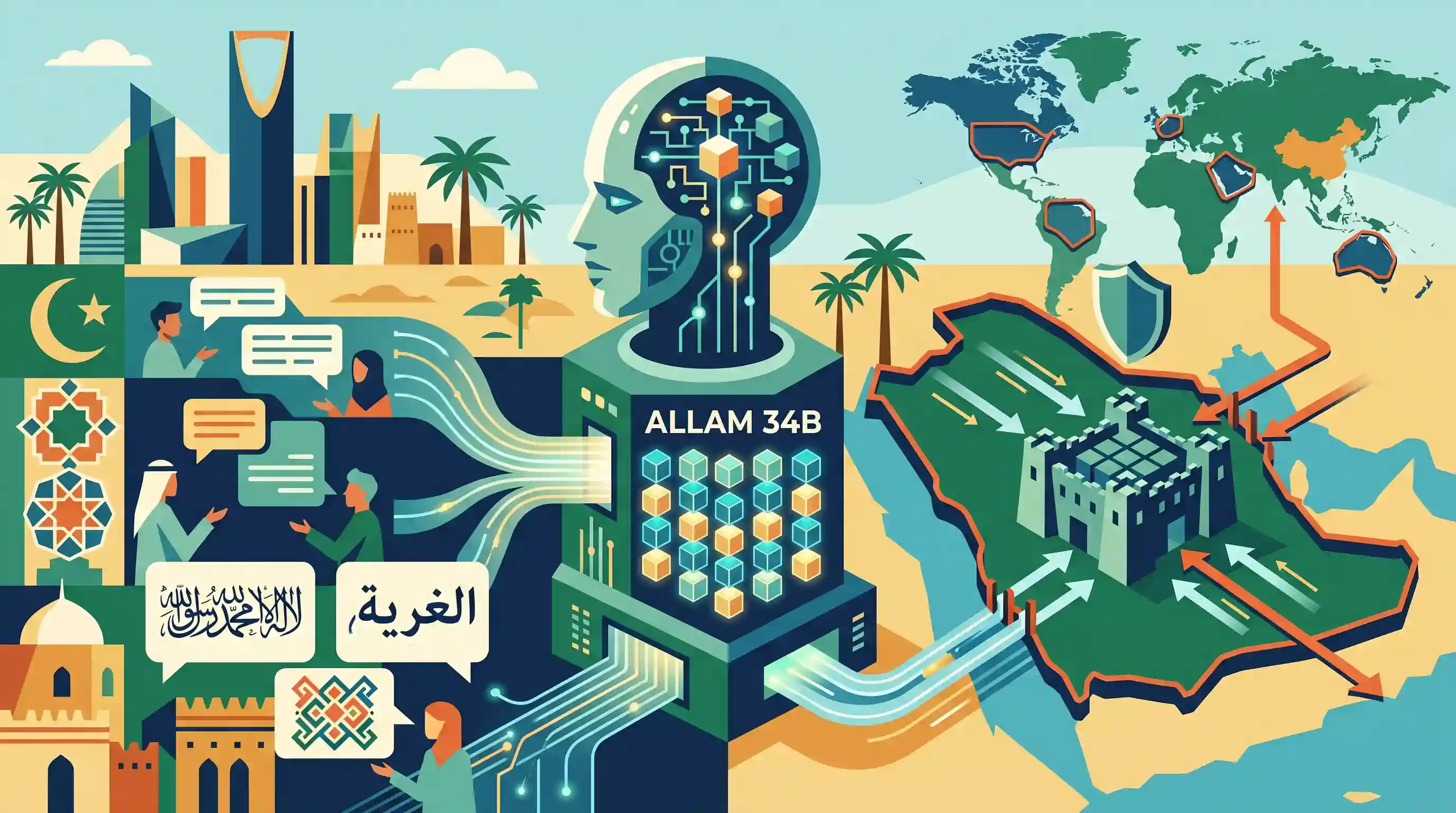
Humain, an AI company backed by Saudi Arabia's Public Investment Fund, has launched Humain Chat, a conversational AI model designed to reflect Arabic culture and Islamic values. Powered by the ALLAM 34B large language model, it offers advanced bilingual communication and dialect-specific speech recognition. Emphasizing national data sovereignty, the application operates entirely within the Kingdom in compliance with local data protection laws, illustrating a growing global trend towards localized, culturally-aligned AI development.
Key Points
- Saudi AI startup Humain launched Humain Chat, the first Arabic conversational AI tailored to Arabic heritage and Islamic values.
- The chatbot is powered by ALLAM 34B, the most advanced LLM in the Arab world, trained on over eight petabytes of Arabic data.
- It features bilingual support, real-time search integration, and speech recognition across multiple Arabic dialects.
- The platform ensures national data sovereignty by hosting all data entirely within Saudi Arabia, complying with the Kingdom's Personal Data Protection Law.
- Owned by the Public Investment Fund (PIF), Humain represents Saudi Arabia\'s broader strategy to build globally competitive, indigenous digital infrastructure.
Important Terms
Public Investment Fund (PIF)

Saudi Arabia's sovereign wealth fund, one of the world's largest, tasked with driving the 'Vision 2030' program to diversify the national economy beyond oil through strategic global and domestic investments.
UPSC context
Relevant for GS Paper 2 (International Relations) and GS Paper 3 (Economy), particularly concerning global investment trends and sovereign wealth funds.
Personal Data Protection Law (PDPL)
Saudi Arabia’s first comprehensive data privacy legislation, regulating the processing of personal data. It emphasizes individual rights, consent, and strict controls on cross-border data transfers to ensure national data security.
UPSC context
Relevant for GS Paper 3 (Cyber Security and Science & Tech) regarding global data protection frameworks and privacy rights.
Humain
A state-backed Saudi AI company formed through the merger of various technological entities. It aims to develop a full-stack AI ecosystem, including infrastructure, cloud services, and culturally aligned Arabic language models.
UPSC context
Significant for GS Paper 3 (Science and Technology) as an example of state-led indigenous technological development and AI governance.
ALLAM 34B
A state-developed, Arabic-centric large language model (LLM) with 34 billion parameters. It is specifically trained on regional dialects and cultural nuances to provide localized AI responses for the Arabic-speaking world.
UPSC context
Relevant for GS Paper 3 (Science and Technology) under 'Developments and their applications' and the evolution of localized AI.
Data Sovereignty
The principle that data is subject to the laws and governance of the nation where it is collected. It ensures a country maintains control over its citizens' information and strategic digital assets.
UPSC context
Critical for GS Paper 3 (Internal Security and IT) and GS Paper 2 (Governance), focusing on digital rights and national security.
Data Localization
The legal requirement that data generated within a country must be stored and processed on servers physically located within its borders, often to facilitate law enforcement access and protect privacy.
UPSC context
Key topic in GS Paper 3 (Science and Tech/Economy) concerning digital trade, infrastructure, and national jurisdiction.
Saudi Data & AI Authority (SDAIA)
The primary government entity in Saudi Arabia responsible for the national data and AI agenda. It oversees the implementation of the PDPL and the development of indigenous AI technologies.
UPSC context
Relevant for GS Paper 2 (International Relations) and GS Paper 3 (Science & Tech) regarding institutional frameworks for emerging technologies.
Prelims Trap
Sovereign AI implies AI models that are exclusively developed for and accessible only by government entities.
Sovereign AI refers to nations building AI infrastructure and training models on local data to reflect regional culture, not state-exclusive usage.
Static Concepts Connected
What is the difference between Data Sovereignty and Data Localization?
- Data Sovereignty: The legal concept that digital data is subject to the national laws, governance, and jurisdiction of the country where it is collected or processed.
- Data Localization: The physical or legal mandate requiring entities to store, process, and handle data strictly within a country's territorial borders, often restricting cross-border transfers.
What causes Algorithmic Bias in Large Language Models (LLMs)?
- Skewed Training Data: Models trained predominantly on Western internet datasets absorb regional cultural biases, leading to poor representation of local languages, dialects, and values.
- Algorithmic Amplification: Inherent human prejudices present in historical data are inadvertently learned and magnified by deep learning algorithms, resulting in culturally insensitive or discriminatory outputs.
Cross-Topic Patterns
Sovereign AI + Data Localization Laws
Saudi Arabia's approach mirrors India's push for indigenous AI (e.g., Bhashini) and data localization, aiming to prevent 'compute colonialism' and ensure cultural representation.
Middle East Geopolitics + Knowledge Economies
Heavy tech investments by sovereign wealth funds (like Saudi's PIF) highlight a strategic geopolitical shift for Gulf nations transitioning from oil-dependency to digital knowledge economies.

Expect a 2026 Prelims multi-statement question linking Sovereign AI, algorithmic bias, and global data localization trends.
Linked PYQs · 2
Linked PYQs · 2
- 2024MainsGS3
Describe the context and salient features of the Digital Personal Data Protection Act, 2023.
- 2018MainsGS3
Data security has assumed significant importance in the digitized world due to rising cyber crimes. The Justice B. N. Srikrishna Committee Report addresses issues related to data security. What, in your view, are the strengths and weaknesses of the Report relating to protection of personal data in cyber space?
