Centre state dynamics and political instability in Bihar
Source:Indian Express ↗
Why It Matters
Understanding the evolution of state politics and the decline of national parties in regional strongholds is crucial for post-independence history. The episode highlights how administrative failures during communal riots and excessive centralization in party politics can trigger long-term electoral and social realignments.
Summary
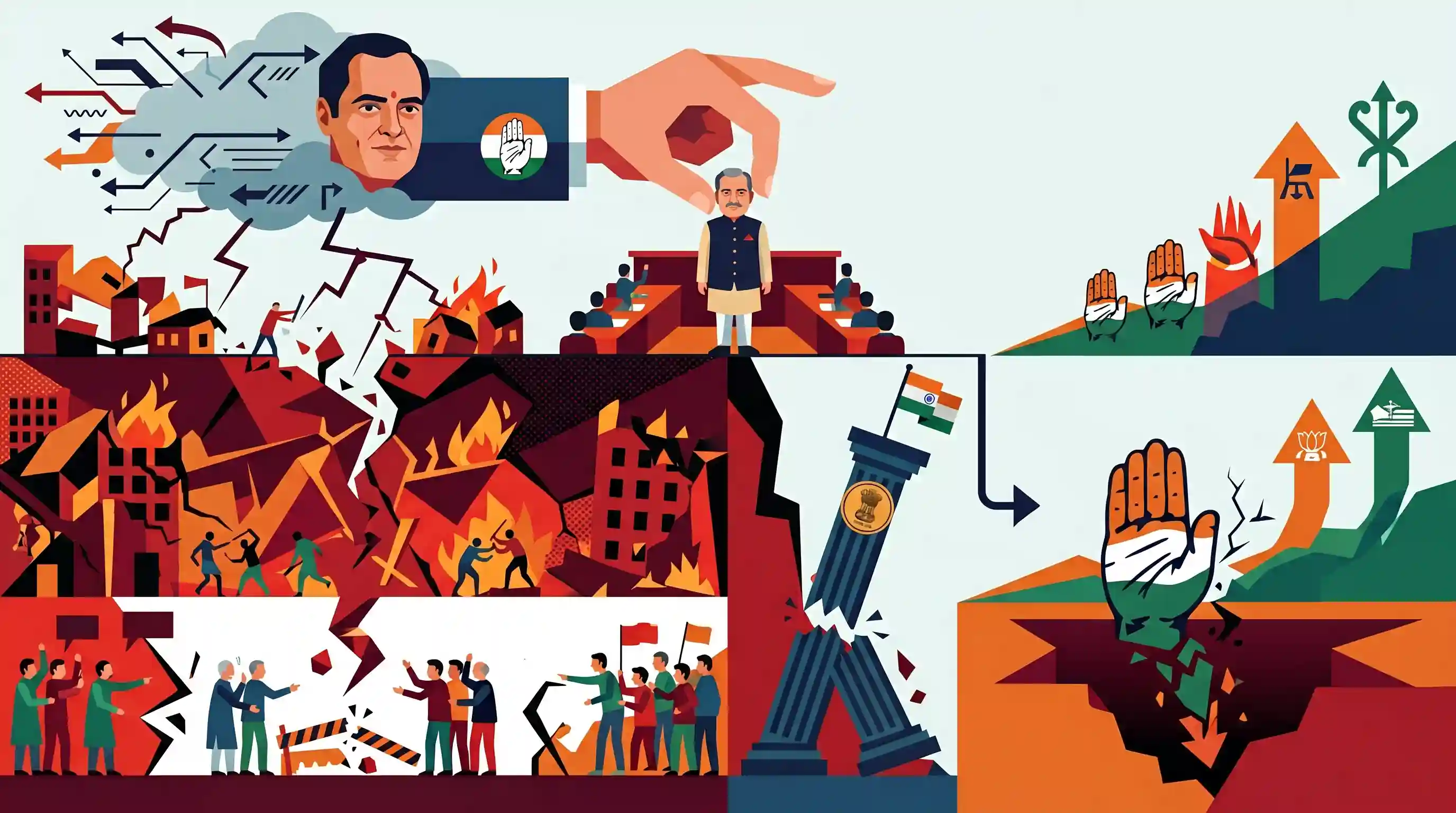
The article examines the brief and turbulent tenure of Satyendra Narayan Sinha, who was appointed as the Chief Minister of Bihar in 1989 amidst a major Congress party reshuffle directed by Rajiv Gandhi. Known as 'Chhote Saheb', Sinha faced immense governance challenges, most notably the catastrophic 1989 Bhagalpur riots, which marked a severe breakdown in law and order. His stint exemplifies the pitfalls of the 'high command culture' where central party leadership dictates state appointments, often leading to political instability. The failure to curb communal violence during his administration led to a massive erosion of the Congress party's traditional support base in Bihar, permanently altering the state's political landscape and paving the way for the dominance of regional forces.
Key Points
- Satyendra Narayan Sinha ('Chhote Saheb') was appointed as Bihar's Chief Minister in 1989 during a massive reshuffle orchestrated by the Congress central leadership.
- His brief tenure was overwhelmed by a severe breakdown in law and order, culminating in the tragic 1989 Bhagalpur communal riots.
- The central 'high command culture' of imposing chief ministers contributed to political instability and weakened effective state administration.
- The administrative failure to control the communal violence alienated the party's traditional vote bank, facilitating the subsequent rise of regional and Mandal politics in Bihar.
- The events serve as a key case study in post-independence Indian political history, illustrating the intersections of communalism, state politics, and central party dominance.
Important Terms
1989 Bhagalpur Riots

A catastrophic outbreak of communal violence in Bihar (Oct-Dec 1989) that killed over 1,000 people. It caused a decisive shift of Muslim voters away from Congress, ending its state dominance.
UPSC context
GS Paper 1 (Secularism/Communalism) and Paper 2 (State Politics). Crucial for understanding the decline of national parties in Hindi Heartland.
High Command Culture
A political system where a party's central leadership dictates state-level appointments and decisions, bypassing local units. It is often linked to political centralisation and the erosion of inner-party democracy.
UPSC context
GS Paper 2 (Political Parties/Federalism). Tests knowledge of internal party structures and their impact on Centre-State dynamics.
Satyendra Narayan Sinha
The 19th Chief Minister of Bihar (1989) and veteran freedom fighter known as 'Chhote Saheb'. His brief tenure is noted for the Bhagalpur riots and the subsequent erosion of Congress support.
UPSC context
GS Paper 1 (Post-Independence History). Relevant for studying leadership transitions and political crises in major Indian states.
Communalism
An ideology where people believe that because they belong to a particular religious community, their interests are different from or antagonistic to those of other communities.
UPSC context
GS Paper 1 (Social Issues). A core syllabus topic; tested via historical events like riots and their socio-political impact.
Regionalism
A political ideology that prioritises the interests of a specific region. In Bihar, it manifested as the rise of regional parties (e.g., RJD, JD-U) following the decline of national parties.
UPSC context
GS Paper 1 (Social Issues) and GS Paper 2 (Political Parties). Explains the fragmentation of the Indian party system post-1980s.
Prelims Trap
The 1989 Bhagalpur riots were a direct consequence of the widespread anti-Mandal Commission protests in Bihar.
This conflates timelines. The 1989 Bhagalpur riots were triggered by the Ramshila processions (Ram Janmabhoomi movement), while anti-Mandal protests erupted later in 1990.
Static Concepts Connected
What was the 'Congress System' and what caused its decline?
- Definition: Coined by Rajni Kothari, it refers to the party's early post-independence dominance as a massive umbrella organization accommodating highly diverse ideological factions.
- Decline Factors: Its collapse was triggered by internal over-centralization, the rise of regional backward-caste assertion, and the systemic alienation of its traditional minority and Dalit vote banks.
How does the 'High Command Culture' impact constitutional federalism?
- Bypassing MLAs: Article 164 states the Governor appoints the CM, but centralized party dictation effectively bypasses the state legislature's democratic prerogative to choose its leader.
- Shifted Accountability: It shifts a Chief Minister's primary accountability from the state electorate and legislature to the central party leadership in Delhi.
- Governance Instability: Imposed leadership frequently leads to rampant factionalism, extremely short tenures, and administrative paralysis during critical state emergencies.
Cross-Topic Patterns
Communalism & Administrative Failure
The 1989 Bhagalpur riots illustrate how political instability via frequent Chief Ministerial changes directly weakens law enforcement, creating a vacuum that facilitates large-scale communal violence.
Congress Decline to Mandal Politics
Administrative collapse in the late 1980s alienated traditional minority bases, accelerating the shift from single-party dominance to an era defined by regional OBC consolidation and Mandal politics.

Expect a GS1 Mains question analyzing how the breakdown of the 'Congress System' birthed the era of regional and identity-based politics.
Linked PYQs · 3
Linked PYQs · 3
- 2018MainsGS1
Communalism arises either due to power struggle or relative deprivation.' Argue by giving suitable illustrations.
- 2025MainsGS1
Trace India's consolidation process during early phase of independence in terms of polity, economy, education and international relations.
- 2024MainsGS2
What changes has the Union Government recently introduced in the domain of Centre-State relations ? Suggest measures to be adopted to build the trust between the Centre and the States and for strengthening federalism.
