Passing of Former Jammu and Kashmir Governor Satya Pal Malik
Source:The Hindu ↗
Why It Matters
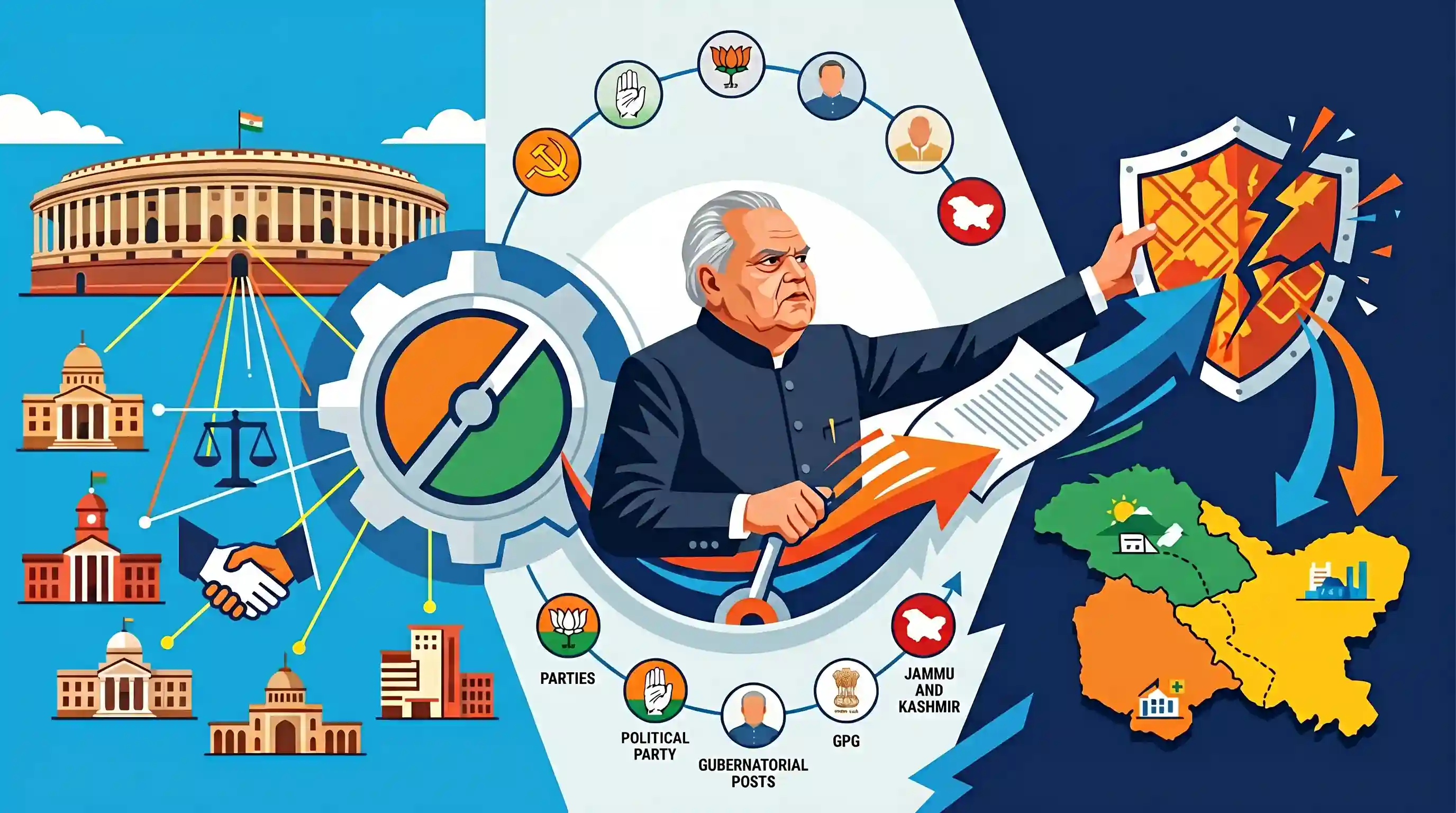
Satya Pal Malik's political career and gubernatorial tenures, especially during the abrogation of Article 370 in J&K, illustrate the constitutional importance of the Governor's office in Centre-State relations and executing major structural reforms in Indian federalism.
Summary
Satya Pal Malik, the former Governor of Jammu and Kashmir, passed away at the age of 79. He had a long political career inspired by socialist ideology, serving in the Congress, Janata Dal, and BJP. He held gubernatorial posts in five states, most notably in Jammu and Kashmir during the historic abrogation of its special status under Article 370 in August 2019. His tenure highlights the pivotal role of the Governor in executing significant constitutional changes in coordination with the Union government.
Key Points
- Former Governor Satya Pal Malik passed away at 79 due to multi-organ dysfunction and septic shock.
- He served as Governor of Jammu and Kashmir during the revocation of its special status under Article 370 on August 5, 2019.
- Throughout his career, he served as the Governor of five states: Bihar, Jammu & Kashmir, Goa, Meghalaya, and Odisha.
- A prominent Jat leader from western UP, he began his career inspired by socialist Ram Manohar Lohia, and was associated with the Congress (quitting over the Bofors scam), Jan Morcha, Janata Dal, before joining the BJP in 2004.
Important Terms
Article 370

A temporary constitutional provision that granted Jammu and Kashmir special autonomous status, including its own constitution and flag, until its revocation in August 2019.
UPSC context
GS Paper II: Constitutional provisions and significant amendments; tests understanding of federalism and historical integration of states.
Role of Governor
The constitutional head of an Indian state appointed by the President, acting as a critical bridge between the Union and State governments.
UPSC context
GS Paper II: Executive and Centre-State relations; tests knowledge of discretionary powers and constitutional roles during emergencies.
Rajya Sabha
The Upper House of the Indian Parliament (Council of States), representing states and UTs; it is a permanent body not subject to dissolution.
UPSC context
GS Paper II: Parliament structure and functioning; tests understanding of bicameralism and the federal representation system.
Lok Sabha
The Lower House of the Indian Parliament (House of the People), consisting of directly elected representatives; holds primary power over Money Bills.
UPSC context
GS Paper II: Parliamentary system and legislative procedures; tests knowledge of democratic representation and executive accountability.
Janata Dal
A political party formed in 1988 through the merger of various factions, ushering in India's era of coalition politics and socialist-secular governance.
UPSC context
GS Paper I/II: Post-independence history and political parties; tests knowledge of the transition from single-party to coalition systems.
Jan Morcha
A political movement/party founded by V.P. Singh in 1987 following the Bofors scandal, later merging into the Janata Dal to challenge Congress.
UPSC context
GS Paper I: Post-independence history; relevant for understanding political movements against corruption and their impact on national governance.
Federalism
A system of governance where power is constitutionally divided between a central authority and constituent units (States), a basic feature of India's Constitution.
UPSC context
GS Paper II: Constitutional features and Centre-State relations; core topic testing the balance of power in a quasi-federal structure.
Prelims Trap
The Jammu and Kashmir State Legislature consented to the 2019 abrogation of Article 370.
The state was under President's Rule. The Governor's concurrence substituted the State Government's, and Parliament assumed the Legislature's powers—a mechanism validated by the Supreme Court.
Static Concepts Connected
What governs the term, transfer, and removal of a State Governor?
- Pleasure of President: Holds office during the pleasure of the President (Article 156), allowing the Union government to dismiss or transfer them at any time.
- No Constitutional Grounds: Unlike the President or Supreme Court judges, the Constitution does not lay down any specific grounds or formal process for a Governor's removal.
- Transferability: The President can transfer a Governor appointed to one state to another state for the remainder of their five-year term.
How did Parliament use Article 3 to bifurcate Jammu and Kashmir?
- Parliamentary Authority: Empowers Parliament to form new states or Union Territories, and alter the areas, boundaries, or names of existing states by a simple majority.
- Prior Recommendation: A bill contemplating such changes requires the prior recommendation of the President before introduction in Parliament.
- Substituted Consent: Because J&K was under President's Rule, Parliament exercised the state legislature's constitutional prerogative to express its views on the Reorganisation Bill.
Cross-Topic Patterns
Asymmetric Federalism and Part XXI
While Article 370 for J&K was abrogated, special provisions under Articles 371A-371J remain highly active, safeguarding tribal customs and regional rights in states like Nagaland, Mizoram, and Maharashtra.
Discretionary vs Statutory Powers of Governors
The Governor's role as a Union agent executing constitutional changes (Art 356/370) frequently contrasts with their statutory, non-executive roles, such as acting as Chancellor of state universities.

Expect a 2026 prelims question contrasting the Governor's removal under the 'pleasure doctrine' with the President's impeachment process.
Linked PYQs · 3
Linked PYQs · 3
- 2022MainsGS2
Discuss the essential conditions for exercise of the legislative powers by the Governor. Discuss the legality of re-promulgation of ordinances by the Governor without placing them before the Legislature.
- 2016MainsGS2
To what extent is Article 370 of the Indian Constitution, bearing marginal note "Temporary provision with respect to the State of Jammu and Kashmir", temporary? Discuss the future prospects of this provision in the context of Indian polity.
- 2025MainsGS2
Discuss the nature of Jammu and Kashmir Legislative Assembly after the Jammu and Kashmir Reorganization Act, 2019. Briefly describe the powers and functions of the Assembly of the Union Territory of Jammu and Kashmir.
