Supreme Court Pan India Safety Guidelines for Urban Buildings
Source:Indian Express ↗
આ શા માટે મહત્વનું છે
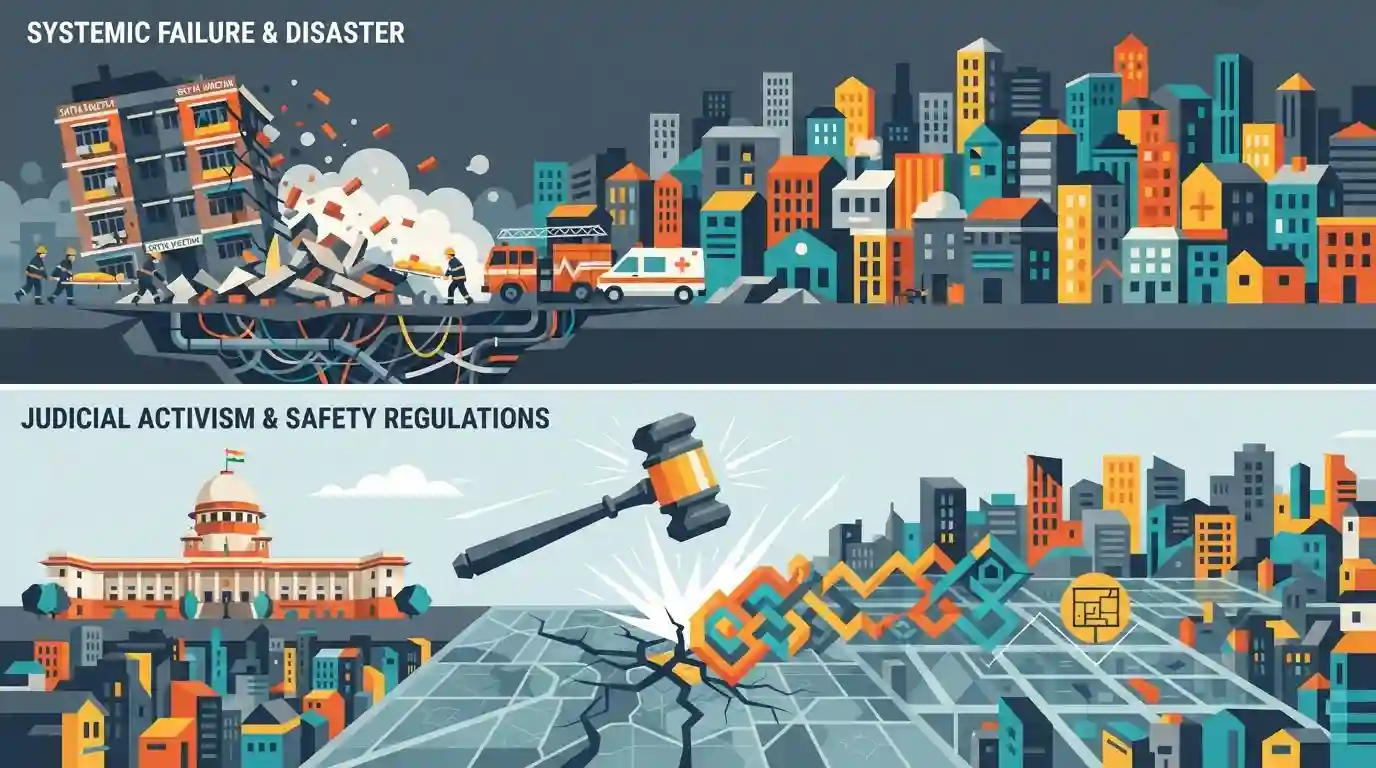
It emphasizes the role of the judiciary in compelling executive and municipal authorities to formulate uniform, pan-India safety standards to curb illegal constructions and avert man-made urban disasters.
સારાંશ
The Supreme Court of India's response to building collapse incidents, such as the Satya Niketan collapse, by pushing for pan-India safety guidelines underlines systemic concerns regarding urban governance, illegal constructions, and building safety enforcement by municipal bodies.
મુખ્ય મુદ્દા
- The Supreme Court called for pan-India safety guidelines following building collapse incidents like the one in Satya Niketan.
- The issue highlights systemic failures in urban local bodies, illegal conversions, and enforcement of building bylaws.
- Judicial intervention emphasizes proactive regulatory frameworks rather than reactive measures to prevent urban disasters.
મહત્વપૂર્ણ શબ્દો
Supreme Court

The apex court of India, which can step in through judicial activism to mandate pan-India building safety guidelines following urban disasters like the Satya Niketan collapse.
UPSC context
UPSC GS Paper II (Polity & Governance — Judiciary, Judicial Activism). Tests the role of the apex court in addressing systemic administrative failures.
Satya Niketan Collapse
The collapse of a multi-story paying guest building in Delhi due to unsafe structural alterations, prompting judicial intervention on urban safety and student housing regulations.
UPSC context
UPSC GS Paper I & III (Disaster Management, Urban Governance). Tests understanding of municipal apathy, illegal construction, and urban safety hazards.
Safety Audit
Systematic evaluations of buildings, paying guest accommodations, and student housing to check structural integrity, zoning compliance, and adherence to fire and safety codes.
UPSC context
UPSC GS Paper III (Disaster Management). Important for preventive governance and mitigating urban infrastructure vulnerabilities.
સંલગ્ન સ્થિર ખ્યાલો
What are the constitutional provisions and municipal mechanisms for urban governance and building safety in India?
- 74th Amendment:: Passed in 1992, it provides constitutional status to Urban Local Bodies (ULBs) with the 12th Schedule listing 18 functional items including urban planning and fire services.
- Building Bye-laws:: State-level municipal legislations empower local bodies to sanction building plans, enforce structural safety audits, and penalize unauthorized constructions.
- National Building Code:: The National Building Code (NBC) of India, published by BIS, serves as a model code providing guidelines for structural safety, fire safety, and hazard resistance.
આંતર-વિષય પેટર્ન
Judicial Activism vs 74th Amendment Urban Governance
Judicial intervention in urban safety exposes the acute capacity deficits of Urban Local Bodies under the 74th Constitutional Amendment Act.

SC directions on ULB accountability and building audits are high-yield for Mains GS-2 (Governance/Judiciary) and GS-3 (Disaster Management).
સંલગ્ન PYQ · 2
સંલગ્ન PYQ · 2
- 2022MainsGS2
“The most significant achievement of modern law in India is the constitutionalization of environmental problems by the Supreme Court.” Discuss this statement with the help of relevant case laws.
- 2020MainsGS3
Discuss the recent measures initiated in disaster management by the Government of India departing from the earlier reactive approach.
