Satkosia Tiger Reintroduction Lessons for Wildlife Conservation
Source:The Hindu ↗
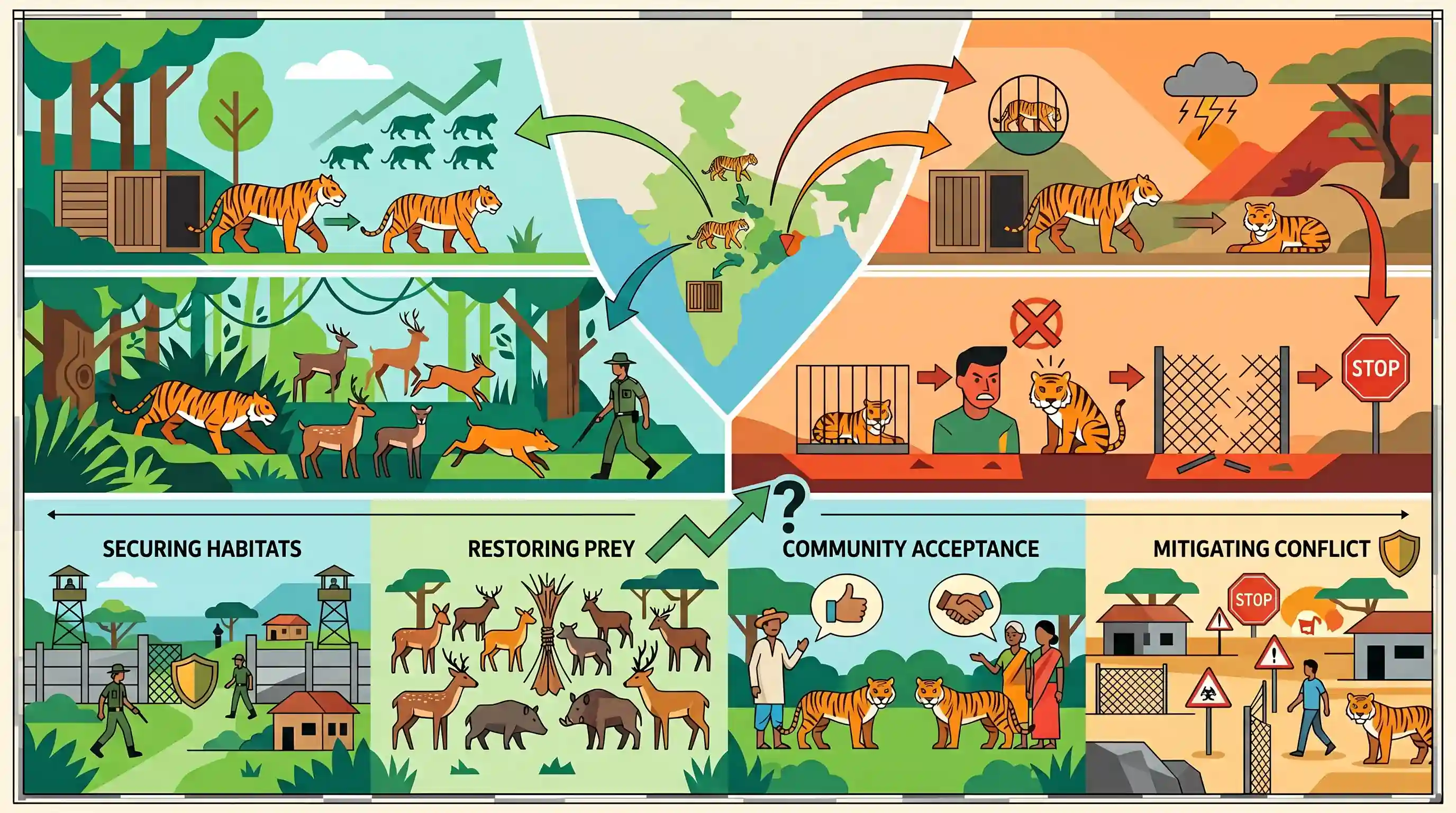
Why It Matters
Provides contrasting case studies (Satkosia vs. Panna/Simlipal) on wildlife reintroduction. It highlights that successful conservation requires a balance of ecological (habitat, prey base) and social (community acceptance) factors, which is highly relevant for GS-3 Environment and GS-4 case studies on human-wildlife conflict.
Summary
The article evaluates India's mixed success with tiger reintroduction programs initiated by the NTCA and WII. While reserves like Panna and Simlipal have witnessed successful tiger population recoveries, the ambitious reintroduction at Odisha's Satkosia Tiger Reserve ended in failure. The Satkosia debacle serves as a crucial lesson that successful wildlife translocation requires extensive groundwork, including securing inviolate habitats, restoring prey bases, and gaining the social acceptance of local communities to mitigate human-animal conflict.
Key Points
- India's tiger reintroduction program, spanning 12 reserves over 16 years, has resulted in a 658% population increase from 38 to 288 tigers.
- Successful reintroduction case studies include Panna (Madhya Pradesh) and Simlipal (Odisha), while Sariska (Rajasthan) has shown slow but steady progress.
- The reintroduction at Satkosia Tiger Reserve (Odisha) failed drastically due to severe habitat degradation, depleted prey base, intense human-tiger conflict, and a lack of community acceptance.
- The Wildlife Institute of India (WII) stresses that pre-requisites for translocation include securing inviolate spaces, rebuilding prey bases, and ensuring social acceptance by local communities before moving big cats.
Important Terms
National Tiger Conservation Authority (NTCA)

A statutory body under the MoEFCC, established in 2005 under the Wildlife (Protection) Act, 1972, to provide legal and institutional oversight to Project Tiger and tiger reserve management.
UPSC context
GS Paper III: Statutory bodies and conservation initiatives. Tests knowledge of environmental governance and tiger protection frameworks.
Project Tiger
India’s flagship tiger conservation scheme launched in 1973, utilizing a 'core-buffer' strategy to ensure viable populations of Bengal tigers in their natural habitats.
UPSC context
GS Paper III: Conservation/Environmental Pollution & Degradation. Tests understanding of flagship species-based conservation models and history.
Satkosia Tiger Reserve
Located in Odisha, this reserve comprises Satkosia Gorge and Baisipalli Sanctuaries. It is significant for being the site of India’s first failed inter-state tiger translocation project.
UPSC context
GS Paper III: Protected Areas. Relevant for map-based questions and case studies on reintroduction failures/challenges.
Wildlife Institute of India (WII)
An autonomous institution under the MoEFCC, based in Dehradun, that provides technical expertise, wildlife research, training, and monitors tiger populations alongside the NTCA.
UPSC context
GS Paper III: Institutions in conservation. Tests knowledge of technical agencies supporting wildlife management and policy.
Wildlife Translocation
The intentional movement of animals from one location to another for conservation purposes, such as re-establishing extinct populations or augmenting existing ones in protected areas.
UPSC context
GS Paper III: Conservation. Important for understanding modern management techniques like Project Cheetah and tiger reintroductions.
Inviolate Habitat
Areas within National Parks and Sanctuaries, defined under the Forest Rights Act (2006), that must be kept free of human presence to support wildlife breeding and survival.
UPSC context
GS Paper III: Environmental legislation. Crucial for understanding the legal balance between forest rights and wildlife protection.
Prelims Trap
"The NTCA is a statutory body established under the Environment (Protection) Act, 1986 to oversee Project Tiger."
NTCA was constituted under the Wild Life (Protection) Amendment Act, 2006. UPSC frequently swaps the WLPA with the EPA 1986 to trick aspirants regarding statutory bodies.
Static Concepts Connected
What are 'Critical Tiger Habitats' (CTH) under Indian law?
- Legal Basis: Notified under the Wild Life (Protection) Act, 1972 (specifically the 2006 amendment), not the Forest Rights Act.
- Core Purpose: Designated as 'inviolate' spaces for tiger conservation, requiring scientific proof that human presence causes irreversible damage to wildlife.
- Notifying Authority: Declared by State Governments in consultation with an expert committee, not unilaterally by the Central Government or NTCA.
What are the key geographical markers for these Tiger Reserves?
- Satkosia (Odisha): Encompasses a deep gorge carved by the Mahanadi River through the Eastern Ghats.
- Panna (MP): Traversed by the Ken River; its landscape is directly impacted by the Ken-Betwa river interlinking project.
- Simlipal (Odisha): Part of the UNESCO Biosphere Reserve network, known for its unique melanistic (pseudo-melanistic/black) tiger population.
Cross-Topic Patterns
Wildlife Conservation vs. FRA 2006
The mandate for 'inviolate spaces' often clashes with tribal rights under the Forest Rights Act. Satkosia’s failure proves ecological relocation fails without resolving tenure and community acceptance.
Translocation vs. Source-Sink Dynamics
UPSC focuses on how reserves act as 'source' populations for 'sink' areas. Successful reintroduction requires continuous genetic exchange via wildlife corridors, linking mapping geography to population genetics.

Expect a pair-matching question on in-news Tiger Reserves (Satkosia/Panna/Sariska) mapped to their central rivers or mountain ranges.
Linked PYQs · 4
Linked PYQs · 4
- 2017PrelimsGS1
The term 'M-STRIPES' is sometimes seen in the news in the context of
- 2017PrelimsGS1
Recently there was a proposal to translocate some of the lions from their natural habitat in Gujarat to which one of the following sites?
- 2020PrelimsGS1
Among the following Tiger Reserves, which one has the largest area under "Critical Tiger Habitat"?
- 2026PrelimsGS1
With reference to Madhav National Park, which of the following statements is/are correct ? 1. It was declared a Tiger Reserve in India in 2025. 2. Sakhya Sagar, which is designated as a Ramsar Site, is situated within this National Park. 3. Its area is shared between Madhya Pradesh and Rajasthan. Select the answer using the code given below :
