Space Spectrum Allocation Sparks Conflict Between Tech and Science
Source:The Hindu ↗
Why It Matters
It highlights an emerging regulatory challenge in the global commons—managing the radio spectrum in space. Understanding the conflict between commercial broadband expansion and scientific research is crucial for GS3 Space Tech and GS2 International organizations.
Summary
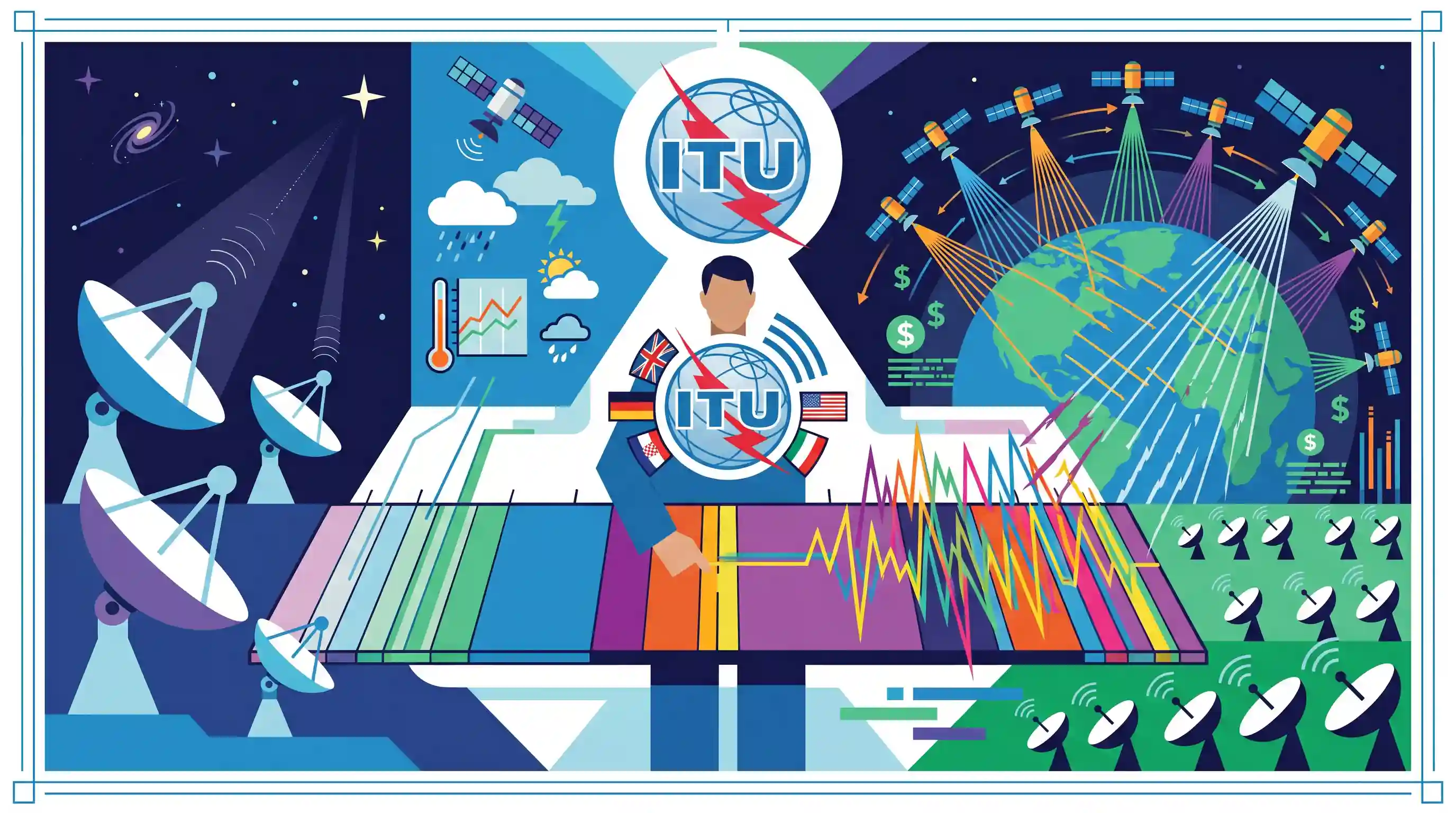
The article highlights the escalating conflict over the allocation of radio frequency spectrum in space. As commercial entities launch mega-constellations of low earth orbit (LEO) satellites to provide global broadband internet, their transmission frequencies threaten to interfere with critical scientific endeavors. Radio astronomers, who rely on detecting faint cosmic signals, and meteorologists, who use specific microwave bands for weather and climate monitoring, are increasingly concerned about this electromagnetic pollution. The International Telecommunication Union (ITU) is at the center of this dispute, tasked with updating global spectrum regulations to balance the lucrative commercial space internet market with the protection of essential scientific observations.
Key Points
- The rapid deployment of satellite broadband mega-constellations (like Starlink and Kuiper) is creating unprecedented demand for radio frequency spectrum in space.
- Radio astronomy faces severe threats from these constellations, as faint cosmic radio signals can be easily drowned out by commercial satellite transmissions.
- Meteorological satellites and climate monitoring also face risks of interference, which could compromise weather forecasting and disaster preparedness.
- The International Telecommunication Union (ITU), the UN agency managing global spectrum allocation, is struggling to balance the interests of powerful commercial telecom companies with the needs of the scientific community.
- There is a pressing need to update space governance and spectrum regulations to prevent commercial activities from blinding scientific observations.
Important Terms
International Telecommunication Union (ITU)

A UN specialized agency that coordinates global radio spectrum and satellite orbits to ensure seamless international connectivity.
UPSC context
GS2 (International Institutions) & GS3 (Telecom); tests understanding of global governance and spectrum regulation.
Satellite Spectrum
Radio frequencies used specifically for communication between satellites and ground stations, a finite global resource managed by the ITU.
UPSC context
GS3 (S&T/Economy); central to India's Satcom policy and the Telecommunications Act 2023.
Megaconstellations
Extensive networks of small satellites (often in LEO) working together to provide continuous global broadband internet coverage.
UPSC context
GS3 (Space Technology); relevant for space debris, orbital crowding, and the digital divide.
Low Earth Orbit (LEO)
An orbit within 2,000 km of Earth's surface, used for high-speed internet satellites due to its proximity and lower signal delay (latency).
UPSC context
GS3 (S&T); basic concept for orbital classification and satellite application questions.
Radio Astronomy
Scientific study of the universe via radio waves, which is increasingly disrupted by electromagnetic interference from commercial satellite transmissions.
UPSC context
GS3 (S&T); highlights the conflict between commercial technological expansion and fundamental scientific observation.
Administrative Allocation
Assigning spectrum licenses directly by the government without an auction, typically for public interest or non-competitive satellite services.
UPSC context
GS3 (Indian Economy/Policy); critical for understanding recent shifts in India's telecom and space sector reforms.
Prelims Trap
The ITU manages only terrestrial radio frequencies, while space orbits and spectrum are managed by UNOOSA.
ITU is the specialized UN agency responsible for allocating BOTH global radio-frequency spectrum and satellite orbits, not just terrestrial networks like 5G.
Static Concepts Connected
How do LEO and GEO satellite networks differ for telecommunications?
- Altitude differences: LEO operates at 160–2,000 km, while GEO sits at ~36,000 km above the Earth's equator.
- Latency: LEO provides much lower latency (delay) ideal for modern internet, whereas GEO has higher latency due to the massive distance.
- Coverage requirements: A single GEO satellite covers 1/3 of the Earth, whereas LEO requires 'mega-constellations' of thousands of satellites for continuous global coverage.
What is the mandate of the International Telecommunication Union (ITU)?
- UN Specialized Agency: It is the oldest UN specialized agency, headquartered in Geneva, dealing with information and communication technologies.
- Spectrum and Orbits: It manages the global allocation of radio-frequency spectrum and satellite orbits to avoid signal interference.
- Global Standardization: It establishes technical standards that ensure networks and technologies seamlessly interconnect globally.
Cross-Topic Patterns
Mega-constellations & Kessler Syndrome
The proliferation of LEO satellites for global broadband not only crowds the radio spectrum but dramatically increases collision risks, heavily linking spectrum management to the Kessler Syndrome and space debris mitigation.
Spectrum conflict with Earth Observation
Commercial satellite frequencies closely border microwave bands used by remote sensing satellites. Interference risks degrading vital Earth observation data required for monsoon and cyclone forecasting.

Expect a 2026 prelims question mixing ITU's mandate over satellite orbits with the latency and RFI challenges of LEO vs GEO satellites.
Linked PYQs · 4
Linked PYQs · 4
- 2016MainsGS3
Discuss India's achievements in the field of Space Science and Technology. How the application of this technology has helped India in its socio-economic development?
- 2011PrelimsGS1
Satellites used for telecommunication relay are kept in a geostationary orbit. A satellite is said to be in such an orbit when: 1. The orbit is geosynchronous. 2. The orbit is circular. 3. The orbit lies in the plane of the Earth's equator. 4. The orbit is at an altitude of 22,236 km.
- 2020PrelimsGS1
"The experiment will employ a trio of spacecraft flying in formation in the shape of an equilateral triangle that has sides one million kilometres long, with lasers shining between the craft." The experiment in question refers to
- 2015MainsGS3
What do you understand by 'Standard Positioning Systems' and 'Precision Positioning Systems' in the GPS era? Discuss the advantages India perceives from its ambitious IRNSS programme employing just seven satellites.
