Satellite Broadband Expansion and Spectrum Allocation Conflicts
Source:The Hindu ↗
Why It Matters
Radio spectrum is a finite natural resource. As India opens its space sector to private enterprise and formulates policies on satellite spectrum allocation (e.g., administrative allocation under the Telecommunications Act), understanding the trade-offs between commercial telecom expansion and critical scientific/environmental monitoring is essential for technology and infrastructure policy questions.
Summary
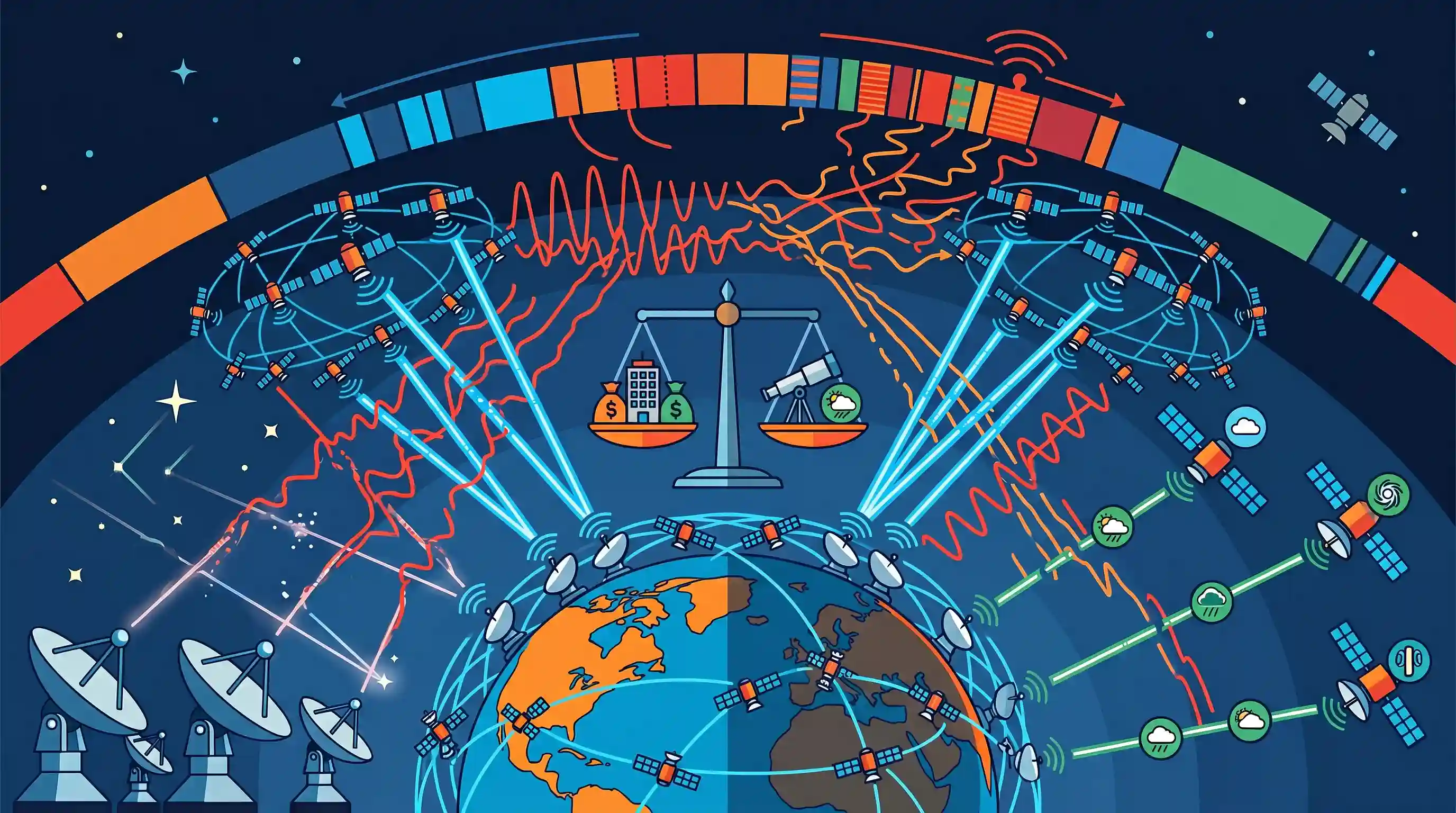
The proliferation of Low Earth Orbit (LEO) satellite constellations for global broadband internet is creating a fierce battle for radio frequency spectrum in space. This commercial expansion threatens to cause severe electromagnetic interference with critical scientific operations, particularly radio astronomy and Earth observation satellites used for weather forecasting and climate monitoring. Regulatory bodies like the International Telecommunication Union (ITU) are struggling to balance the economic potential of commercial space telecommunications with the imperative to protect fundamental scientific research from radio frequency congestion and signal leakage.
Key Points
- The rapid deployment of Low Earth Orbit (LEO) satellite constellations for global broadband is creating intense competition for radio frequency spectrum in space.
- Commercial satellite operations risk causing severe electromagnetic interference with highly sensitive scientific instruments, particularly in radio astronomy.
- Earth observation satellites, which rely on specific frequencies for weather forecasting, climate tracking, and disaster management, are also threatened by signal 'leakage' from adjacent telecom bands.
- The International Telecommunication Union (ITU) faces a critical challenge in updating global Radio Regulations to balance commercial telecommunication needs with the protection of scientific research.
- The issue highlights the broader policy challenge of managing space as a global commons and allocating limited spectrum resources equitably, mirroring domestic debates on spectrum auction vs. administrative allocation.
Important Terms
International Telecommunication Union (ITU)

A UN specialized agency that coordinates global telecommunications, manages the radio-frequency spectrum, and allocates satellite orbits to ensure international connectivity.
UPSC context
GS Paper-II/III; tests knowledge of international organizations and global governance of information technology and space.
ITU Radio Regulations
A binding international treaty established by the ITU that governs how the radio-frequency spectrum and satellite orbits are shared to prevent harmful interference.
UPSC context
GS Paper-III; tests understanding of international legal frameworks for space-based communication and spectrum management.
Low Earth Orbit (LEO)
An orbital region 160–2,000 km above Earth, commonly used for satellite internet constellations and earth observation due to lower latency and launch costs.
UPSC context
GS Paper-III; key topic for space technology, satellite internet, and space debris management.
Radio Astronomy
The study of celestial objects via their radio frequency emissions; it requires "radio quiet" environments to detect extremely weak signals from space.
UPSC context
GS Paper-III; relevant to scientific research and the impact of commercial satellite constellations on fundamental science.
Spectrum Allocation
The regulatory process of assigning specific radio frequency bands to different services to prevent signal interference and ensure efficient use of electromagnetic resources.
UPSC context
GS Paper-III; tests knowledge of telecommunication policy, India's 2023 Telecom Act, and global resource management.
Prelims Trap
"In India, satellite broadband spectrum must be allocated exclusively through competitive auctions following the Supreme Court's 2G judgment."
Satellite spectrum is globally shared, making auctions impractical. The Telecommunications Act 2023 specifically places satellite broadband under administrative allocation, distinguishing it from terrestrial mobile spectrum.
Static Concepts Connected
How do LEO constellations differ from GEO satellites for telecommunications?
- Altitude: LEOs operate below 2,000 km, while GEOs sit at 35,786 km above the equator.
- Latency: LEOs offer significantly lower signal delay, making them ideal for high-speed global broadband internet.
- Coverage: A GEO can cover one-third of Earth, whereas LEOs require 'mega-constellations' of thousands of satellites for continuous global coverage.
What is the role and structure of the International Telecommunication Union (ITU)?
- UN Agency: It is a specialized agency of the United Nations, and significantly, the oldest UN agency, established in 1865.
- Core Function: It allocates global radio spectrum and satellite orbits to prevent signal interference between nations.
- Radio Regulations: Its Radio Regulations treaty holds binding international authority over how spectrum is shared globally.
Cross-Topic Patterns
Telecom Act 2023 vs 2G Verdict
The administrative allocation of satellite spectrum in the 2023 Act modifies the post-2G Supreme Court paradigm that mandated auctions, justified here by the non-exclusive, globally shared nature of satellite frequencies.
Earth Observation & Disaster Management
Signal leakage from commercial telecom bands directly threatens microwave sounding instruments on meteorological satellites. This jeopardizes crucial data used by the IMD for cyclone tracking and climate modeling.

Expect a multi-statement question in 2026 combining LEO/GEO communication bands (Ku/Ka) with the Telecom Act 2023's spectrum allocation.
Linked PYQs · 4
Linked PYQs · 4
- 2022PrelimsGS1
If a major solar storm (solar flare) reaches the Earth, which of the following are the possible effects on the Earth? 1. GPS and navigation systems could fail. 2. Tsunamis could occur at equatorial regions. 3. Power grids could be damaged. 4. Intense auroras could occur over much of the Earth. 5. Forest fires could take place over much of the planet. 6. Orbits of the satellites could be disturbed. 7. Shortwave radio communication of the aircraft flying over polar regions could be interrupted. Select the correct answer using the code given below:
- 2020PrelimsGS1
With reference to Visible Light Communication (VLC) technology, which of the following statements are correct? 1. VLC uses electromagnetic spectrum wavelengths 375 to 780 nm. 2. VLC is known as long-range optical wireless communication. 3. VLC can transmit large amounts of data faster than Bluetooth. 4. VLC has no electromagnetic interference. Select the correct answer using the code given below:
- 2023PrelimsGS1
Consider the following pairs: Objects in space Description 1. Cepheids: Giant clouds of dust and gas in space 2. Nebulae: Stars which brighten and dim periodically 3. Pulsars: Neutron stars that are formed when massive stars run out of fuel and collapse How many of the above pairs are correctly matched?
- 2016MainsGS3
Discuss India's achievements in the field of Space Science and Technology. How the application of this technology has helped India in its socio-economic development?
