Precision Strikes and Drone Warfare in Recent Border Conflict
Source:The Hindu ↗
Why It Matters
Operation Sindoor illustrates a highly proactive shift in India's military strategy against cross-border terrorism, emphasizing rapid precision strikes. The unprecedented retaliatory drone swarm by Pakistan also presents a critical case study for UPSC aspirants regarding modern border security challenges and drone countermeasures.
Summary
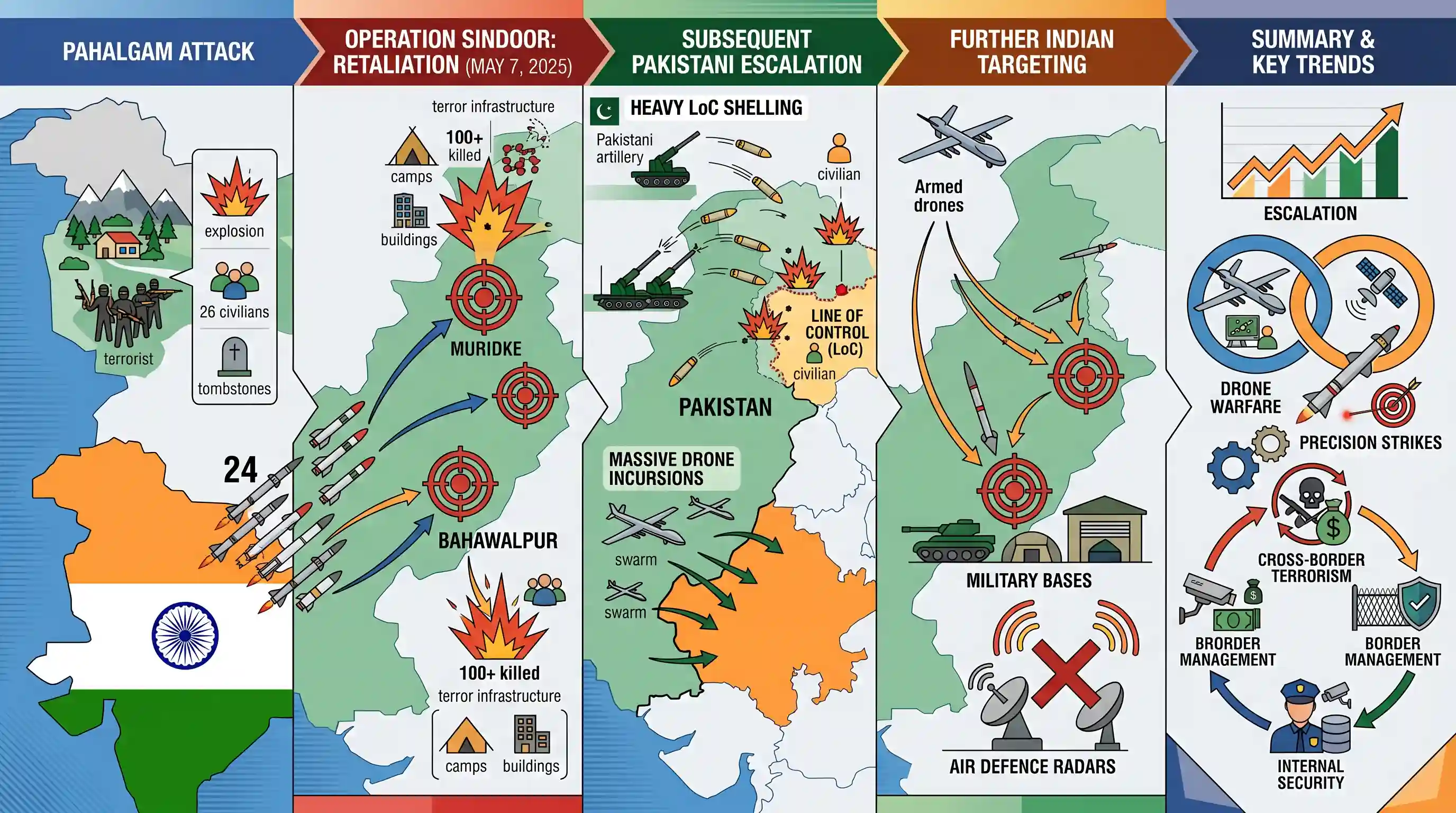
The Indian Armed Forces conducted Operation Sindoor on May 7, 2025, launching 24 precision strikes against terror infrastructure in Pakistan and PoK in retaliation for the Pahalgam attack. The strikes devastated camps in Muridke and Bahawalpur, killing over 100 terrorists. In response to subsequent Pakistani escalations, including heavy LoC shelling and massive drone incursions across several border states, India further targeted major Pakistani military bases and air defence radars. The event marks a significant escalation and underscores the growing role of drone warfare and precision strikes in border conflicts.
Key Points
- On May 7, 2025, the Indian Armed Forces executed Operation Sindoor, conducting 24 precision strikes on 9 terror and military targets in Pakistan and PoK within 25 minutes.
- The operation was a response to the Pahalgam attack, exercising India's right to self-defence, and resulted in the elimination of over 100 terrorists at camps in Muridke and Bahawalpur.
- Pakistan retaliated with unprovoked LoC firing, killing 16 civilians, and launched massive drone incursions (300-400 drones) across border states which were largely intercepted.
- India further responded by targeting Pakistani military infrastructure, destroying air defence radars and striking airfields at Jacobabad, Nur Khan, Sukkur, Sargodha, and others.
Important Terms
Operation Sindoor

A May 2025 Indian military campaign involving precision strikes against terrorist hubs in Pakistan and PoK, retaliating for the Pahalgam civilian massacre.
UPSC context
GS Paper III; Internal Security. Tests India's evolving response doctrine to proxy warfare below the nuclear threshold.
Pahalgam attack (2025)
An April 22, 2025, terrorist strike in Kashmir’s Baisaran Valley killing 26 tourists, which served as the trigger for major Indian military retaliation.
UPSC context
GS Paper III; Security Challenges. Tests analysis of terror-tactics targeting civilians to disrupt regional normalcy and tourism.
Cross-border Terrorism
State-sponsored or supported militancy originating from one country to cause instability in another; a core challenge in India-Pakistan relations.
UPSC context
GS Paper III; Internal Security. A fundamental topic regarding non-state actors and external state-sponsored security threats.
Drone Warfare
The strategic use of UAVs and loitering munitions for surveillance and kinetic strikes, adding a technological "third dimension" to border conflicts.
UPSC context
GS Paper III; Science & Tech/Security. Focuses on emerging threats and India's integrated anti-drone defensive grids.
Precision Strikes
Highly accurate military attacks (using missiles or smart bombs) designed to destroy specific high-value targets while minimizing collateral damage.
UPSC context
GS Paper III; Defense Tech. Relevant for discussing "non-contact" warfare and calibrated punitive actions in modern doctrine.
Border Management
The integrated strategy of securing national boundaries using physical barriers, surveillance technology (CIBMS), and military deployment to prevent infiltration.
UPSC context
GS Paper III; Internal Security. Tests knowledge of securing sensitive zones like the LoC and International Border (IB).
Prelims Trap
Article 51 of the UN Charter explicitly grants the right of pre-emptive military strikes against non-state actors.
Article 51 permits self-defence against an 'armed attack'. Extending this to pre-emptive strikes against non-state actors in foreign territory relies on contested customary law (the 'unwilling or unable' doctrine), not explicit Charter text.
Static Concepts Connected
What is Article 51 of the United Nations Charter?
- Inherent Right: Recognizes the inherent right of individual or collective self-defence if an armed attack occurs against a UN Member State.
- UNSC Oversight: Measures taken in self-defence must be immediately reported to the UN Security Council.
- Modern Application: Increasingly invoked post-9/11 by states to justify strikes against terror groups when the host nation is 'unwilling or unable' to act.
How do Counter-Unmanned Aircraft Systems (C-UAS) neutralize drone threats?
- RF Jamming: Disrupts the radio frequency (RF) link between the drone and its operator, forcing it to land, crash, or return to base.
- Kinetic Defeat: Involves the physical destruction or capture of the drone using nets, specialized guns, or interceptor missiles.
- Directed Energy: Deploys high-energy lasers or high-power microwaves (HPM) to instantly destroy or fry the drone's electronic circuits.
Cross-Topic Patterns
Swarm Drones & Smart Border Management
The use of 300-400 drones shifts focus from traditional infiltration to aerial asymmetry, mapping directly to Internal Security themes of border technology and transnational arms/narcotics smuggling.
Active Defence Doctrine & Nuclear Overhang
Operation Sindoor signals a continued shift away from 'strategic restraint', demonstrating how India executes sub-conventional precision strikes and SEAD operations under a nuclear overhang.

Swarm drone threats (C-UAS tech) and Article 51 (self-defense vs non-state actors) likely to combine in a 2026 Internal Security question.
Linked PYQs · 3
Linked PYQs · 3
- 2020MainsGS3
Analyze internal security threats and transborder crimes along Myanmar, Bangladesh and Pakistan borders including Line of Control (LoC). Also discuss the role played by various security forces in this regard.
- 2023MainsGS3
The use of unmanned aerial vehicles (UAVs) by our adversaries across the borders to ferry arms/ammunitions, drugs, etc., is a serious threat to the internal security. Comment on the measures being taken to tackle this threat.
- 2015MainsGS2
Terrorist activities and mutual distrust have clouded India-Pakistan relations. To what extent the use of soft power like sports and cultural exchanges could help generate goodwill between the two countries? Discuss with suitable examples.
