India Major Deltas Sinking Due to Human Activity and Groundwater Loss
Source:The Hindu ↗
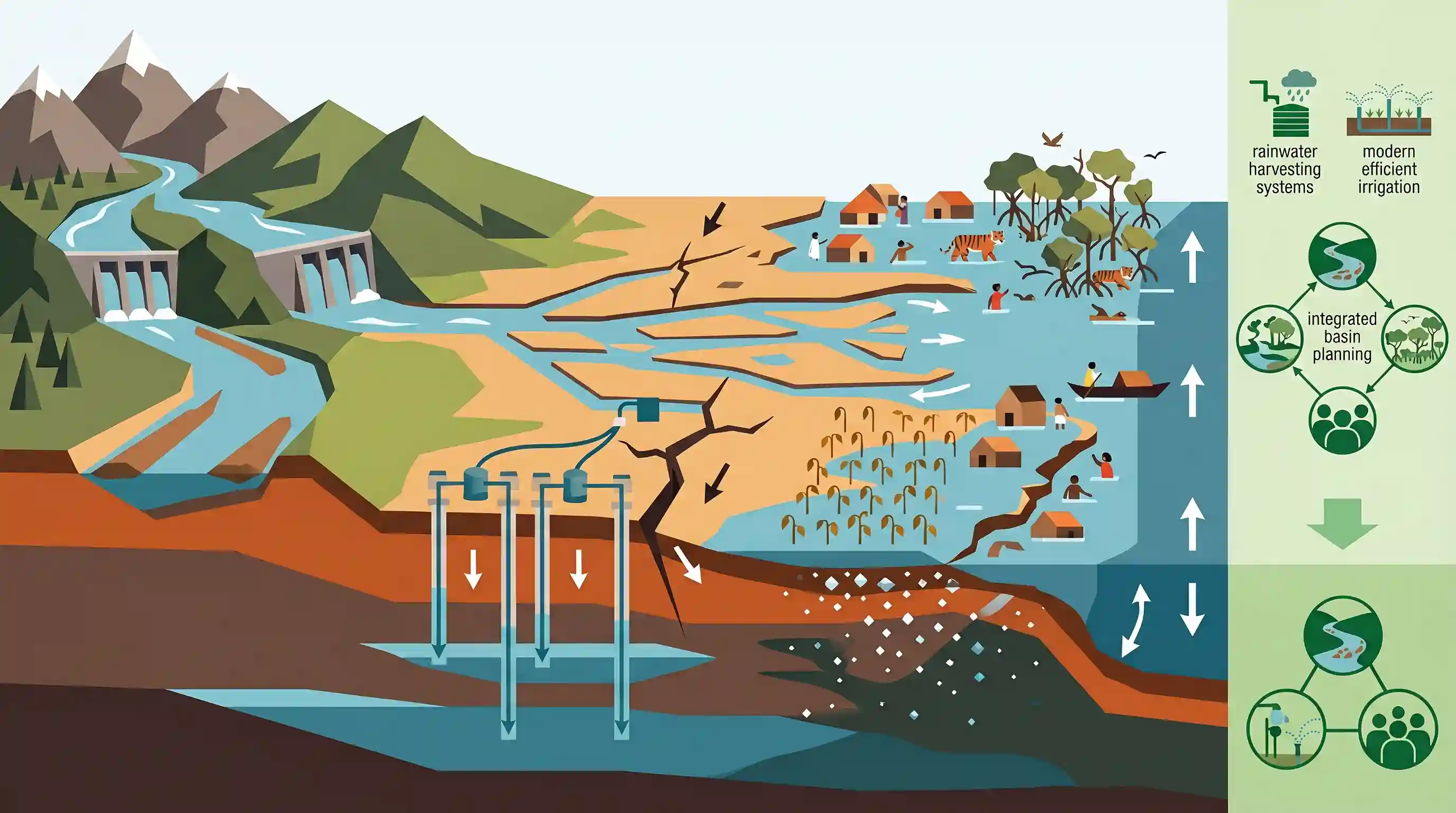
Why It Matters
The sinking of Indian deltas lies at the intersection of Physical Geography (GS1) and Environment (GS3). It illustrates how human-induced resource exploitation (groundwater, dams) physically alters critical geographical features, creating compounding disaster risks when mixed with climate change.
Summary
Satellite observations indicate that India's major river deltas—including those of the Ganga-Brahmaputra, Godavari, and Krishna—are sinking at alarming rates. This coastal subsidence is primarily driven by human activities, notably excessive groundwater extraction and upstream dam construction that starves deltas of replenishing sediment. When coupled with global sea-level rise caused by climate change, the sinking landmasses lead to a compounded 'relative sea-level rise.' This growing vulnerability poses severe threats to coastal ecology, agricultural viability due to saltwater intrusion, and the millions of people inhabiting these flood-prone deltaic regions. Addressing the crisis requires sustainable water management and integrated basin planning.
Key Points
- Satellite data reveals that major Indian river deltas are experiencing rapid subsidence (sinking) at rates that often outpace global sea-level rise.
- The primary anthropogenic cause of this subsidence is excessive groundwater extraction, which leads to soil compaction and the sinking of landmasses.
- Upstream dam construction exacerbates the issue by trapping sediment, thereby preventing the natural replenishment of deltaic lands that historically countered subsidence.
- The combination of local land subsidence and climate-induced global sea-level rise results in a higher 'relative sea-level rise,' dramatically increasing the risk of coastal flooding and storm surges.
- This phenomenon threatens coastal ecosystems, including mangroves, and endangers human settlements and agricultural lands via saltwater intrusion and erosion.
Prelims Trap
The sinking of India's major river deltas is primarily caused by climate change-induced global sea-level rise.
While climate change causes absolute sea-level rise, the actual "subsidence" (sinking of the land itself) is primarily driven by anthropogenic groundwater extraction and sediment starvation.
Static Concepts Connected
What factors maintain the dynamic geomorphological equilibrium of a river delta?
- Sediment Deposition: Continuous supply of alluvial sediment from upstream rivers is required to offset natural compaction and tectonic subsidence.
- Tidal/Wave Action: Oceanic forces (tides, currents, and waves) rework and redistribute sediments along the coast, shaping the delta front.
- Freshwater Discharge: Rivers must maintain adequate freshwater flow to push back the tidal wedge, preventing estuarine erosion and maintaining land elevation.
How does human activity trigger saltwater intrusion in coastal aquifers?
- Hydraulic Gradient Reversal: Over-extraction of groundwater lowers the freshwater table, reversing the hydraulic gradient and allowing denser seawater to flow inland.
- Relative Sea-Level Rise: Coastal land subsidence combined with global sea-level rise pushes the saltwater interface further inland, permanently contaminating agricultural soils.
- Reduced Freshwater Flow: Upstream dams reduce the total freshwater discharge that normally flushes estuaries and pushes back the tidal saltwater wedge.
Cross-Topic Patterns
Joshimath to Deltas: Subsidence Geographies
While Himalayan subsidence (e.g., Joshimath) involves tectonic fragility and heavy construction, deltaic sinking stems from groundwater pumping and sediment starvation. Both highlight the severe impacts of unplanned extraction on vulnerable geomorphologies.
Transboundary rivers and sediment starvation
Run-of-the-river projects and dams don't just alter water flow; they trap silt. This links upstream dam geopolitics (like China on the Brahmaputra) directly to downstream coastal erosion and delta sinking.

Expect a 2026 prelims question distinguishing 'absolute' vs 'relative' sea level rise, linking groundwater extraction to delta subsidence.
Linked PYQs · 3
Linked PYQs · 3
- 2025MainsGS3
Examine the factors responsible for depleting groundwater in India. What are the steps taken by the government to mitigate such depletion of groundwater?
- 2025MainsGS1
How are climate change and the sea level rise affecting the very existence of many island nations? Discuss with examples.
- 2019MainsGS1
Discuss the causes of depletion of mangroves and explain their importance in maintaining coastal ecology.
