Bhutan glacial lake shrinkage after GLOF
Source:The Hindu ↗
Why It Matters
Glacial Lake Outburst Floods (GLOFs) represent a critical and growing transboundary hazard across the Himalayas. Understanding satellite-based risk assessments aids aspirants in analyzing proactive disaster mitigation, climate change impacts on high-altitude ecosystems, and regional resilience frameworks.
Summary
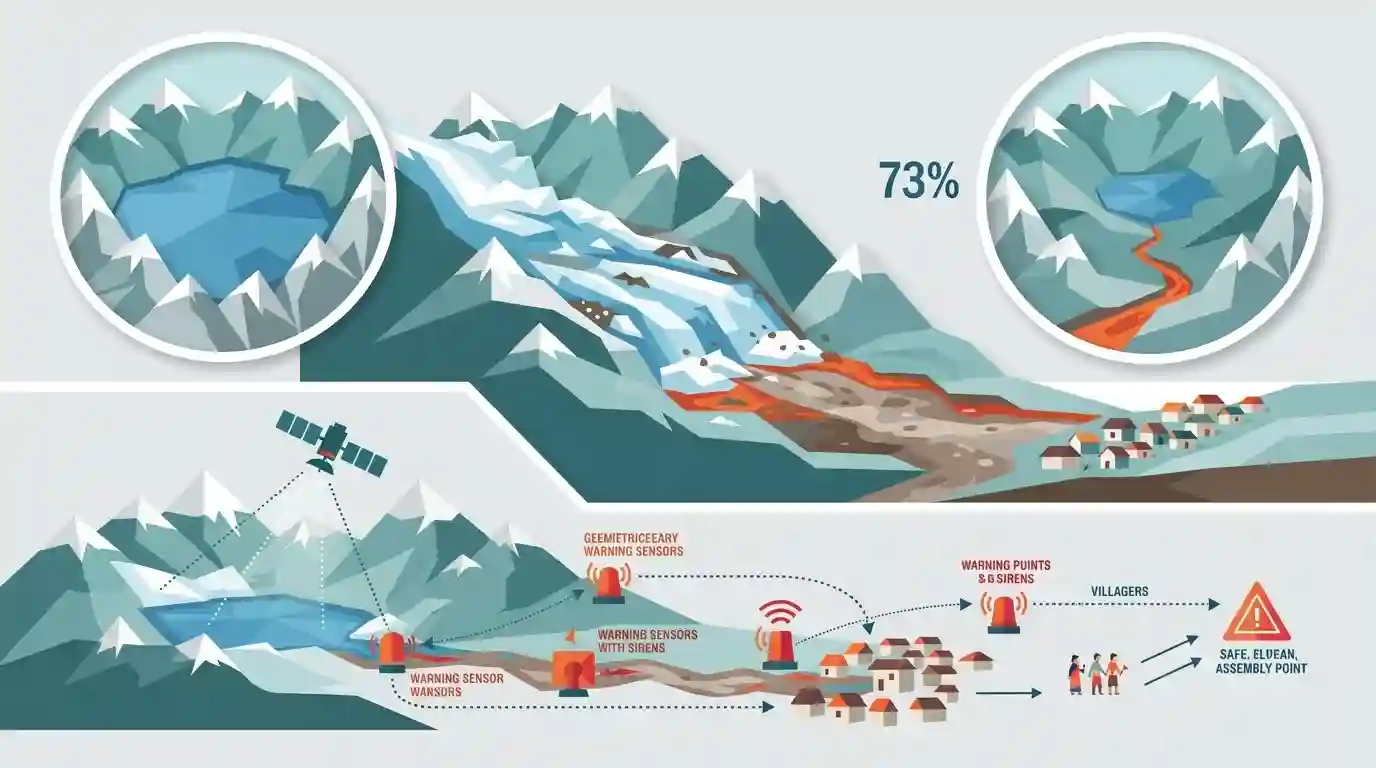
Recent satellite assessments of a glacial lake in Bhutan demonstrated a 73% reduction in its size following a Glacial Lake Outburst Flood (GLOF). This event underscores the mounting climate change risks in the Himalayan ecosystem, highlighting the necessity of proactive disaster management, space-based monitoring, and robust early warning frameworks to safeguard vulnerable downstream populations.
Key Points
- A satellite assessment revealed a 73% reduction in the volume/size of a glacial lake in Bhutan following a Glacial Lake Outburst Flood (GLOF).
- GLOF events pose severe downstream risks to Himalayan communities and infrastructure due to rapid drainage of glacial lakes.
- Highlights the critical need for continuous satellite monitoring and early warning systems for glacial hazards in the Hindu Kush Himalaya region.
Important Terms
Glacial Lake Outburst Flood (GLOF)

A sudden release of a massive volume of water from a glacial lake, caused by the failure of a natural moraine or ice dam, often triggered by climate change, melting, or avalanches.
UPSC context
UPSC Paper III (Disaster Management). Tests knowledge of natural disasters, vulnerability of Himalayan ecosystems, and mitigation frameworks.
Glacial Lake
A lake located on, within, or at the terminus of a glacier, formed by the accumulation of meltwater behind moraines or ice walls.
UPSC context
UPSC Paper III (Environment & Ecology). Tests understanding of cryospheric changes, global warming impacts, and high-altitude geographical features.
Space-based Monitoring
The use of satellite imagery, remote sensing, and geospatial intelligence to track environmental changes, water levels, and disaster risks in inaccessible high-altitude regions.
UPSC context
UPSC Paper III (Science & Technology / Disaster Management). Tests application of remote sensing technologies in hazard mapping and disaster mitigation.
Prelims Trap
A 73% reduction in lake size following a GLOF implies the total elimination of the glacial lake.
A GLOF does not mean the lake permanently disappears; rather, it experiences catastrophic drainage of a major portion of its water volume, leaving a significantly reduced residual lake body behind moraine walls.
Static Concepts Connected
What is a Glacial Lake Outburst Flood (GLOF) and how do moraine dams fail?
- Moraine Dam:: Rapid accumulation of meltwater behind unstable moraine dams (composed of loose rock and debris).
- Trigger Mechanism:: Triggered by avalanches, earthquakes, excessive melting, or internal water pressure breaching the barrier.
- Impact:: Sudden, catastrophic release of massive volumes of water causing severe downstream flash floods and debris flows.
Cross-Topic Patterns
Himalayan GLOF + Transboundary River Diplomacy
Glacial lake outbursts in the Himalayas affect downstream hydro projects and border populations, requiring coordinated transboundary early-warning systems between India and Bhutan.
Space-Based Remote Sensing + Disaster Management
Satellite data and remote sensing are vital not only for disaster response but also for strategic mapping of border regions and climate resilience.

GLOF mechanics + transboundary Himalayan vulnerability likely to appear as a statement-based prelims question.
Linked PYQs · 2
Linked PYQs · 2
- 2025PrelimsGS1
Consider the following statements : Statement I: Scientific studies suggest that a shift is taking place in the Earth's rotation and axis. Statement II: Solar flares and associated coronal mass ejections bombarded the Earth's outermost atmosphere with tremendous amount of energy. Statement III : As the Earth's polar ice melts, the water tends to move towards the equator. Which one of the following is correct in respect of the above statements?
- 2020MainsGS3
Discuss the recent measures initiated in disaster management by the Government of India departing from the earlier reactive approach.
