Integration of princely states in post independence India
Source:Indian Express ↗
Why It Matters
The 150th birth anniversary of Sardar Patel brings renewed focus to his foundational role in the integration of princely states, directly aligning with the GS1 Post-Independence Consolidation syllabus. Understanding his administrative and political acumen is essential for questions on the unification of India.
Summary
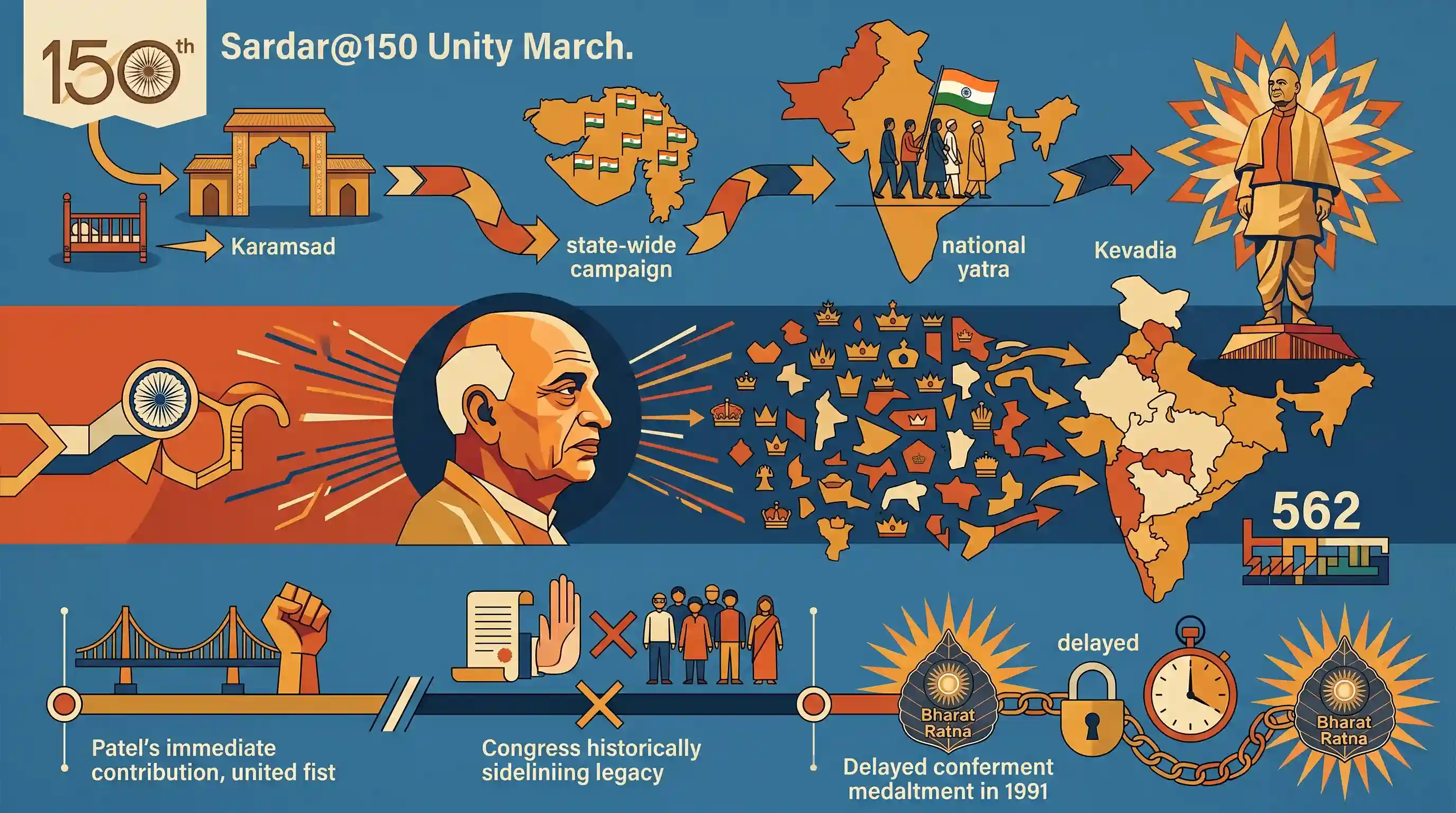
To mark the 150th birth anniversary of Sardar Vallabhbhai Patel, the BJP in Gujarat has announced the 'Sardar@150 Unity March', encompassing both a state-wide campaign and a national yatra from Karamsad to Kevadia. The initiative underscores Patel's monumental contribution to post-independence consolidation by integrating 562 princely states into a united India. The event also served as a political platform to criticize the Congress for historically sidelining his legacy, particularly pointing to the delayed conferment of the Bharat Ratna in 1991.
Key Points
- The Gujarat BJP has organized a 'Sardar@150 Unity March' to commemorate the 150th birth anniversary of Sardar Vallabhbhai Patel.
- A national yatra will run from Karamsad (Patel's home) to Kevadia (Statue of Unity) from October 24-31, crossing 15 states, alongside a state-wide march in Gujarat.
- Sardar Patel is celebrated for integrating 562 princely states into the Indian Union, fulfilling the vision of an 'Akhand Bharat' (United India).
- The political narrative highlighted the historical delay in awarding Patel the Bharat Ratna, which was conferred posthumously in 1991 during Chandrashekhar's tenure, leading to political critiques of the Congress party's handling of his legacy.
Important Terms
Sardar@150 Unity March

A 152-km national padyatra (November–December 2025) from Karamsad to Kevadia commemorating Sardar Patel's 150th birth anniversary, promoting national unity and 'Ek Bharat Shreshtha Bharat' ideals.
UPSC context
Relevant for GS Paper I (Modern History) and Paper II (Governance) regarding national integration initiatives and commemorative celebrations.
Bharat Ratna
The highest civilian award of India; conferred posthumously on Sardar Patel in 1991 for his monumental contributions to independence and the political unification of India.
UPSC context
Relevant for Preliminary exam (Awards) and GS Paper I (Personalities) regarding the delayed recognition of Patel's legacy.
Integration of Princely States
The historical process post-1947 where 562 princely states were integrated into the Indian Union through Sardar Patel's diplomacy, use of 'Privy Purses', and the Instrument of Accession.
UPSC context
Core GS Paper I topic (Post-independence Consolidation). Tests understanding of India's territorial formation and Patel's 'Iron Man' legacy.
Post-independence Consolidation
A major UPSC syllabus theme focusing on the administrative, political, and social unification of India after 1947, including state reorganization and tribal integration.
UPSC context
Major GS Paper I topic. Tests knowledge of the challenges faced by the newly independent Indian state.
Statue of Unity
The world's tallest statue (182 meters) located in Kevadia, Gujarat, dedicated to Sardar Vallabhbhai Patel; it serves as a global symbol of India’s political integrity.
UPSC context
Relevant for Prelims (Geography/Art & Culture) and GS Paper I (Modern Personalities) as a symbol of Patel’s unification efforts.
Karamsad
The ancestral home and birthplace of Sardar Vallabhbhai Patel in Anand district, Gujarat; historically significant as the starting point for various unity and commemorative marches.
UPSC context
Relevant for Prelims (Places in news/History) as the geographical origin of Patel’s early life and legacy movements.
Prelims Trap
The Instrument of Accession required princely states to surrender Defence, Foreign Affairs, and Finance to the Indian Union.
The Instrument of Accession was strictly limited to Defence, External Affairs, and Communications. Finance, taxation, and internal administration initially remained with the princely states.
Static Concepts Connected
What were the primary legal and political tools used for integrating princely states?
- Instrument of Accession: A legal document where princely rulers surrendered only Defence, External Affairs, and Communications to the Government of India.
- Standstill Agreement: A temporary mechanism that maintained the status quo of pre-independence administrative arrangements until final integration could be negotiated.
- Privy Purses: A constitutional guarantee of fixed, tax-free monetary allowances given to rulers as an incentive to surrender their sovereign status peacefully.
- Military Action: Used as a last resort when diplomacy failed, such as Operation Polo to annex Hyderabad and Operation Vijay for Goa.
What were Sardar Patel's major milestones in the pre-independence national movement?
- Kheda Satyagraha: Supported Mahatma Gandhi in organizing the 1918 no-tax campaign for peasants suffering from crop failure and plague.
- Bardoli Satyagraha: Led the successful 1928 movement against unjust British tax hikes. Local women bestowed upon him the title "Sardar" (Leader).
- 1931 Karachi Session: Presided over this landmark session which formally adopted pioneering resolutions on Fundamental Rights and the National Economic Programme.
Cross-Topic Patterns
Integration to Linguistic Reorganization
Patel’s integration of princely states established 'Part B' states, linking directly to the later 1956 State Reorganisation Act and the 7th Amendment's abolition of A/B/C/D state classifications.
Karachi 1931 to Constituent Assembly
Patel's leadership on Fundamental Rights at the 1931 Karachi Session logically foreshadowed his vital role as Chairman of the Advisory Committee on Fundamental Rights in the Constituent Assembly.

150th anniversary makes Patel a high-yield 2026 target. Expect multi-statement Prelims questions linking his Satyagrahas to integration.
Linked PYQs · 2
Linked PYQs · 2
- 2021MainsGS1
Assess the main administrative issues and socio-cultural problems in the integration process of Indian Princely States.
- 2025MainsGS1
Trace India's consolidation process during early phase of independence in terms of polity, economy, education and international relations.
