Inclusive Education in India: Supporting Diverse Learners
Source:Indian Express ↗
Why It Matters
This article is highly relevant for GS Paper 2 as it connects individual achievement to systemic policy gaps in India's education sector. It provides an excellent case study for answers dealing with inclusive education, the practical implementation of the RPWD Act 2016, and the inclusive vision of NEP 2020.
Summary
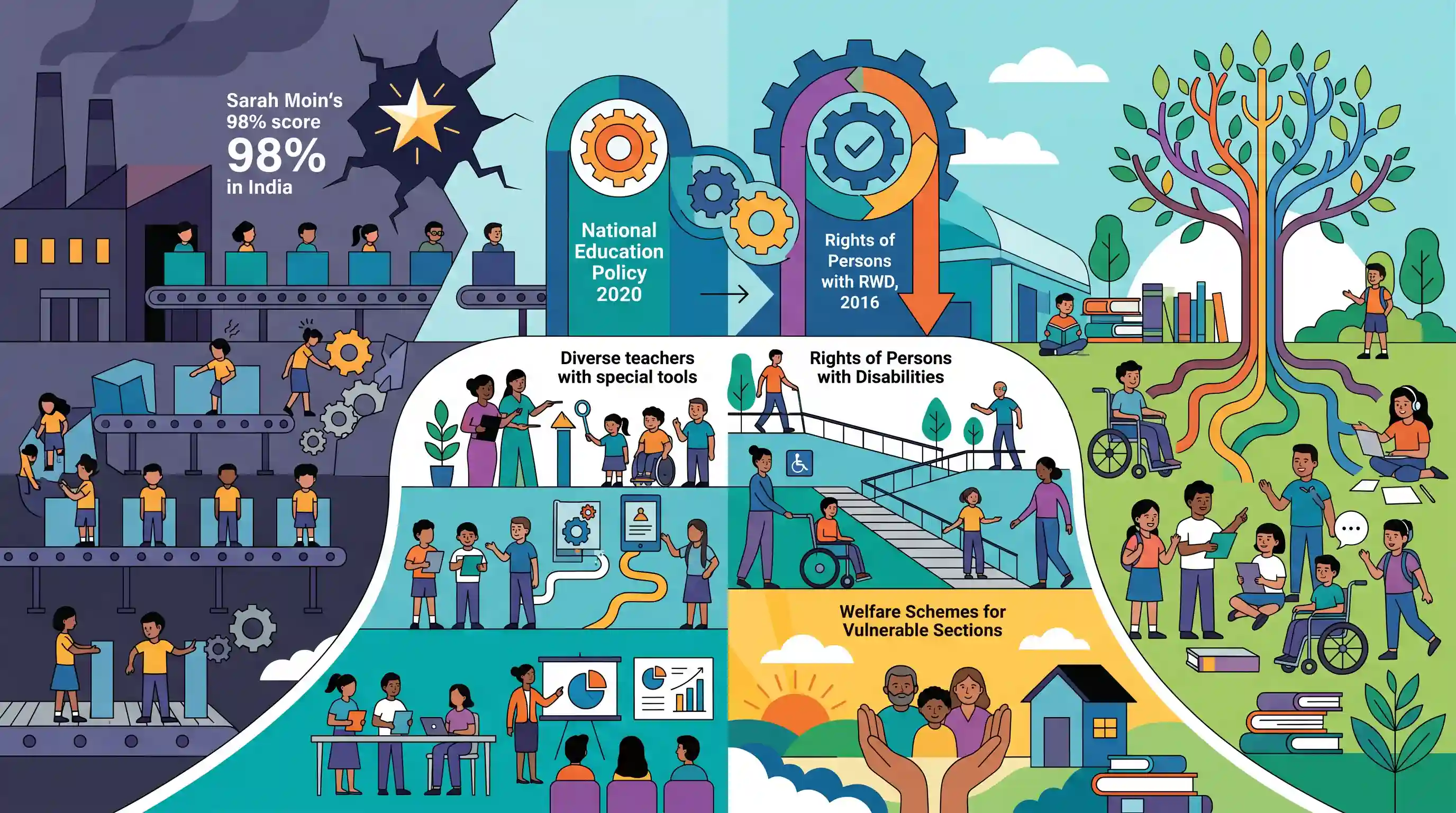
The article underscores the necessity for a more inclusive education system in India, prompted by the exceptional achievement of Sarah Moin, who scored 98%. Her success acts as a wake-up call, exposing the limitations of a standardized, one-size-fits-all pedagogical approach that fails to accommodate neurodivergent individuals and students with specific learning challenges. The author advocates for actionable educational reforms—such as better integration of the National Education Policy (NEP) 2020 and the Rights of Persons with Disabilities (RPWD) Act, 2016—to ensure that schools offer tailored support, flexible evaluation frameworks, and adequately trained special educators. Ultimately, the piece calls for shifting the focus from fitting diverse learners into rigid systems to redesigning the system to empower every type of learner.
Key Points
- Sarah Moin’s remarkable 98% score serves as a critical reminder of the vast, often untapped potential of non-traditional learners in India.
- India’s education system currently suffers from a one-size-fits-all approach that disadvantages neurodivergent students and those with specific learning disabilities.
- The article highlights the urgent need to bridge the gap between policy intent (like NEP 2020 and the RPWD Act 2016) and ground-level implementation for inclusive education.
- Meaningful reform requires structural changes including the deployment of trained special educators, flexible assessment methods, and destigmatizing diverse learning needs in classrooms.
Important Terms
National Education Policy (NEP) 2020

A comprehensive framework launched to transform India's education system, emphasizing holistic, flexible, and multidisciplinary learning while aiming for 100% Gross Enrolment Ratio by 2030.
UPSC context
GS Paper II: Government policies and interventions for development in the Education sector and issues arising out of their design.
Rights of Persons with Disabilities (RPWD) Act 2016
Legislation that operationalizes the UNCRPD, increasing recognized disabilities from 7 to 21 and mandating inclusive education and 5% reservation in higher education for persons with benchmark disabilities.
UPSC context
GS Paper II: Welfare schemes for vulnerable sections and the performance of these schemes/laws.
Sustainable Development Goal 4 (SDG 4)
A global goal set by the United Nations to ensure inclusive and equitable quality education and promote lifelong learning opportunities for all by 2030.
UPSC context
GS Paper II & III: International treaties and agreements affecting India's interests and social development goals.
Inclusive Education
A system where students with and without disabilities learn together in the same classroom, with teaching and curriculum adapted to meet diverse learning needs.
UPSC context
GS Paper II: Social Justice and Education. Focuses on equity, accessibility, and the removal of educational disparities.
Neurodivergent
An umbrella term for individuals whose brain functions, learns, and processes information differently than what is considered 'typical,' including those with autism, ADHD, and dyslexia.
UPSC context
GS Paper II: Issues relating to the management of Social Sector/Services relating to Education and Human Resources.
Ministry of Education
The nodal ministry responsible for the formulation and implementation of the National Education Policy and overseeing the country's school and higher education departments.
UPSC context
GS Paper II: Statutory, regulatory and various quasi-judicial bodies and their role in educational governance.
Prelims Trap
The statutory right to free education for children with disabilities is restricted to the 6 to 14 years age group.
While the RTE Act applies to children aged 6-14, the RPWD Act 2016 specifically mandates free education for children with benchmark disabilities up to 18 years.
Static Concepts Connected
What are the key educational mandates under the RPWD Act, 2016?
- Expanded Categories: Increased recognized disabilities from 7 to 21, officially codifying Specific Learning Disabilities (SLD) and Autism Spectrum Disorder (ASD).
- Extended Free Education: Guarantees free education for children with benchmark disabilities between the ages of 6 and 18 years, extending beyond standard RTE limits.
- Reasonable Accommodation: Mandates government and recognized institutions to provide reasonable accommodations, including flexible evaluation and examination frameworks.
What is the mandate of the Rehabilitation Council of India (RCI)?
- Statutory Body: It is a statutory body constituted under the RCI Act, 1992 to regulate training policies and programs for persons with disabilities.
- Standardizing Training: Maintains the Central Rehabilitation Register and prescribes minimum standards of education and training for special educators nationwide.
Cross-Topic Patterns
Digital Accessibility & EdTech
Digital India initiatives are increasingly tested against web accessibility guidelines (GIGW) and how EdTech platforms bridge assessment gaps for neurodivergent students under NEP 2020 framework.
Demographic Dividend & Inclusive Education
Realizing India's demographic dividend is impossible without mainstreaming the estimated 79 lakh children with disabilities into the productive workforce via inclusive education (SDG 4).

Expect a Mains GS2 question linking NEP 2020's 'whole-school approach' with the implementation bottlenecks of the RPWD Act.
Linked PYQs · 2
Linked PYQs · 2
- 2017MainsGS2
Does the Rights of Persons with Disabilities Act, 2016 ensure effective mechanism for empowerment and inclusion of the intended beneficiaries in the society? Discuss.
- 2020MainsGS2
National Education Policy 2020 is in conformity with the Sustainable Development Goal-4 (2030). It intends to restructure and reorient education system in India. Critically examine the statement.
