Saputara monsoon festival begins to promote tribal heritage tourism
Source:deshgujarat ↗
Why It Matters
The Saputara Monsoon Festival is a key cultural and economic event in Gujarat. Questions in GPSC Prelims frequently target Gujarat's tribal festivals, dances (like Dangi dance), regional geography (Dang district), and state tourism initiatives. Understanding the cultural and economic significance of such festivals is crucial for the Art & Culture and Geography sections.
Summary
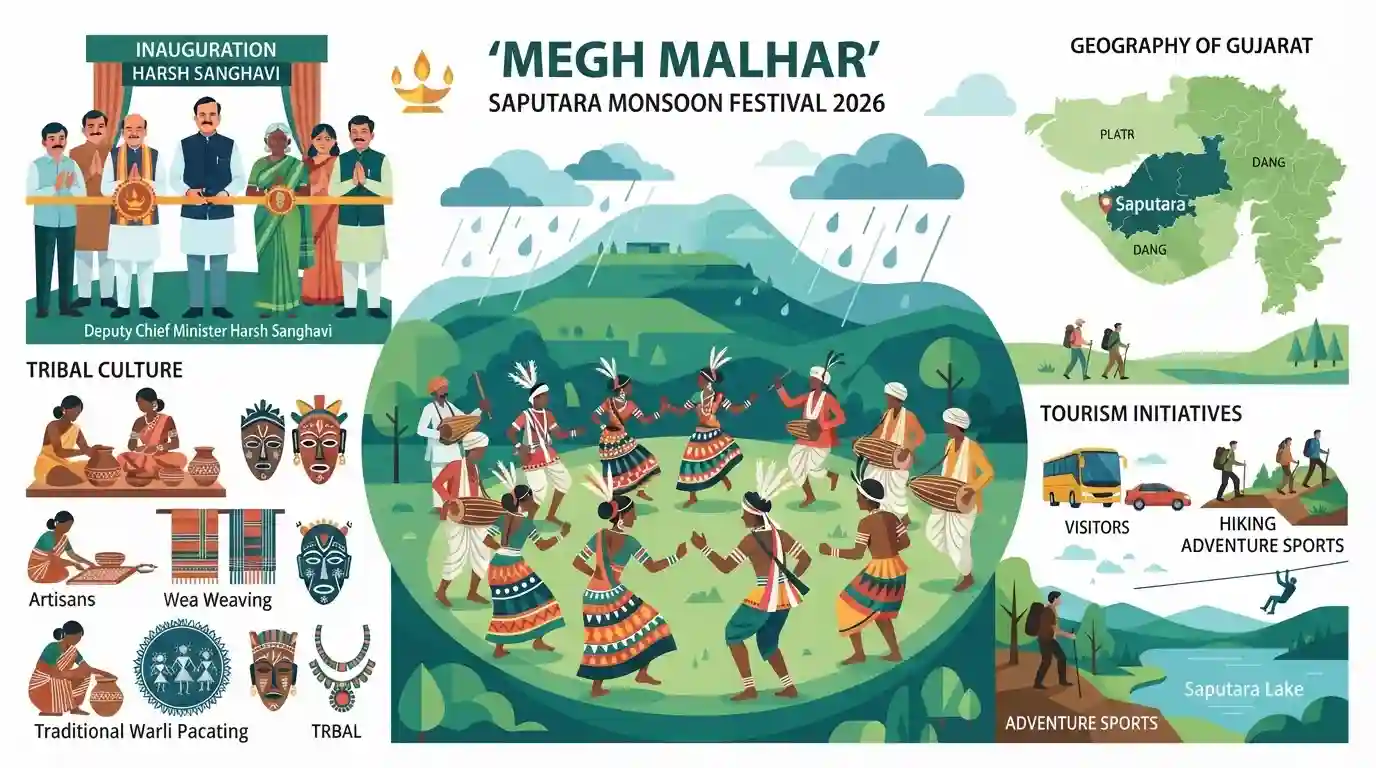
The 'Megh Malhar' Saputara Monsoon Festival 2026 was inaugurated by Gujarat Deputy Chief Minister Harsh Sanghavi in Saputara, Gujarat's premier hill station located in the Dang district. Scheduled to run from August 8 to August 29, the month-long festival is themed 'Ek Bharat, Shreshtha Bharat'. It aims to showcase the rich tribal heritage of the region, featuring traditional Dangi dance performances, tribal arts and crafts, and various cultural and sporting events. The festival plays a vital role in promoting monsoon tourism in Gujarat and generating local employment for tribal communities.
Key Points
- Gujarat Deputy Chief Minister Harsh Sanghavi inaugurated the 'Megh Malhar' Saputara Monsoon Festival 2026 in Dang district.
- The festival is being held in Saputara, Gujarat's only hill station, from August 8 to August 29, 2026.
- It runs on the theme of 'Ek Bharat, Shreshtha Bharat', aiming to foster cultural integration.
- Key attractions include traditional Dangi dance, tribal arts and crafts exhibitions, sports activities, and cultural programs.
- The event is designed to boost tourism in the region and provide local employment opportunities for the tribal population.
Important Terms
Ek Bharat Shreshtha Bharat

A central government initiative launched in 2015 to strengthen national integration. It pairs states and Union Territories for year-long cultural, linguistic, and educational exchanges to celebrate India's unity in diversity.
UPSC context
GS II (Governance) & GS I (Culture). Tests knowledge of schemes fostering national integration and cultural diplomacy.
Megh Malhar Parv
An annual monsoon festival organized by Gujarat Tourism in Saputara, the state's only hill station. It promotes eco-tourism, local employment, and showcases the Dang region's vibrant tribal heritage and arts.
UPSC context
GS I (Culture) & GS III (Economy/Tourism). Highlights the intersection of cultural preservation and regional tourism promotion.
Dangi Dance
A vibrant traditional folk dance of the Dangi tribe in Gujarat’s Dang region. Characterized by human pyramids, circular formations, and rhythmic movements, it reflects the community's deep connection to nature.
UPSC context
GS I (Art and Culture). Highly relevant for objective questions on regional folk dances, tribal culture, and indigenous traditions.
Saputara
Gujarat's only hill station, located in the Sahyadri range (Western Ghats) of the Dang district. Known for its rich biodiversity, tribal populations, and temperate climate, driving regional tourism.
UPSC context
GS I (Geography). Important for map-based questions, Western Ghats ecology, and understanding the geographical distribution of tribal populations.
Prelims Trap
"Saputara, Gujarat's only hill station, is located in the southern extensions of the Aravalli mountain range."
Aspirants often associate Gujarat's hills exclusively with the Gir ranges or Aravallis. Saputara actually lies in the Sahyadris (Western Ghats).
Static Concepts Connected
What is the geographical extent and significance of the Western Ghats in Gujarat?
- Northern Origin: The Western Ghats (Sahyadris) begin south of the Tapti river near the border of Gujarat and Maharashtra.
- Saputara Plateau: Saputara, located on a plateau in the Dang district, represents the northernmost hill station ecosystem of the Western Ghats in Gujarat.
- State Coverage: It forms a continuous chain running through Gujarat, Maharashtra, Goa, Karnataka, Kerala, and Tamil Nadu, acting as a major drainage divide.
Who are the major tribal communities inhabiting the Dang district of Gujarat?
- Bhil Tribe: One of India's largest tribal groups, geographically spread across Western and Central India, historically known for their archery skills.
- Warli Tribe: Indigenous to the Maharashtra-Gujarat border, renowned for their distinctive, rudimentary geometric wall paintings depicting rural and natural life.
- Dangi Community: Known for the 'Dangi' folk dance, which involves creating human pyramids and is performed during communal celebrations and festivals like Megh Malhar.
Cross-Topic Patterns
Western Ghats geography + Tribal Demographics
UPSC frequently pairs regional geography with specific indigenous tribes (e.g., Shola forests with Todas). The northernmost Sahyadris in Gujarat provide the habitat for Bhil, Warli, and Kunbi tribes.
Cultural Schemes + Regional Tourism Integration
The 'Ek Bharat Shreshtha Bharat' scheme is increasingly mapped to regional tourism. State-level tribal festivals are frequently used to demonstrate national cultural integration through paired-state activities.

Expect a 'pairs' matching question in Prelims linking lesser-known geography or festivals (like Saputara/Dangi) to their states or tribes.
Linked PYQs · 3
Linked PYQs · 3
- 2021GPSC_PRELIMSGS1
'Chadia' fair is a festival celebrated mainly by ___________.
- 2021GPSC_PRELIMSGS1
Which of the following statements are correct regarding Tangaliya Work of Gujarat? 1. Tangaliya weaving, also known as Daana weaving 2. This is famously practised in the Kutchh District 3. This is mainly practised by the Dangasia community
- 2025GPSC_PRELIMSGS1
Which of the following statements are correct regarding the importance of fairs and festivals in the contemporary context of Gujarat? 1. Gujarat's fair and festivals serve as a platform for showcasing traditional crafts, agricultural products and livestock trade, continuing the historical tradition of economic and cultural exchange. 2. Events like Rann Utsav, Tarnetar Fair and Bhavnath Fair bring together diverse religious communities, artisans and craftsmen from across India. 3. The International Kite Festival (Uttarayan) and Modhera Dance Festival highlight Gujarat's ability to blend tradition with modern trends, attracting global tourists and fostering cultural diplomacy. 4. In modern Gujarat, fairs and festivals continue to be a driving force for tourism and local economic growth, preserving cultural heritage while adapting to contemporary trends.
