Rajasthan Panchayati Raj Ward Reservation Lottery Contempt Petition
Source:punjab-kesari ↗
Why It Matters
This development highlights the constitutional mandates for conducting timely local body elections and the role of the judiciary in enforcing these deadlines. It also brings into focus the functional dynamics between the State Election Commission, the state government, and the High Court's writ and contempt jurisdictions.
Summary
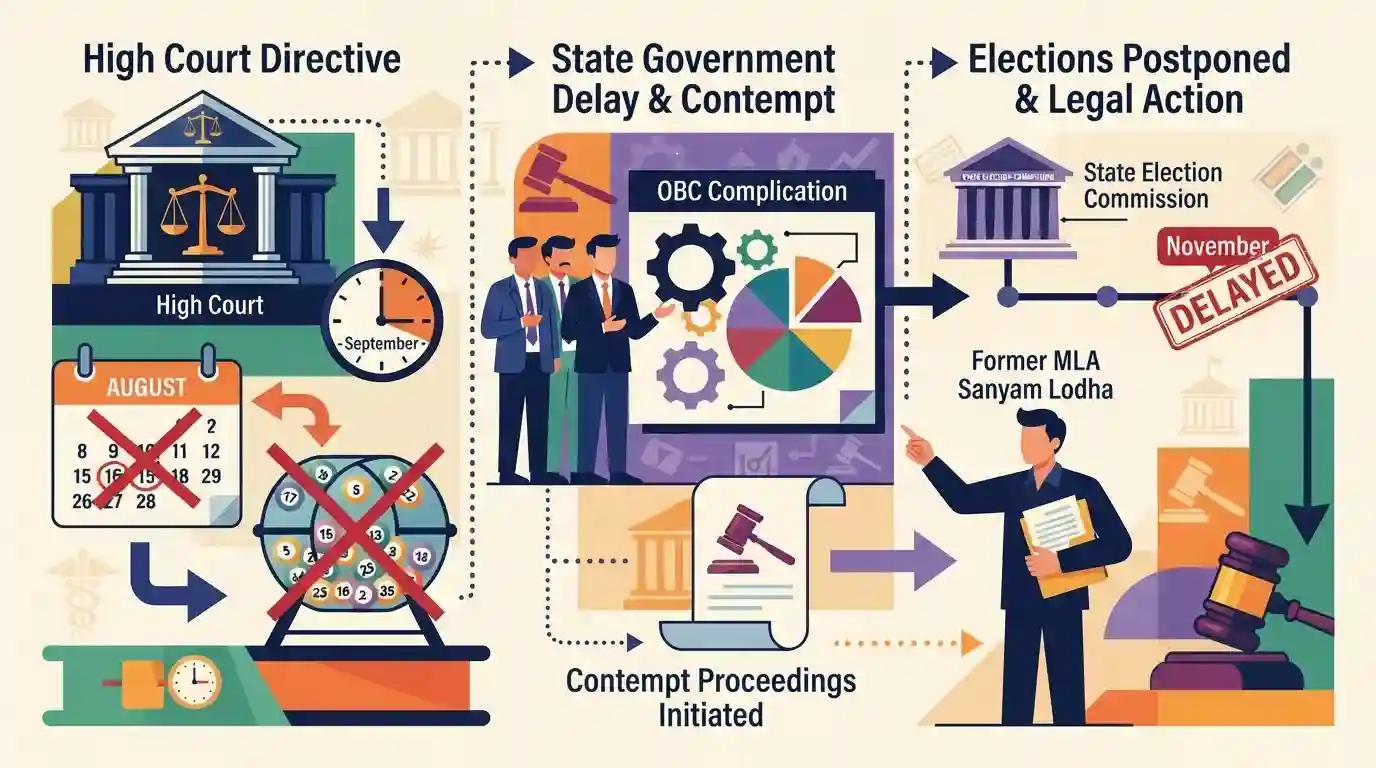
Congress leader and former MLA Sanyam Lodha has initiated contempt proceedings against Rajasthan government officials for postponing the reservation lottery for Panchayati Raj institutions (PRIs). Despite a prior Rajasthan High Court directive mandating the completion of the lottery by August 15 and the election process by November, the state government delayed the schedule to mid-September. The government cited complications regarding OBC reservations and the ongoing Assembly session as reasons for the delay. Lodha has threatened to file a formal contempt petition in the High Court if the process is not expedited.
Key Points
- Congress leader Sanyam Lodha issued contempt notices to Rajasthan officials for delaying the Panchayati Raj ward reservation lottery.
- The Rajasthan High Court had ordered the reservation lottery to be completed by August 15 and the overall election process by November.
- The state government postponed the lottery for various Panchayati Raj posts to September 17 and 18, citing issues with OBC reservations and the ongoing Assembly session.
- Lodha warned that a formal contempt petition will be filed in the High Court if the lottery process is not immediately concluded.
Important Terms
State Election Commission

Formed in July 1994 under Article 243K, this constitutional body oversees electoral roll preparation and conducts free and fair elections for Rajasthan's Panchayati Raj and urban local bodies.
UPSC context
Crucial for Rajasthan Polity; tests constitutional provisions (Article 243K, 243ZA) and state electoral machinery.
Panchayati Raj Institutions
The three-tier rural local self-government system in India. Granted constitutional status by the 73rd Amendment, it empowers villages through grassroots governance and localized development planning.
UPSC context
Central to Indian and Rajasthan Polity syllabi, testing decentralization, the 73rd Amendment, and the 11th Schedule.
Contempt of Court
The legal concept penalizing willful disobedience to or disregard of court orders. It serves to uphold the dignity, authority, and effective functioning of the judicial system.
UPSC context
Tests knowledge of judicial powers, Article 215 (High Courts), and the balance between executive action and judicial oversight.
Reservation in Local Bodies
A constitutional mechanism under Article 243D that mandates proportional seat reservation for SCs/STs, one-third for women, and allows states to reserve seats for Backward Classes in local elections.
UPSC context
Highly relevant to social justice, testing the 73rd Amendment, OBC quotas, and state-level policy implementation.
Rajasthan High Court
The apex judicial body in Rajasthan, possessing constitutional authority to issue directives to the state executive, enforce legal mandates, and uphold the rule of law within the state.
UPSC context
Relevant to State Judiciary topics, testing Article 214, the High Court's writ jurisdiction, and its supervisory powers.
Prelims Trap
"The State Election Commissioner is appointed and can be removed by the Governor of the respective state."
While the Governor appoints the SEC, removal is solely by the President, following the identical procedure and grounds as a High Court judge.
Static Concepts Connected
What governs OBC reservation in Panchayati Raj Institutions (PRIs)?
- Constitutional provision: Article 243D(6) of the Constitution empowers state legislatures to enact provisions reserving PRI seats or chairperson offices for backward classes.
- Triple test mandate: States must fulfill the "triple test": establish a dedicated commission, gather empirical data, and ensure aggregate reservations (SC/ST/OBC) do not breach the 50% cap.
What constitutes the contempt powers of a High Court?
- Article 215: Article 215 declares every High Court a 'court of record' with the inherent constitutional power to punish for contempt of itself.
- Civil contempt: Willfully disobeying a High Court directive or timeline (like the August 15 PRI lottery deadline) constitutes civil contempt, attracting judicial penalties against state officials.
Cross-Topic Patterns
Judicial review vs. Article 243O bar
Article 243O bars judicial interference in electoral matters, but courts intervene when constitutional mandates—like timely elections or the Supreme Court's OBC triple-test criteria—are violated by the state.
SEC autonomy vs. State Government machinery
State governments control delimitation and reservation rules, frequently causing election delays. This highlights the functional dependency of the State Election Commission on state administration despite its constitutional mandate.

Expect a multi-statement question combining Article 243D (PRI reservations), SEC removal procedures, and the SC's triple-test criteria.
Linked PYQs · 3
Linked PYQs · 3
- 2023RPSC_PRELIMSGS1
Consider the following statements regarding the State Election Commission of Rajasthan: (i) It was constituted in July 1994 under Article 243 T of the Constitution of India. (ii) It is a one-member commission headed by the State Election Commissioner.
- 2016RPSC_PRELIMSGS1
The State Election Commission of Rajasthan is
- 2013RPSC_PRELIMSGS1
List-1 is matched with List-2 and the correct answer is selected using the codes given below - List-1 – List-2 Constitutional Article – Provision A. 215 1. Transfer of a judge from one High Court to another High Court B. 222 2. Power of superintendence over all courts C. 226 3. Power of the High Court to issue certain writs D. 227 4. The High Court as a court of record Code:
