Santa Marta Climate Meetings and Minilateral Environmental Alliances
Source:Indian Express ↗
Why It Matters
Understanding alternative climate alliances outside the UNFCCC framework is important for mains answers on climate geopolitics, global environmental governance, and the challenges of climate finance and fossil-fuel phase-down.
Summary
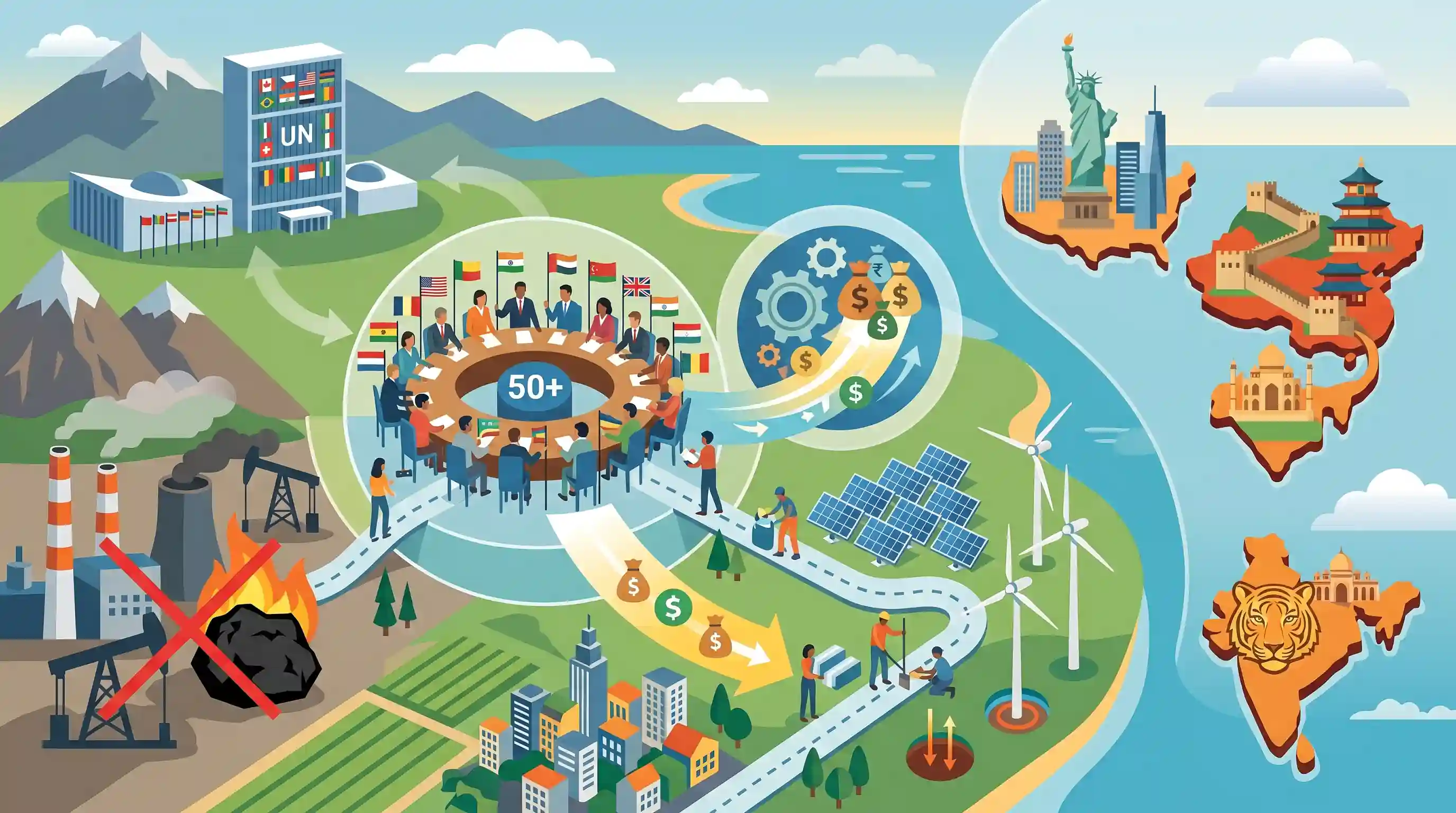
The editorial discusses the recent Santa Marta climate meeting in Colombia, where over 50 countries met outside the UN framework to pledge roadmaps for phasing out fossil fuels. While the absence of major emitters like the US, China, and India limits its immediate impact, the gathering of diverse economies representing 50% of global GDP signals a positive shift towards minilateral climate alliances. The author emphasizes that such alliances are crucial complements to the UNFCCC, provided they lead to tangible policies and deliver necessary climate finance for developing nations.
Key Points
- Representatives from over 50 countries gathered at the Santa Marta climate meeting in Colombia to develop national roadmaps to end fossil fuel use outside the consensus-bound UNFCCC framework.
- While dynamic, the meeting lacked the participation of the top three global greenhouse gas emitters: the US, China, and India.
- Participating nations, representing nearly 50% of global GDP, agreed to align their trade and finance policies with green transition plans.
- The meeting successfully bridged divides typical in UN summits, bringing together developed and developing nations (e.g., France and Germany with Brazil and Nepal).
- The editorial argues that climate change requires multi-level alliances beyond the UN, provided roadmaps are translated into actual policy and supported by financial mechanisms for poorer nations.
Important Terms
UNFCCC

The 1992 international treaty aimed at stabilizing greenhouse gas concentrations to prevent dangerous human interference with the climate system; the parent treaty of the Paris Agreement.
UPSC context
GS Paper III: Environment. Tests knowledge of core international governance frameworks and climate negotiation history.
Minilateralism
A diplomatic approach involving small, interest-based coalitions of like-minded countries focused on specific, actionable goals to bypass traditional multilateral gridlock.
UPSC context
GS Paper II: International Relations. Evaluates understanding of modern diplomatic shifts and agile global groupings.
Climate Finance
Financial resources—from public, private, or alternative sources—supporting mitigation and adaptation actions to address climate change in developing or vulnerable nations.
UPSC context
GS Paper III: Environment. Crucial for topics on mobilization of resources and global climate justice.
Just Transition
A framework ensuring that the transition to a low-carbon economy is fair and inclusive, supporting workers and communities dependent on fossil fuel industries.
UPSC context
GS Paper III: Environment and Economy. Tests awareness of social equity in industrial and environmental policy shifts.
Fossil Fuel Phase-out
The intentional reduction and ultimate cessation of the extraction, production, and consumption of coal, oil, and gas to achieve global net-zero targets.
UPSC context
GS Paper III: Environment and Energy. Tests understanding of decarbonization strategies and global energy transition policies.
Santa Marta Climate Meeting
A 2026 conference co-hosted by Colombia and the Netherlands dedicated to developing practical national roadmaps for moving away from fossil fuels outside the formal UN consensus.
UPSC context
Current Affairs: Environment. Tests knowledge of emerging non-traditional climate alliances and their impact on global policy.
Prelims Trap
"The Santa Marta climate meeting is an official UNFCCC-mandated initiative for phasing out fossil fuels."
Santa Marta is a minilateral platform existing strictly outside the formal, consensus-bound UNFCCC framework, designed precisely to bypass UN deadlocks.
Static Concepts Connected
What is 'Minilateralism' in international relations?
- Targeted approach: Focuses on specific issues with a smaller, willing group of nations rather than seeking universal participation.
- Agility over consensus: Bypasses the slow, consensus-based decision-making models of large multilateral bodies like the UN or WTO to achieve faster outcomes.
- Effectiveness vs Legitimacy: While often more effective in execution, minilateral agreements may lack the universal legitimacy of multilateral treaties.
What are the key obligations of Climate Finance under the UNFCCC framework?
- CBDR-RC principle: The Common But Differentiated Responsibilities principle dictates that developed historical emitters bear the primary financial burden of climate action.
- Article 9 mandate: The Paris Agreement legally mandates developed countries to provide financial resources to assist developing countries in mitigation and adaptation.
- Just transition financing: Funding is essential to offset the macroeconomic shocks and social costs of moving away from fossil fuels in developing nations.
Cross-Topic Patterns
Minilateralism filling multilateral voids
Platforms like Santa Marta reflect a structural shift in global governance, where agile "minilaterals" (like ISA or the Climate Club) bypass consensus-bound UN deadlocks to achieve faster outcomes.
Trade policy as climate action
Participating nations agreed to align trade policies with green transitions. This mirrors mechanisms like the EU's CBAM, increasingly blurring the lines between domestic environmental goals and international trade barriers.

Expect a Prelims question contrasting minilateral climate platforms (like Santa Marta, ISA) against consensus-bound UN mechanisms.
Linked PYQs · 4
Linked PYQs · 4
- 2021MainsGS3
Describe the major outcomes of the 26th session of the Conference of the Parties (COP) to the United Nations Framework Convention on Climate Change (UNFCCC). What are the commitments made by India in this conference?
- 2022MainsGS3
Discuss global warming and mention its effects on the global climate. Explain the control measures to bring down the level of greenhouse gases which cause global warming, in the light of the Kyoto Protocol, 1997.
- 2022MainsGS2
‘Clean energy is the order of the day.’ Describe briefly India's changing policy towards climate change in various international fora in the context of geopolitics.
- 2025PrelimsGS1
Consider the following statements : Statement I: Article 6 of the Paris Agreement on climate change is frequently discussed in global discussions on sustainable development and climate change. Statement II: Article 6 of the Paris Agreement on climate change sets out the principles of carbon markets. Statement III : Article 6 of the Paris Agreement on climate change intends to promote inter-country non-market strategies to reach their climate targets. Which one of the following is correct in respect of the above statements?
