India US Trade Deal Transparency and Strategic Autonomy Concerns
Source:Indian Express ↗
Why It Matters
This article touches upon the intersection of foreign policy (GS2) and economic strategy (GS3), questioning the balance between deepening strategic partnerships and protecting domestic interests. It provides critical talking points for Mains answers on the nuances of FTAs, India-US relations, and the necessity of parliamentary oversight in executive treaty-making.
Summary
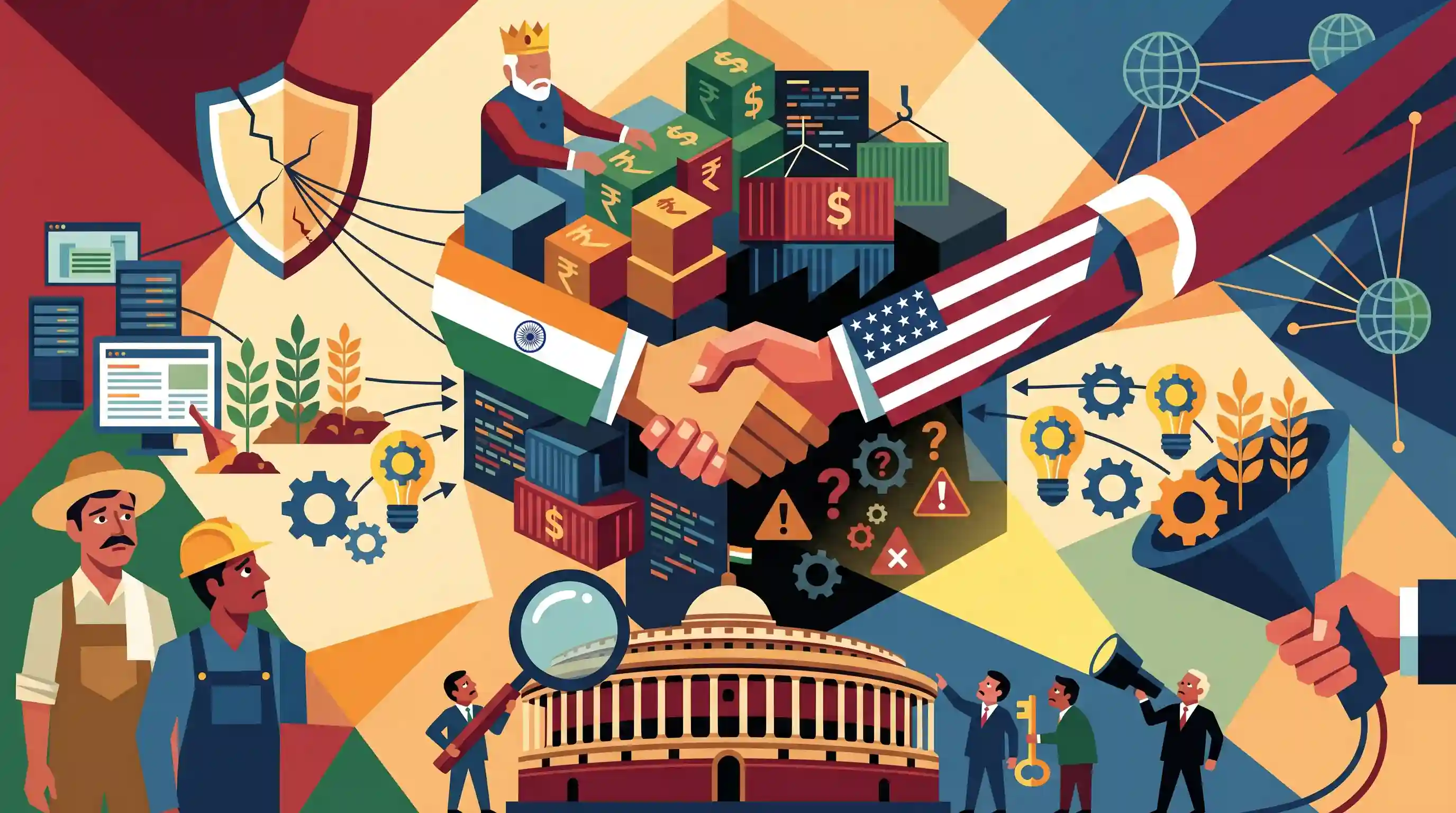
In this opinion piece, Sanjaya Baru critically examines the recent $500-billion trade deal negotiated between India and the United States, raising concerns over its opacity and potential strategic compromises. Baru questions what India is giving up—specifically regarding market access, digital policies, agriculture, and intellectual property rights—to achieve this ambitious target. He underscores the urgent need for parliamentary oversight in international treaty-making and urges the Prime Minister to clarify India’s stance, cautioning against sacrificing domestic economic interests and strategic autonomy under the guise of strengthening bilateral relations.
Key Points
- Sanjaya Baru criticizes the proposed $500-billion India-US trade deal for its lack of transparency and questions what strategic concessions India is making to achieve this target.
- Concerns are raised regarding potential compromises in critical domestic sectors such as agriculture, intellectual property rights, and data localization.
- The article highlights the democratic deficit in treaty-making, emphasizing the need for parliamentary scrutiny and debate before the executive commits to far-reaching international agreements.
- Baru cautions that while strengthening ties with the US is important, India must not compromise its strategic autonomy or domestic economic security in the process.
Important Terms
Strategic Autonomy

The ability of a state to pursue its national interests and foreign policy independently, without being constrained by other states or formal military alliances.
UPSC context
GS Paper II: International Relations. Core principle of Indian diplomacy; tested by trade-offs in bilateral deals like India-US agreements.
Parliamentary Oversight
The scrutiny exercised by the legislature over the executive's actions. In treaty-making, India currently lacks a mandatory pre-ratification parliamentary approval process, relying on ex-post implementation laws.
UPSC context
GS Paper II: Indian Polity. Tests knowledge of executive vs. legislative powers (Articles 73, 246, 253) regarding international commitments.
Intellectual Property Rights (IPR)
Legal rights protecting creations of the mind (patents, copyrights, etc.). India's Section 3(d) of the Patents Act prevents "evergreening," often a major friction point in US trade negotiations.
UPSC context
GS Paper III: Economy/S&T. Tests understanding of TRIPS compliance, pharmaceutical patenting, and trade disputes with the US.
Free Trade Agreements (FTAs)
A treaty between two or more countries to facilitate trade by reducing or eliminating tariffs, quotas, and other barriers on most goods and services.
UPSC context
GS Paper III: Indian Economy. Relevant for trade policy, export growth, and impact on domestic sectors like agriculture.
Non-Tariff Barriers
Trade restrictive measures other than tariffs, such as sanitary/phytosanitary standards, technical regulations, and licensing, often used as points of negotiation to ensure "market access."
UPSC context
GS Paper III: Economy/Trade. Tests understanding of modern protectionism and challenges faced by Indian exporters in Western markets.
Bilateral Trade Agreement (BTA)
A specific economic agreement between two nations, like the proposed 2026 framework aiming for $500 billion in trade, focusing on reciprocal market access and tariff reductions.
UPSC context
GS Paper II: International Relations. Key to analyzing shifts in India-US economic ties from general cooperation to specific transactional frameworks.
Prelims Trap
International treaties signed by the Indian executive require prior mandatory ratification by Parliament.
In India, treaty-making is an executive power (Article 73). Parliament is only involved later via Article 253 if implementing the treaty requires altering domestic law.
Static Concepts Connected
How is international treaty-making power distributed in the Indian Constitution?
- Executive domain: Article 73 grants the Union executive the absolute power to negotiate and sign international treaties.
- Legislative implementation: Article 253 gives Parliament exclusive power to enact laws to implement any international agreement if domestic rights are affected.
- No prior ratification: Unlike the US Senate, the Indian Parliament does not need to ratify a treaty before the executive signs it.
Why does the US consistently challenge Section 3(d) of the Indian Patents Act?
- Anti-evergreening: Section 3(d) prevents pharmaceutical companies from extending patent life by making minor modifications to existing drugs without enhancing efficacy.
- TRIPS compliance: India argues the law complies with WTO TRIPS to protect public health, while the US views it as anti-innovation.
- Special 301 Report: This specific friction is the primary reason India routinely remains on the USTR's Special 301 Priority Watch List.
Cross-Topic Patterns
Data localization vs. Digital FTAs
India's RBI data localization mandates clash with US pushes for unrestricted cross-border data flows, merging tech sovereignty with bilateral trade negotiations.
Agriculture NTBs and Protectionism
Strict domestic rules on GM-free crops and dairy feed are increasingly contested by the US as disguised protectionist Non-Tariff Barriers (NTBs).

Expect a multi-statement question pairing Article 253 (treaty-making) with India's WTO stance on IPR or cross-border data flows.
Linked PYQs · 4
Linked PYQs · 4
- 2020MainsGS2
What is the significance of Indo-US defence deals over Indo-Russian defence deals? Discuss with reference to stability in the Indo-Pacific region.
- 2023MainsGS2
‘The expansion and strengthening of NATO and a stronger US-Europe strategic partnership works well for India.’ What is your opinion about this statement ? Give reasons and examples to support your answer.
- 2021MainsGS2
Do Department-related Parliamentary Standing Committees keep the administration on its toes and inspire reverence for parliamentary control? Evaluate the working of such committees with suitable examples.
- 2023MainsGS3
What are the direct and indirect subsidies provided to farm sector in India? Discuss the issues raised by the World Trade Organization (WTO) in relation to agricultural subsidies.
