India Russia strategic partnership and western sanctions impact
Source:The Hindu ↗
Why It Matters
This article is crucial for understanding India's complex geopolitical balancing act. It highlights the real-world application of strategic autonomy, where India navigates the threat of Western sanctions (like CAATSA) while maintaining a vital defense relationship with Russia and a growing strategic partnership with the US. It also touches upon the transition from defense imports to indigenization (AMCA project).
Summary
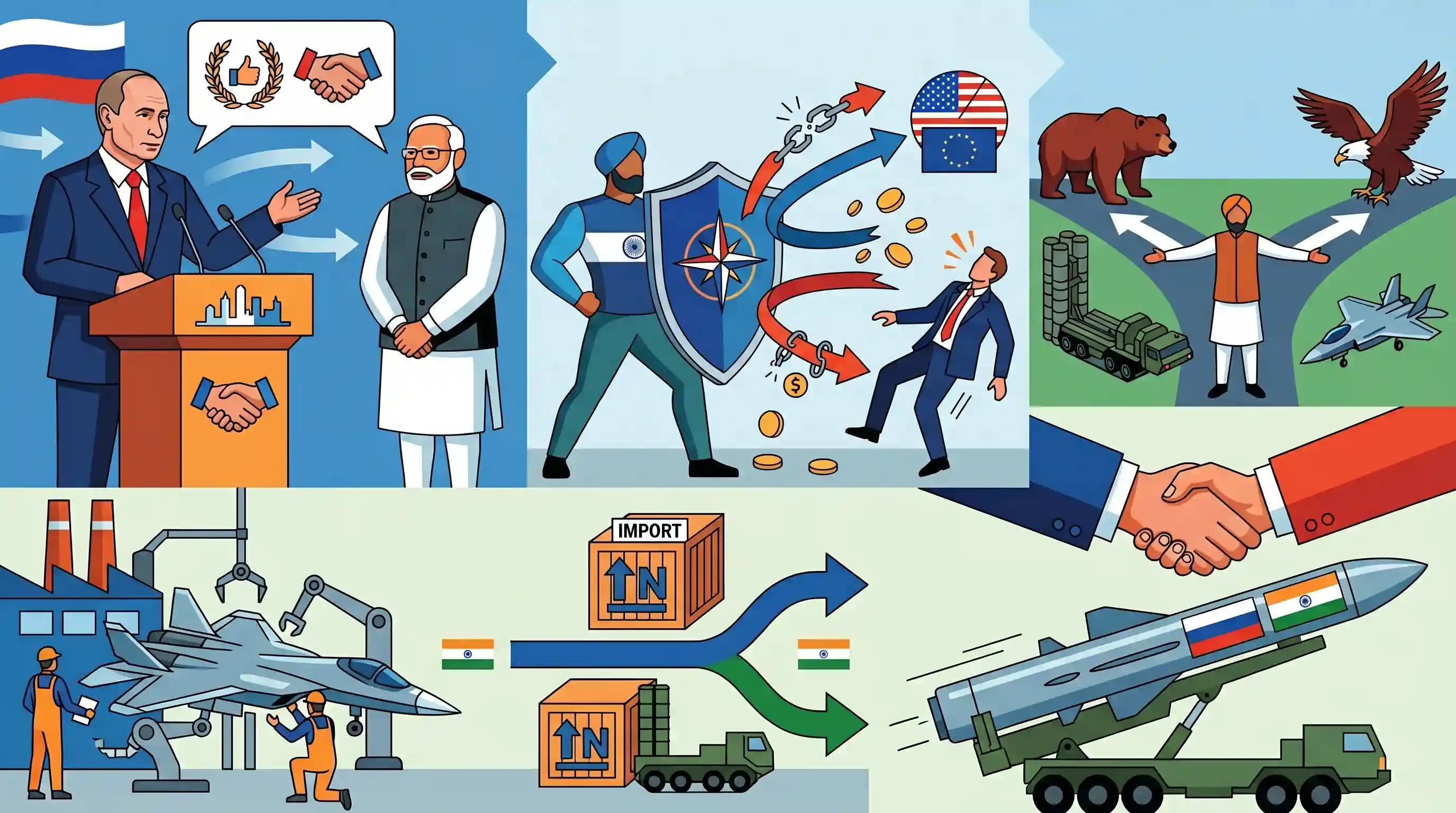
Speaking at the St. Petersburg International Economic Forum, Russian President Vladimir Putin praised Indian Prime Minister Narendra Modi's leadership, stating that threats of Western sanctions against India would fail and 'boomerang' on those imposing them. Putin commended Modi's ability to maintain strategic autonomy and defend India's national interests, noting India's simultaneous successful engagement with both Russia and the United States. While acknowledging India's need to diversify its defense imports and pursue indigenous projects like the AMCA (Advanced Medium Combat Aircraft), Putin reaffirmed Russia's readiness to supply cutting-edge platforms, including the S-500 air defense system and Su-57 stealth fighters. He also highlighted the enduring strength of the bilateral defense relationship, exemplified by the joint BrahMos missile project.
Key Points
- Russian President Vladimir Putin asserted that any Western sanctions aimed at pressuring India's strategic choices would 'boomerang' due to PM Modi's strong leadership and commitment to national interests.
- Putin acknowledged India's successful development of ties with the US, viewing it as a testament to India's sovereign foreign policy despite past US entry bans on PM Modi.
- Russia remains open to supplying advanced defense platforms like the S-500 air defence system and Su-57 stealth aircraft, while respecting India's drive to diversify and indigenize its defense procurement through projects like AMCA.
- The longstanding India-Russia defense partnership was highlighted, noting successful joint ventures like the BrahMos missile and emphasizing mutual trust.
Important Terms
Strategic Autonomy

A nation's ability to make independent foreign policy and defense decisions based on national interests, without being coerced by external powers or formal alliances.
UPSC context
GS Paper II (International Relations); examines India's 'multi-alignment' strategy in a multipolar world.
CAATSA (Countering America’s Adversaries Through Sanctions Act)
A 2017 US federal law that imposes sanctions on countries engaging in "significant transactions" with Russia's defense or intelligence sectors, creating diplomatic friction for India.
UPSC context
GS Paper II (Bilateral Relations); tests understanding of US-India-Russia trilateral dynamics.
Advanced Medium Combat Aircraft (AMCA) project
India's indigenous program to develop a fifth-generation, twin-engine stealth multirole fighter jet, aimed at achieving self-reliance in advanced aerospace technology.
UPSC context
GS Paper III (Defense Technology); vital for 'Aatmanirbhar Bharat' and indigenization.
BrahMos Missile Program
A joint venture between India (DRDO) and Russia producing the world's fastest supersonic cruise missile, capable of being launched from land, sea, and air.
UPSC context
GS Paper II/III (International Relations & Security); highlights successful strategic defense co-production.
Defense Indigenization
The policy of designing and manufacturing defense equipment domestically to reduce import dependency and enhance national security and economic growth.
UPSC context
GS Paper III (Internal Security); assesses the impact of 'Make in India' in the defense sector.
Prelims Trap
"CAATSA is a binding UN-mandated sanctions framework imposing automatic penalties."
CAATSA is a US domestic law, not a UN mandate. It also contains presidential waiver provisions, meaning it does not automatically trigger inescapable sanctions for all defense deals.
Static Concepts Connected
How does Strategic Autonomy differ from traditional Non-Alignment?
- Core Philosophy: NAM focused on avoiding Cold War blocs (equidistance), while Strategic Autonomy embraces issue-based multi-alignment to maximize national interests.
- Practical Application: India simultaneously engages in the US-led Quad and the Russia-led SCO without committing to binding military alliances in either.
What defines a 5th-generation fighter aircraft like the AMCA or Su-57?
- Stealth: Features low-observable design, internal weapons bays, and radar-absorbent materials to drastically minimize its radar cross-section.
- Supercruise: The capability to sustain supersonic flight speeds for extended durations without the use of highly inefficient afterburners.
- Sensor Fusion: Integrated advanced avionics that combine data from multiple sensors to provide the pilot with 360-degree battlefield awareness.
Cross-Topic Patterns
Defense Indigenization vs Partnerships
India balances rejecting joint 5th-gen aircraft ventures with Russia to pursue indigenous projects (AMCA), reflecting 'Atmanirbhar Bharat' intersecting with foreign policy.
Sanctions & Rupee-Ruble Trade
Western financial sanctions threats accelerate alternative payment mechanisms like Special Rupee Vostro Accounts, linking defense procurement to macroeconomic de-dollarization efforts.

Expect a Mains question assessing how defense indigenization (AMCA) acts as the true guarantor of India's Strategic Autonomy by 2026.
Linked PYQs · 2
Linked PYQs · 2
- 2020MainsGS2
What is the significance of Indo-US defence deals over Indo-Russian defence deals? Discuss with reference to stability in the Indo-Pacific region.
- 2023PrelimsGS1
Consider the following statements: 1. Ballistic missiles are jet-propelled at subsonic speeds throughout their flights, while cruise missiles are rocket-powered only in the initial phase of flight. 2. Agni-V is a medium-range supersonic cruise missile, while BrahMos is a solid-fuelled intercontinental ballistic missile. Which of the statements given above is/are correct?
