Sanchar Saathi App Mandate and Cybersecurity Privacy Debate
Source:The Hindu ↗
Why It Matters
Demonstrates the critical balance the state must maintain between implementing robust cybersecurity measures to combat digital fraud and safeguarding citizens' fundamental right to privacy against potential state surveillance.
Summary
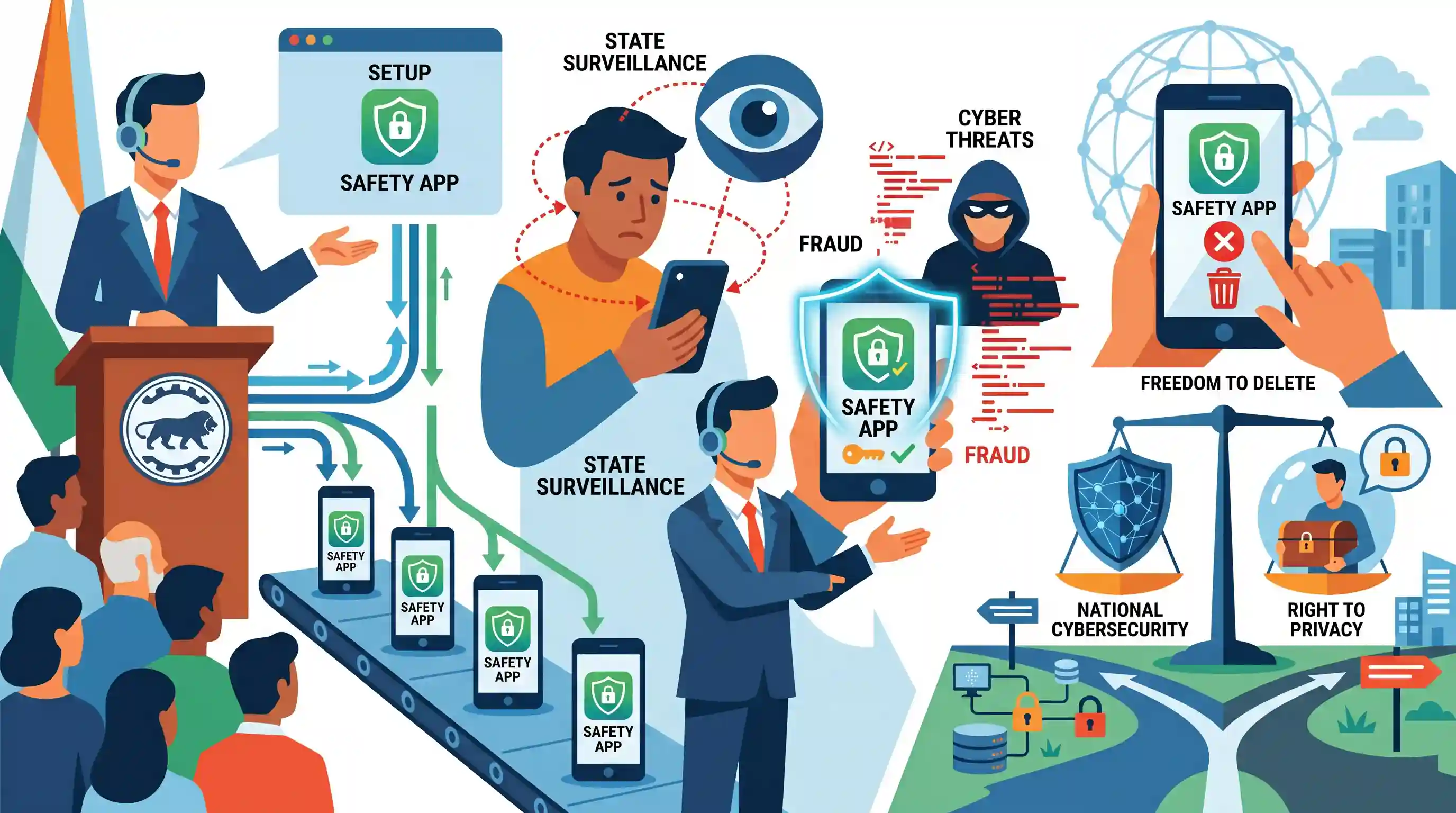
The Union government has defended its mandate to preload the state-run Sanchar Saathi safety app on all smartphones, amidst allegations that it could function as a state surveillance tool. Communications Minister Jyotiraditya Scindia assured the Lok Sabha that snooping is neither intended nor technically possible, emphasizing the app's utility in protecting users from cyber threats and fraud. While a recent directive requires manufacturers to make the app prominently accessible upon device setup, the Minister clarified that citizens retain the freedom to delete it, highlighting the ongoing policy tension between national cybersecurity initiatives and the right to digital privacy.
Key Points
- Union Communications Minister Jyotiraditya Scindia assured the Lok Sabha that the Sanchar Saathi safety app cannot and will not be used for state snooping.
- The controversy stems from a November 28 Ministry directive mandating smartphone manufacturers to preload the app on new devices and install it on existing ones via software updates.
- The government maintains the app is designed to empower citizens to protect themselves from cyber frauds and scams.
- Critics have raised privacy concerns, labeling it a potential state-owned surveillance tool, though the Minister clarified that users are free to delete the app.
Important Terms
Sanchar Saathi Portal/App

An integrated citizen-centric portal and app by the Department of Telecommunications to secure the mobile ecosystem. It allows users to track/block lost mobiles and verify connections registered in their names.
UPSC context
GS Paper 2 (E-governance) and GS Paper 3 (Cybersecurity). Vital for understanding digital safety initiatives and consumer protection.
Right to Privacy
A fundamental right under Article 21, as affirmed in the Justice K.S. Puttaswamy judgment. It protects individuals from unauthorized state intrusion into their personal data and digital life.
UPSC context
GS Paper 2 (Fundamental Rights). Central to the debate between national cybersecurity mandates and individual civil liberties.
Department of Telecommunications (DoT)
The nodal agency under the Ministry of Communications responsible for telecom policy, licensing, and security. It manages the Sanchar Saathi initiative and regulates mobile network infrastructure.
UPSC context
GS Paper 2 (Governance). Relevant for the executive's role in implementing technology-driven public safety and regulatory policies.
Central Equipment Identity Register (CEIR)
A central database of mobile IMEI numbers integrated with Sanchar Saathi. It enables the blocking and tracing of stolen or lost handsets across all telecom networks in India.
UPSC context
GS Paper 3 (Internal Security). A technical mechanism tested under measures to curb mobile theft and ensure device traceability.
TAFCOP (Telecom Analytics for Fraud Management and Consumer Protection)
A module under Sanchar Saathi that allows subscribers to view the number of mobile connections issued against their identity and report unauthorized or fraudulent connections.
UPSC context
GS Paper 2 (Governance). Tests knowledge of citizen-empowerment tools aimed at preventing identity theft in the digital sector.
Cybersecurity
The practice of protecting systems, networks, and data from digital attacks. It involves government-led initiatives to safeguard the national communication infrastructure from fraud and surveillance.
UPSC context
GS Paper 3 (Security). A core topic involving national security strategies, threat mitigation, and the Digital India mission.
Prelims Trap
Sanchar Saathi is a mandatory, non-removable security app pre-installed on all smartphones.
The government mandate only requires manufacturers to preload the app. The Communications Minister clarified that citizens retain the freedom to uninstall or delete it.
Static Concepts Connected
What is the Puttaswamy three-fold test to restrict the Right to Privacy?
- Legality: The restriction must be explicitly backed by a valid legislative mandate.
- Legitimate Goal: The restriction must serve a legitimate state aim, such as national security or preventing cybercrime.
- Proportionality: There must be a rational nexus between the object and the means adopted, being the least restrictive measure possible.
How does the IMEI system prevent mobile handset theft?
- Unique Identifier: A 15-digit code unique to every mobile phone globally, distinct from the SIM card.
- Network Blocking: Equipment Identity Registers (like India's CEIR) can blacklist stolen IMEIs, blocking them from accessing any telecom network even if a new SIM is inserted.
Cross-Topic Patterns
State surveillance & DPDP Act 2023
The Sanchar Saathi debate echoes past spyware controversies, directly testing the exemptions granted to state agencies under the newly enacted Digital Personal Data Protection (DPDP) Act 2023.
DPI for consumer protection
Unlike Aadhaar or UPI which primarily enable service delivery, Sanchar Saathi represents a new wave of Digital Public Infrastructure (DPI) focused exclusively on consumer protection and telecom fraud mitigation.

Expect a 2026 Prelims match-the-following question pairing Sanchar Saathi modules (CEIR, TAFCOP, Chakshu) with their specific functions.
Linked PYQs · 3
Linked PYQs · 3
- 2018MainsGS3
Data security has assumed significant importance in the digitized world due to rising cyber crimes. The Justice B. N. Srikrishna Committee Report addresses issues related to data security. What, in your view, are the strengths and weaknesses of the Report relating to protection of personal data in cyber space?
- 2020MainsGS3
Discuss different types of cyber crimes and measures required to be taken to fight the menace.
- 2017MainsGS2
Examine the scope of Fundamental Rights in the light of the latest judgement of the Supreme Court on Right to Privacy.
