Agricultural Input Subsidies and Natural Farming Debate
Source:The Hindu ↗
Why It Matters
The article highlights the critical tension between the government's long-term environmental goals (natural farming) and the immediate economic realities of farmers (yields, input costs, and guaranteed prices). It underscores the vulnerability of the Indian agricultural sector to geopolitical shifts affecting fertiliser and fuel prices, making it highly relevant for GS3 topics on agricultural economics, subsidies, and MSP.
Summary
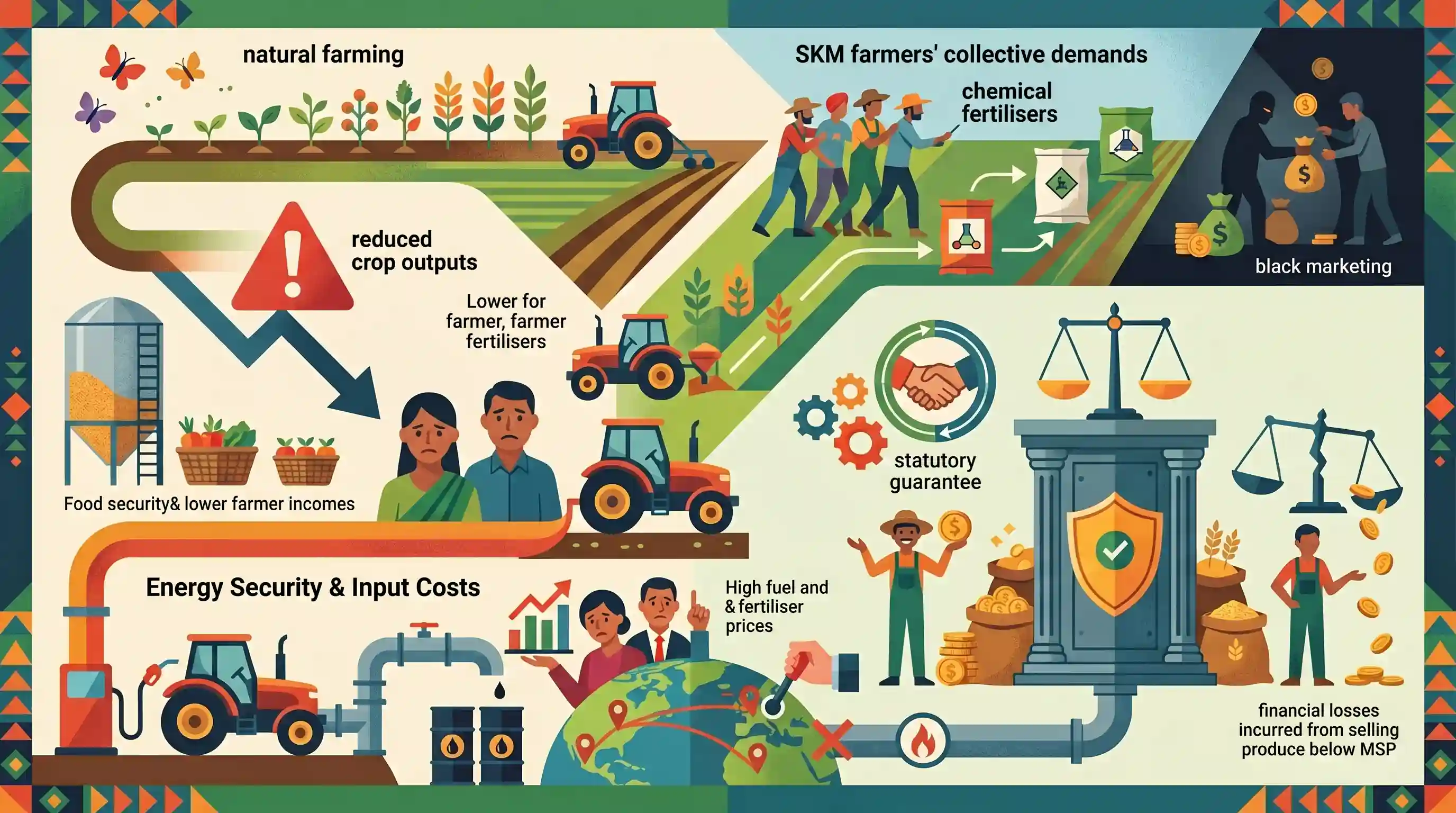
The Samyukt Kisan Morcha (SKM) has expressed strong opposition to the Union Government's push for 'natural farming', warning that it could cause crop outputs to plummet by up to 30%, jeopardizing farmer incomes and food security. Ahead of the Kharif season, the farmers' collective has urged the Centre to ensure an adequate supply of chemical fertilisers and combat black marketing. The SKM also announced protests to press for their core demand of a statutory guarantee for Minimum Support Price (MSP), citing significant financial losses incurred from selling produce below MSP. Additionally, the group criticized the government's foreign policy, linking higher input costs (such as for diesel and fertilisers) to failures in securing cheap crude oil and natural gas imports from countries like Russia and Iran.
Key Points
- The Samyukt Kisan Morcha (SKM) warned against the government's push for natural farming, claiming it could lead to a 30% reduction in crop yields.
- Farmers demanded an uninterrupted and adequate supply of chemical fertilisers for the upcoming Kharif sowing season.
- The SKM reiterated its demand for a statutory guarantee for Minimum Support Price (MSP), claiming farmers lost ₹27 lakh crore by selling crops below MSP.
- The farmers' body criticized the Centre's foreign policy, arguing that restrictions on imports from Iran and Russia have led to higher prices for diesel, crude oil, natural gas, and fertilisers.
Important Terms
Minimum Support Price (MSP)

A floor price set by the government to purchase crops from farmers, providing a safety net against market price volatility and ensuring remunerative returns.
UPSC context
GS Paper III: Vital for topics on farm subsidies, agricultural pricing policy, and food security mechanisms like procurement.
Natural Farming
A chemical-free, agroecology-based traditional farming method that replaces synthetic fertilisers and pesticides with on-farm inputs like livestock-based formulations.
UPSC context
GS Paper III: Relevant to sustainable agriculture, cropping patterns, and ecological impacts of the Green Revolution.
Samyukt Kisan Morcha (SKM)
An umbrella coalition of Indian farmers' unions formed in 2020 to lead protests against agricultural reforms and advocate for statutory MSP guarantees.
UPSC context
GS Paper II: Significant as a major pressure group influencing public policy and democratic participation in governance.
Fertiliser Subsidy
Government financial assistance provided to ensure essential nutrients (like Urea and P&K) are available to farmers at affordable, controlled prices.
UPSC context
GS Paper III: Central to government budgeting, fiscal deficit management, and input-related agricultural subsidies.
Food Security
The physical and economic access for all people at all times to sufficient, safe, and nutritious food to meet dietary needs.
UPSC context
GS Paper III: Critical for discussions on the Public Distribution System (PDS) and buffer stock management.
Swaminathan Commission
Formally known as the National Commission on Farmers; it famously recommended fixing MSP at 50% above the comprehensive cost (C2) of production.
UPSC context
GS Paper III: Essential historical context for agricultural reforms and the ongoing debate over farmers' income.
Prelims Trap
"The Minimum Support Price (MSP) is a statutory right guaranteed to farmers in India."
MSP is purely an administrative decision announced by the CCEA. There is currently no central statute making it legally binding for private traders or the government to procure crops at MSP.
Static Concepts Connected
What distinguishes Natural Farming from Organic Farming?
- Input additions: Organic farming uses organic fertilizers like compost and manure. Natural farming adds absolutely no external inputs (chemical or organic) to the soil.
- Soil management: Organic farming requires plowing and mixing manures. Natural farming encourages undisturbed soil with surface cover (mulching) and relies on soil microbes.
- Input costs: Natural farming (e.g., ZBNF) is virtually zero-cost, whereas organic farming can require purchasing expensive bulk organic inputs.
How are India's chemical fertilisers linked to global hydrocarbon markets?
- Natural Gas: Ammonia, the primary feedstock for urea manufacturing, is derived directly from natural gas (methane).
- Refinery byproducts: Sulphur, a crucial input for manufacturing phosphatic fertilisers (like DAP), is primarily sourced as a byproduct of petroleum refining.
- Import dependence: India's heavy reliance on imported crude oil and LNG makes domestic fertiliser prices and government subsidy bills highly vulnerable to global geopolitical shocks.
Cross-Topic Patterns
Geopolitics dictating agro-economics
Western sanctions on Iran and Russia directly impact India's crude and natural gas imports, inflating the domestic fertiliser subsidy burden and driving up input costs for farmers.
Food Security vs. Ecological Sustainability
The push for natural farming exposes a critical trade-off between ecological sustainability (reducing chemical footprint) and national food security (managing the expected 30% yield drop during the transition phase).

Expect a 2026 multi-statement question contrasting Natural Farming with Organic Farming, focusing on transition yield penalties & MSP status.
Linked PYQs · 4
Linked PYQs · 4
- 2018MainsGS3
What do you mean by Minimum Support Price (MSP)? How will MSP rescue the farmers from the low income trap?
- 2017MainsGS3
How do subsidies affect the cropping pattern, crop diversity and economy of farmers? What is the significance of crop insurance, minimum support price and food processing for small and marginal farmers?
- 2023MainsGS3
What are the direct and indirect subsidies provided to farm sector in India? Discuss the issues raised by the World Trade Organization (WTO) in relation to agricultural subsidies.
- 2020PrelimsGS1
Consider the following statements: 1. In the case of all cereals, pulses and oil-seeds, the procurement at Minimum Support Price (MSP) is unlimited in any State/UT of India. 2. In the case of cereals and pulses, the MSP is fixed in any State/UT at a level to which the market price will never rise. Which of the statements given above is/are correct?
