Kharif MSP Formulas and Farmer Pricing Grievances
Source:The Hindu ↗
Why It Matters
The ongoing friction over MSP calculations highlights a core issue in Indian agriculture: ensuring remunerative prices to address agrarian distress. Understanding the distinction between A2+FL and C2+50% costs, alongside the structural deficits in procurement and input availability, is crucial for analyzing India's agricultural policies and rural economy.
Summary
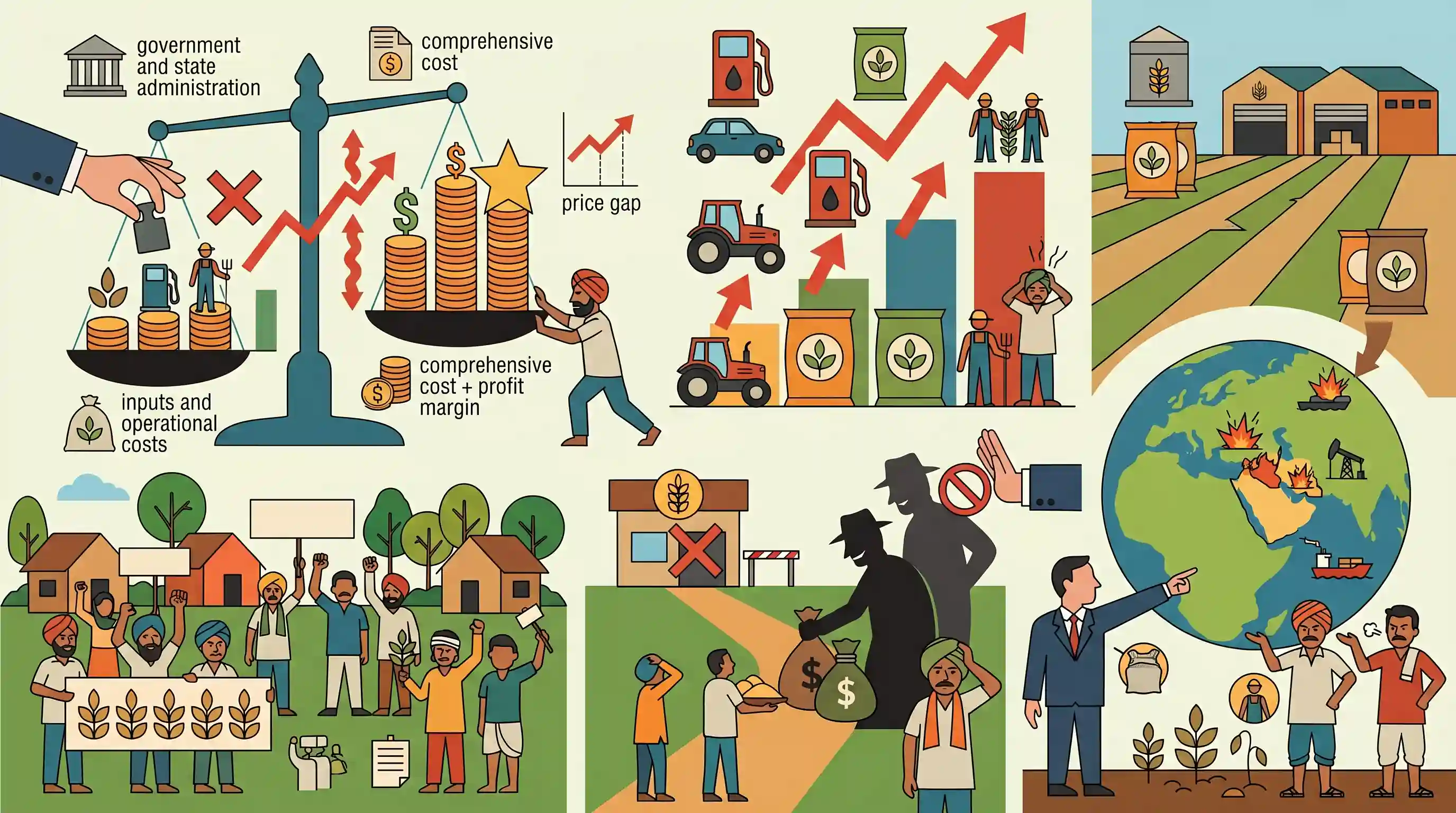
The Samyukt Kisan Morcha (SKM) has rejected the Union government's revised Minimum Support Price (MSP) for kharif crops, planning village-level protests to demand adherence to the Swaminathan Commission's C2+50% formula. Currently, the government calculates MSP using the A2+FL formula, which farmers argue is about 30% lower than comprehensive costs. For instance, the MSP for paddy is set at ₹2,441 per quintal instead of the ₹3,243 demanded under C2+50%. Beyond pricing, the SKM criticized the absence of a robust public procurement system, leaving farmers vulnerable to exploitation by large traders. Furthermore, skyrocketing input costs—ranging from seeds and diesel to fertilizers and labor—have exacerbated agrarian distress. The farmers also expressed concerns regarding an impending fertilizer scarcity, pushing back against the government's attribution of the shortage to the geopolitical crisis in West Asia.
Key Points
- The Samyukt Kisan Morcha (SKM) rejected the Central government's kharif MSP hike, arguing it does not meet the Swaminathan Commission’s C2+50% formula.
- The government calculates MSP based on the A2+FL formula, which covers input costs and family labor but remains approximately 30% lower than the comprehensive C2 cost.
- Farmers assert that the lack of a robust procurement system forces them to sell to large traders at distress prices below the announced MSP.
- Rising cultivation costs, driven by expensive seeds, fertilizers, diesel, and labor, are significantly squeezing farmers' profit margins.
- SKM highlighted concerns over a potential fertilizer scarcity, which the government attributes to the West Asian crisis, viewing it as an excuse for austerity measures.
Important Terms
Minimum Support Price (MSP)

A pre-announced minimum price at which the government purchases crops from farmers to ensure price stability and protect them from market volatility and distress sales.
UPSC context
GS Paper III (Agriculture): Major policy tool for food security and farmer income; frequent topic in Prelims and Mains.
Samyukt Kisan Morcha (SKM)
An umbrella coalition of over 400 farmers' unions formed in 2020 to lead protests against the (now repealed) farm laws and advocate for legal MSP guarantees.
UPSC context
GS Paper II (Pressure Groups): Illustrates the role of agrarian collectives in influencing national policy and federal relations.
National Commission on Farmers (Swaminathan Commission)
An expert panel (2004–2006) chaired by M.S. Swaminathan that recommended holistic agricultural reforms, including setting MSP at 50% above the comprehensive cost of production.
UPSC context
GS Paper III (Agricultural Reforms): Essential for discussing farmer distress and structural changes needed in India's primary sector.
C2+50% Formula
A comprehensive cost calculation including actual expenses (seeds, labor, fuel), imputed value of family labor, and rental/interest value of owned land and capital.
UPSC context
GS Paper III (Agriculture): Central demand in farmer protests; tests understanding of cost accounting in agricultural economics.
A2+FL Formula
The government's current MSP base, covering actual paid-out costs (A2) plus the estimated value of unpaid family labor (FL).
UPSC context
GS Paper III (Agriculture): Distinguishing between different MSP calculation methods is a common technical requirement in UPSC exams.
Kharif Crops
Monsoon-season crops (e.g., paddy, maize, cotton) sown in June–July and harvested in September–October; MSP for these is typically announced before sowing starts.
UPSC context
Prelims (Geography/Agriculture): Tests knowledge of cropping seasons, specific crops covered under MSP, and monsoon patterns.
Prelims Trap
The government currently calculates MSP using the C2 formula as recommended by the Swaminathan Commission.
The government uses the A2+FL formula (paid-out costs + family labor) multiplied by 1.5. It has not adopted the comprehensive C2 formula, which includes rent and interest—the core demand of farmers.
Static Concepts Connected
What are the A2, A2+FL, and C2 cost formulas for crops?
- A2 Cost: Actual paid-out expenses incurred by farmers on seeds, fertilizers, pesticides, hired labor, and fuel.
- A2+FL Cost: Includes A2 cost plus the imputed value of unpaid family labor. This is the baseline currently used by the government for setting MSP.
- C2 Cost: A comprehensive measure that includes A2+FL plus imputed rental value of owned land and interest on fixed capital assets.
How does India procure agricultural commodities under MSP?
- Open-Ended Procurement: The Food Corporation of India (FCI) procures wheat and paddy in bulk to maintain buffer stocks and supply the Public Distribution System (PDS).
- PM-AASHA Framework: Includes the Price Support Scheme (PSS) where central agencies like NAFED procure pulses, oilseeds, and copra when market prices fall below the MSP.
- Decentralized Procurement: State governments procure food grains directly from local farmers, retaining stocks for their own welfare schemes and transferring surplus to the central pool.
Cross-Topic Patterns
Geopolitics driving agrarian inflation
India's high import dependency for LNG from West Asia, used as a feedstock for urea synthesis, directly links global geopolitical instability (GS2) with domestic agricultural input costs (GS3).
PM-AASHA and procurement deficits
Mere announcement of MSP is ineffective without physical procurement. Outside of paddy and wheat, interventions like PM-AASHA struggle with inadequate state procurement infrastructure, leading to frequent distress sales by farmers.

Expect a Prelims question comparing A2+FL and C2 metrics, combined with CCEA's role in approvals and India's import dependency for fertilizers.
Linked PYQs · 5
Linked PYQs · 5
- 2018MainsGS3
What do you mean by Minimum Support Price (MSP)? How will MSP rescue the farmers from the low income trap?
- 2017MainsGS3
How do subsidies affect the cropping pattern, crop diversity and economy of farmers? What is the significance of crop insurance, minimum support price and food processing for small and marginal farmers?
- 2014MainsGS3
There is also a point of view that Agricultural Produce Market Committees (APMCs) set up under the State Acts have not only impeded the development of agriculture but also have been the cause of food inflation in India. Critically examine.
- 2025MainsGS3
Elaborate the scope and significance of supply chain management of agricultural commodities in India.
- 2023MainsGS3
What are the direct and indirect subsidies provided to farm sector in India? Discuss the issues raised by the World Trade Organization (WTO) in relation to agricultural subsidies.
