Nitish Kumar Resigns As Samrat Choudhary Becomes Bihar CM
Source:The Hindu ↗
Why It Matters
The developments highlight the constitutional mechanisms underlying the resignation and appointment of a Chief Minister, the discretionary powers of the Governor during a change in government, and the practical dynamics of coalition politics in Indian states.
Summary
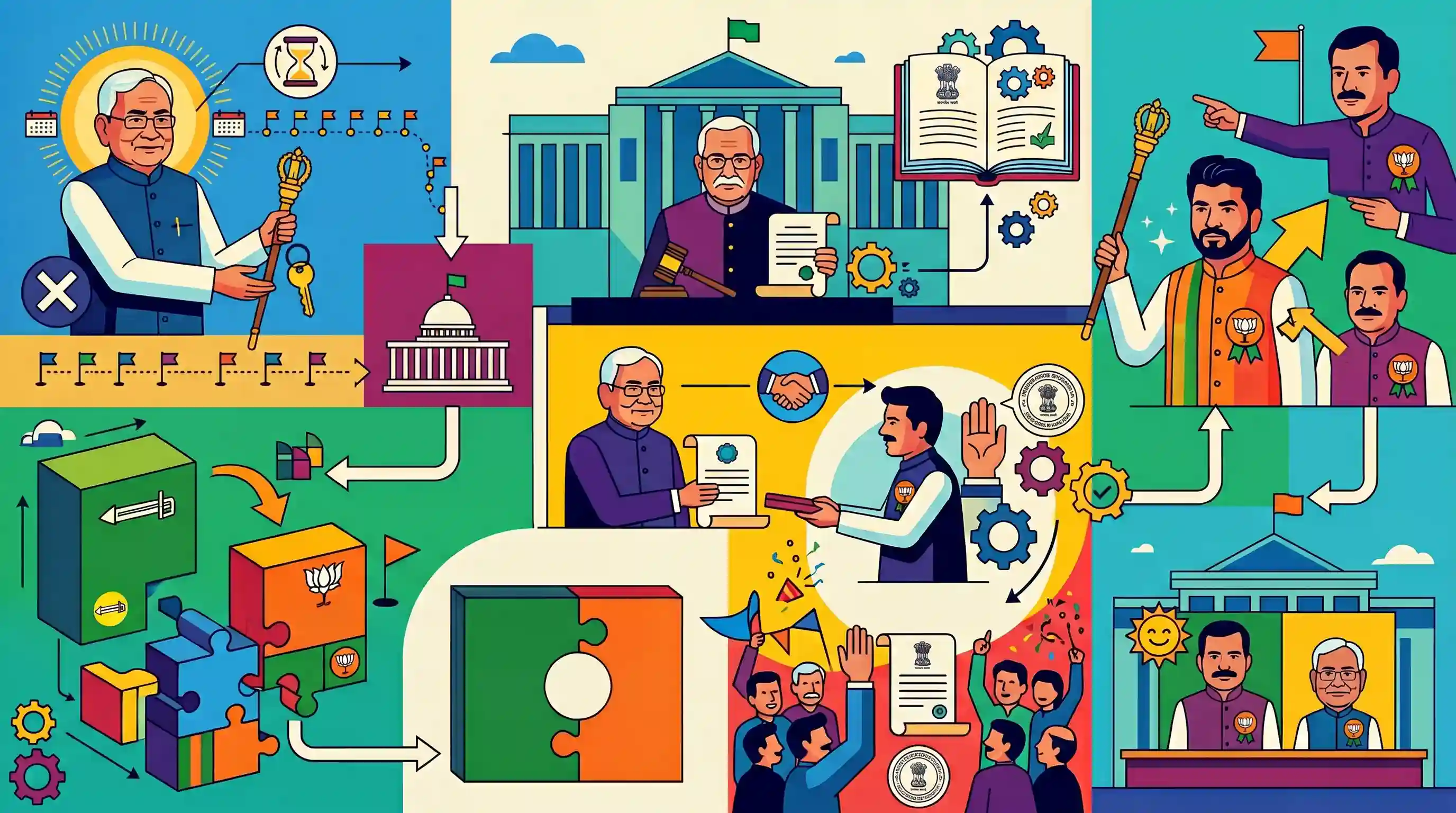
Nitish Kumar has resigned as the Chief Minister of Bihar, paving the way for a transition of power within the National Democratic Alliance (NDA). BJP's Samrat Choudhary has been elected as the leader of the NDA legislature party and is set to become the new Chief Minister, with Vijay Kumar Sinha serving as his deputy. Nitish Kumar, the longest-serving CM in the state's history, is expected to move to the Rajya Sabha.
Key Points
- Nitish Kumar resigned as the Chief Minister of Bihar, submitting his resignation to Governor Rajendra Vishwanath Arlekar.
- Samrat Choudhary of the BJP was unanimously elected as the leader of the NDA legislature party and is set to take oath as the new Chief Minister.
- Vijay Kumar Sinha was chosen as the deputy leader of the NDA legislature party and will serve as the Deputy Chief Minister.
- Nitish Kumar, who has taken oath as Chief Minister nine times and is the longest-serving CM of Bihar, is likely to transition to the Rajya Sabha.
Important Terms
Chief Minister

The real executive head of a state government, appointed by the Governor under Article 164. The CM must command the majority support of the State Legislative Assembly.
UPSC context
GS Paper II: State Executive. Tests knowledge of appointment procedures, powers, and relationship with the Governor.
Governor
The constitutional head of a state (Articles 153-167) who acts as a link between the Union and State. Possesses situational discretion during government formation and hung assemblies.
UPSC context
GS Paper II: Role of the Governor. Often tested regarding discretionary powers and constitutional friction with elected governments.
National Democratic Alliance (NDA)
A centre-right political coalition in India led by the Bharatiya Janata Party (BJP), formed in 1998. It exemplifies pre-poll alliance dynamics in Indian multi-party democracy.
UPSC context
GS Paper II: Coalition Politics. Relevant for studying alliance stability and the role of regional parties in national governance.
Coalition Government
A government formed by multiple political parties collaborating to achieve a majority. It typically operates on a Common Minimum Programme (CMP) and involves consensus-based decision-making.
UPSC context
GS Paper II: Governance. Tests understanding of federalism, regionalism, and challenges to political stability in India.
Raj Bhavan
The official residence of a State Governor. It serves as the symbolic seat of the state's nominal executive and the site for constitutional ceremonies like oath-taking.
UPSC context
GS Paper II: State Executive. Symbolizes the Governor's office and its role in state-level constitutional processes.
Rajya Sabha
The Upper House of Parliament (Article 80) representing States and UTs. Members are elected indirectly by State MLAs; it is a permanent body ensuring continuity in governance.
UPSC context
GS Paper II: Parliament. Tests knowledge of the indirect election process, federal representation, and its role as a revising chamber.
Collective Responsibility
A constitutional principle (Article 164(2)) stating the State Council of Ministers is jointly accountable to the Legislative Assembly. If a no-confidence motion passes, the entire ministry resigns.
UPSC context
GS Paper II: Parliamentary System. Fundamental to understanding executive accountability to the legislature in the Indian constitutional framework.
Prelims Trap
"The post of Deputy Chief Minister is established under Article 164 of the Constitution."
The Constitution does not mention Deputy Chief Ministers. The post is purely a political convention, though appointees hold the rank and pay of a State Cabinet Minister.
Static Concepts Connected
When does a Governor exercise situational discretion in appointing a CM?
- Hung assembly: When no single party or pre-poll coalition secures a clear majority in the Legislative Assembly after an election.
- Coalition collapse: When a ruling coalition breaks down or loses a trust vote, requiring the Governor to explore alternative government formations.
- Incumbent's death: When the sitting Chief Minister dies suddenly in office and the ruling party lacks an obvious, immediate successor.
What are the constitutional consequences of a Chief Minister's resignation?
- Council dissolution: The resignation of the Chief Minister automatically and immediately dissolves the entire State Council of Ministers.
- Collective responsibility: Under Article 164, ministers are collectively responsible to the Assembly; they effectively sink or swim with the Chief Minister.
- Caretaker government: The Governor typically asks the outgoing Chief Minister to continue in a caretaker capacity until the new government officially takes the oath.
Cross-Topic Patterns
Coalition shifts and Anti-Defection Law
Frequent alliance changes by intact political parties circumvent the Tenth Schedule, as the Anti-Defection Law penalizes individual rebel legislators but does not regulate post-poll whole-party alliance shifts.
State to Centre parliamentary transitions
A Chief Minister moving to the Rajya Sabha triggers Article 101 (Prohibition of simultaneous membership), strictly requiring them to formally vacate their State Legislature seat.

Expect a 2026 prelims statement testing the non-constitutional nature of Deputy CMs alongside the Governor's situational discretion.
Linked PYQs · 3
Linked PYQs · 3
- 2025PrelimsGS1
With reference to the Indian polity, consider the following statements : I. The Governor of a State is not answerable to any court for the exercise and performance of the powers and duties of his/her office. II. No criminal proceedings shall be instituted or continued against the Governor during his/her term of office. III. Members of a State Legislature are not liable to any proceedings in any court in respect of anything said within the House. Which of the statements given above are correct?
- 2022MainsGS2
Discuss the essential conditions for exercise of the legislative powers by the Governor. Discuss the legality of re-promulgation of ordinances by the Governor without placing them before the Legislature.
- 2022MainsGS2
“While the national political parties in India favour centralisation, the regional parties are in favour of State autonomy.” Comment.
