Kolkata Hosts Eastern India India-Russia Bilateral Conclave
Source:the-p3 ↗
Why It Matters
This conclave demonstrates how individual Indian states (like West Bengal) are increasingly participating in foreign trade and diplomatic outreach. In the context of India-Russia strategic relations, utilizing Eastern Indian ports and regional platforms helps diversify trade beyond traditional corridors.
Summary
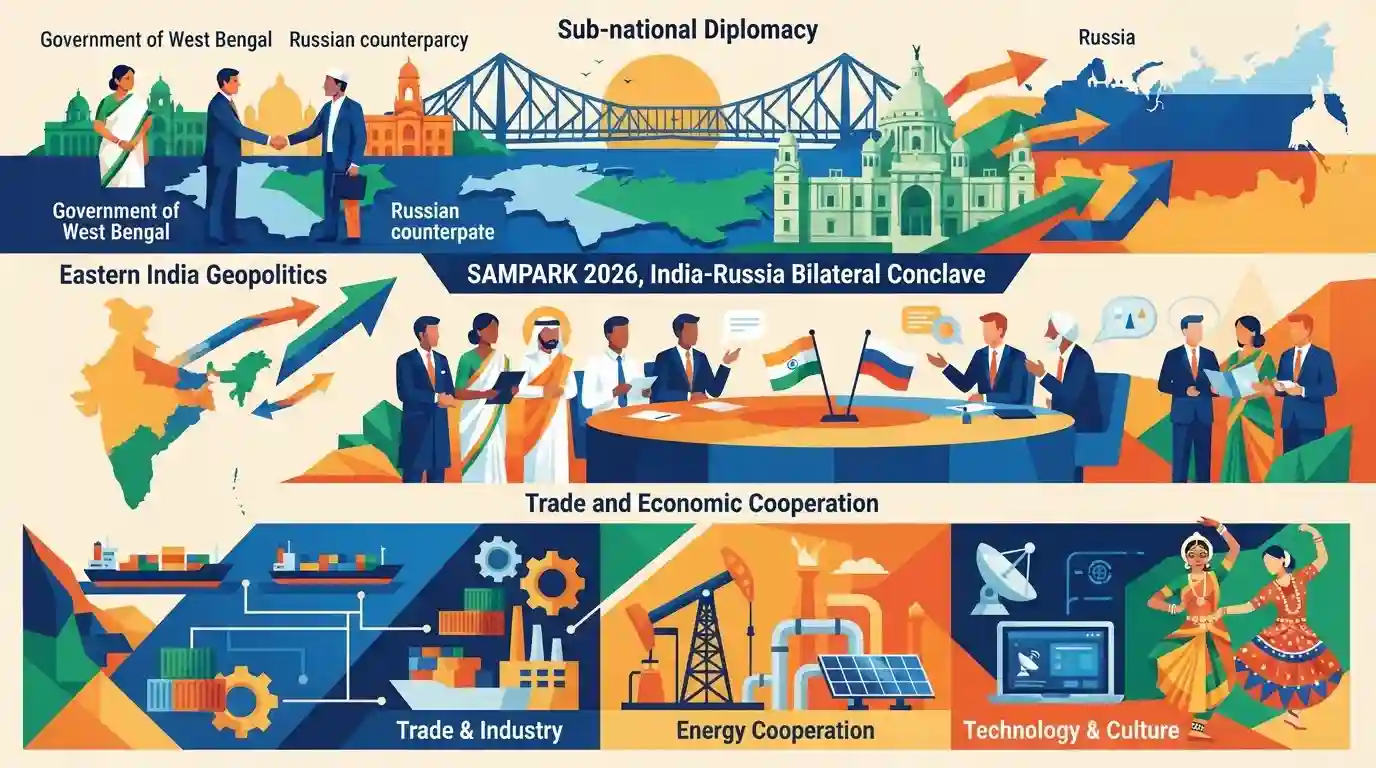
SAMPARK 2026, convened in Kolkata on August 31, 2026, marks Eastern India's first high-level India-Russia bilateral conclave. Organised by the strategic think tank P3 (People. Policy. Polity.) with the support of 10 ministries of the Government of West Bengal, the event brought together diplomats, policymakers, and business leaders to foster collaboration in Trade, Industry, Energy, Technology, and Culture. The conclave highlights the growing significance of sub-national diplomacy and positions Eastern India as an active player in international strategic dialogues.
Key Points
- First of its kind: SAMPARK 2026 is the first high-level India-Russia bilateral conclave held in Eastern India, hosted in Kolkata on August 31, 2026.
- Organizers & Support: The conclave was organized under the aegis of the strategic think tank P3 (People. Policy. Polity.) and supported by 10 ministries of the Government of West Bengal.
- Core Pillars: The dialogue and partnerships focused on five foundational sectors: Trade, Industry, Energy, Technology, and Culture.
- Sub-national Diplomacy: The active involvement of the state administration emphasizes the rising role of Indian states in economic diplomacy and foreign policy execution, leveraging regional logistics hubs like Kolkata.
Important Terms
SAMPARK 2026

Eastern India’s first high-level India-Russia Bilateral Conclave held in Kolkata in August 2026, targeting sub-national strategic collaboration in trade, energy, technology, and culture.
UPSC context
WBCS Paper III (Current Affairs/IR); tests awareness of West Bengal's bilateral initiatives and regional geopolitical partnerships.
Sub-national Diplomacy
The practice of regional or state-level governments conducting international engagement and partnerships to promote local trade, foreign investment, and cultural linkages.
UPSC context
WBCS Paper V (Polity/Federalism); tests center-state dynamics, cooperative federalism, and decentralization of foreign policy.
P3 (People. Policy. Polity.)
A Kolkata-based strategic think tank that organizes public policy dialogues, summits, and academic research platforms to foster sub-national diplomacy and policy engagement.
UPSC context
WBCS Personality Test & Current Affairs; tests knowledge of local civil society/think tank involvement in state policy.
Government of West Bengal
The constitutional executive body responsible for administering the state of West Bengal, actively participating in policy execution and promoting regional economic development.
UPSC context
WBCS Paper V (Polity/Administration); tests state governance, executive structures, and regional policies.
Prelims Trap
SAMPARK 2026 was a union-level diplomatic summit hosted directly by the Ministry of External Affairs to sign bilateral treaties.
SAMPARK 2026 was curated by a private think-tank (P3) and supported by the West Bengal State Government, not organized or sponsored directly by India's Ministry of External Affairs.
Static Concepts Connected
What is sub-national diplomacy and its constitutional standing in India?
- Definition: States directly engage in international economic relations, investments, and cultural partnerships to boost regional development.
- Union Primacy: Under the Seventh Schedule (List I, Entries 10-14), foreign relations and treaty-making remain exclusive domains of the Union Parliament.
- Cooperative Federalism: States operate within federal boundaries, leveraging global platforms (like business summits) under the umbrella of cooperative federalism.
What are Dry Ports and their significance in West Bengal's trade?
- Definition: Inland multimodal logistics centers directly connected to seaports, offering inland customs clearance, warehousing, and cargo consolidation.
- West Bengal Context: Major facilities in Kolkata and Haldia reduce maritime port congestion and facilitate transit trade with landlocked neighbors.
Cross-Topic Patterns
Sub-national diplomacy & Act East
Kolkata's emergence in bilateral dialogues highlights the shift towards decentralised foreign policy, leveraging border states to execute national geoeconomic goals.
Logistics hubs & India-Russia trade
Achieving the $100 billion trade target by 2030 relies heavily on regional dry ports overcoming global supply chain bottlenecks and sanctions.

Sub-national economic diplomacy and Eastern dry ports' role in trade targets are high-yield topics for WBCS GS-II and GS-III.
Linked PYQs · 3
Linked PYQs · 3
- 2018WBCS_PRELIMSGS1
'Dry Port' of West Bengal is located at
- 2024WBCS_PRELIMSGS1
What is the SHANTI Act, 2025?
- 2014WBCS_PRELIMSGS1
World Trade Organisation (WTO) directed LDCs including India to
