SAMPADA Survey Data and Anaemia Prevalence in India
Source:The Hindu ↗
Why It Matters
Reliable health statistics are the foundation of effective public policy and targeted welfare schemes like Poshan Abhiyaan and Anaemia Mukt Bharat. Discrepancies between health surveys pose challenges for governance, resource allocation, and tracking human capital development.
Summary
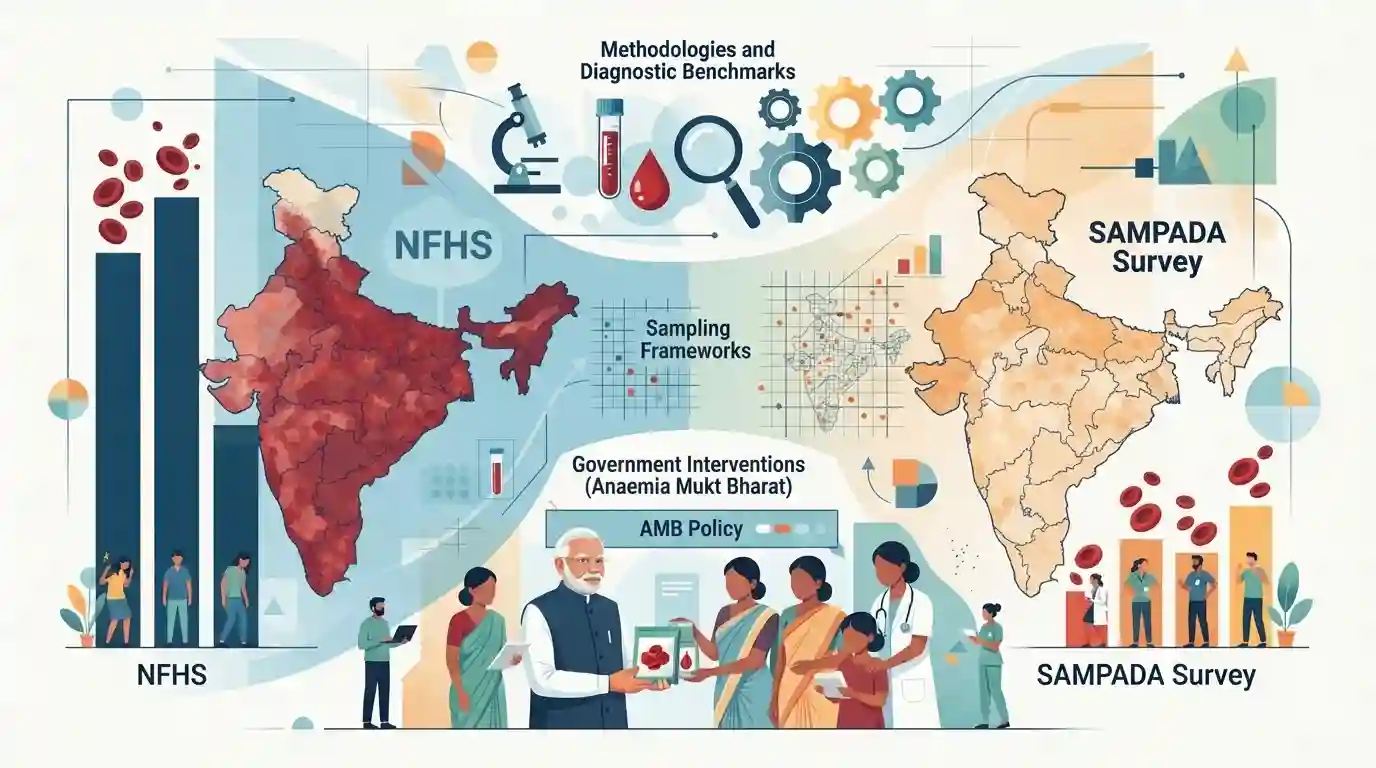
The article discusses findings from the SAMPADA data survey, which reports a lower prevalence of anaemia across India compared to previous benchmark surveys such as the National Family Health Survey (NFHS). Experts note that differing methodologies, diagnostic benchmarks, and sampling frameworks can significantly influence public health metrics, carrying implications for framing national nutrition policies like Anaemia Mukt Bharat.
Key Points
- New survey data from SAMPADA indicates a significantly lower prevalence of anaemia in India compared to historical estimates from surveys like NFHS.
- Discrepancies in health survey data highlight methodological challenges, variations in diagnostic criteria, and sampling differences in measuring public health metrics.
- Accurate estimation of anaemia is crucial for designing targeted nutritional interventions like Anaemia Mukt Bharat and Poshan Abhiyaan.
- Health data discrepancies underscore the need for standardized measurement protocols and robust validation in national health tracking.
Important Terms
SAMPADA

A comprehensive nationally representative health survey conducted by ICMR between 2023 and 2025 using venous blood sampling, revealing lower anaemia prevalence figures than earlier benchmark surveys.
UPSC context
GS Paper II (Health Policies & Data Reliability); tests understanding of public health metrics, health survey methodologies, and nutritional policy framing in India.
Anaemia Mukt Bharat
A flagship national initiative launched by the Ministry of Health and Family Welfare under POSHAN Abhiyaan, utilizing a 6x6x6 strategy to systematically reduce anaemia across vulnerable groups in India.
UPSC context
GS Paper II (Government Interventions & Welfare Schemes); evaluates government strategies targeting malnutrition, maternal-child health, and anaemia eradication.
Poshan Abhiyaan
India's flagship multi-ministerial mission aimed at improving nutritional outcomes for children, pregnant women, and lactating mothers by reducing stunting, undernutrition, anaemia, and low birth weight.
UPSC context
GS Paper II (Human Resource Development & Social Sector Schemes); crucial for questions on converging nutrition interventions and combating malnutrition in India.
National Family Health Survey
A large-scale, multi-round household survey providing critical data on population, health, and nutrition in India, serving as a primary benchmark for tracking health indicators like anaemia.
UPSC context
GS Paper II / GS Paper III (Social Sector Data & Governance); tests the ability to analyze demographic trends, health statistics, and policy formulation.
Prelims Trap
SAMPADA survey data indicates that iron deficiency accounts for 100% of anaemia cases in India.
SAMPADA states iron deficiency accounts for approximately half of the anaemia cases, with vitamin B12 and folate also contributing, not all.
Static Concepts Connected
What are the key differences between capillary blood and venous blood sampling in national health surveys?
- Fluid Dilution: Cellular differences: Capillary blood contains interstitial and intracellular fluid mixed with blood, which can dilute hemoglobin concentrations compared to venous blood.
- Gold Standard: Standardisation: Venous blood collection is considered the clinical gold standard as it avoids tissue fluid contamination and minimizes hemolysis risks.
- NFHS Methodology: Survey impact: Previous NFHS rounds used capillary blood (via finger-prick), whereas studies like SAMPADA utilize venous samples, affecting prevalence comparisons.
Cross-Topic Patterns
Health Data Discrepancies vs. Welfare Targeting
Survey discrepancies between ICMR-NIN findings and NFHS test the government's ability to allocate resources under flagship nutrition schemes like POSHAN Abhiyaan and Anaemia Mukt Bharat.

Expect statement-based questions comparing venous blood (SAMPADA) vs capillary finger-prick (NFHS) methodologies for anaemia estimation.
Linked PYQs · 3
Linked PYQs · 3
- 2023PrelimsGS1
Consider the following statements in the context of interventions being undertaken under Anaemia Mukt Bharat Strategy: 1. It provides prophylactic calcium supplementation for pre-school children, adolescents and pregnant women. 2. It runs a campaign for delayed cord clamping at the time of child-birth. 3. It provides for periodic deworming to children and adolescents. 4. It addresses non-nutritional causes of anaemia in endemic pockets with special focus on malaria, hemoglobinopathies and fluorosis. How many of the statements given above are correct?
- 2017PrelimsGS1
Which of the following are the objectives of 'National Nutrition Mission'? 1. To create awareness relating to malnutrition among pregnant women and lactating mothers. 2. To reduce the incidence of anaemia among young children, adolescent girls and women. 3. To promote the consumption of millets, coarse cereals and unpolished rice. 4. To promote the consumption of poultry eggs. Select the correct answer using the code given below:
- 2024MainsGS2
Poverty and malnutrition create a vicious cycle, adversely affecting human capital formation. What steps can be taken to break the cycle ?
