Foreign Direct Investment in Sammaan Capital by IHC Group
Source:The Hindu ↗
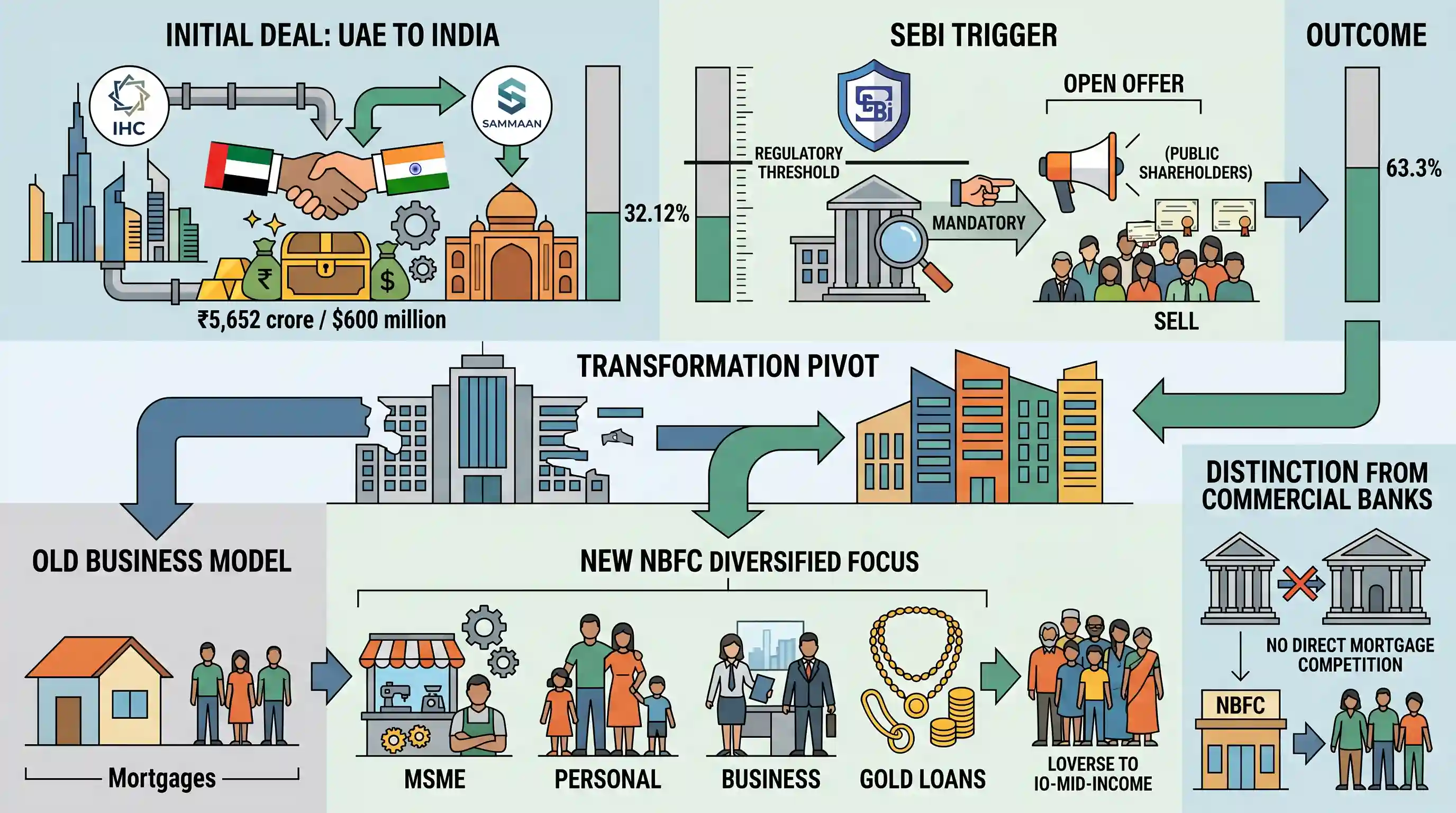
Why It Matters
The acquisition is a prime example of large-scale foreign investment in India's shadow banking sector, illustrating the regulatory mechanics of an 'open offer' and structural shifts in how NBFCs are diversifying their lending portfolios to complement rather than compete with traditional banking.
Summary
UAE-based IHC Group, through its investment arm Avenir Investment RSC Ltd., has agreed to invest ₹5,652 crore ($600 million) in Sammaan Capital Ltd., formerly known as Indiabulls Housing Finance. The deal grants IHC an initial 32.12% stake through preferential shares and warrants, triggering a mandatory open offer under SEBI regulations that could boost its holding up to 63.3%. With this major influx of foreign capital, Sammaan Capital plans to pivot from being primarily a housing finance company to a diversified NBFC, focusing on MSME, personal, business, and gold loans aimed at low- and middle-income segments, rather than competing directly with commercial banks in the mortgage sector.
Key Points
- Sammaan Capital Ltd. (formerly Indiabulls Housing Finance) has secured a massive ₹5,652 crore ($600 million) equity investment from UAE's IHC Group via its investment vehicle, Avenir Investment RSC Ltd.
- The initial preferential allotment of shares and warrants will give IHC a 32.12% stake, triggering an open offer that could raise its ownership to a maximum of 63.3%.
- Sammaan Capital transitioned from an institutional promoter-driven firm to a board-run company in 2023, completely de-promoterising after founder Sameer Gehlaut stepped down.
- With the fresh capital, the NBFC aims to diversify its loan portfolio away from pure housing finance, targeting MSME, personal, business, and gold loans for middle-to-low income borrowers.
- This pivot aligns with a broader industry trend where NBFCs are avoiding direct competition with large commercial banks in traditional home loans.
Important Terms
Non-Banking Financial Company (NBFC)

A financial institution providing banking services without a full license. Regulated by RBI, they cannot accept demand deposits, but play a critical role in credit delivery to underserved segments.
UPSC context
GS Paper 3 (Economy); tests institutional types, financial stability, and regulatory differences from commercial banks.
SEBI (Securities and Exchange Board of India)
The statutory regulator for India's securities and commodity markets. It ensures market transparency and protects investors through regulations like the Substantial Acquisition of Shares and Takeovers (SAST) Code.
UPSC context
GS Paper 3 (Economy); key for understanding capital market regulation and corporate governance.
Mandatory Open Offer
A SEBI-mandated requirement where an acquirer of ≥25% stake in a listed firm must offer to buy an additional ≥26% from public shareholders at a specific price.
UPSC context
GS Paper 3 (Economy); tests knowledge of the Takeover Code and protections for minority shareholders during corporate acquisitions.
Foreign Direct Investment (FDI)
Investment by a foreign entity into an Indian company's productive assets, granting significant control. In the NBFC sector, 100% FDI is allowed via the automatic route.
UPSC context
GS Paper 3 (Economy); essential for understanding external sector capital flows and balance of payments.
India-UAE Strategic Partnership
The deep economic relationship governed by the 2022 Comprehensive Economic Partnership Agreement (CEPA), making the UAE a top trade partner and significant source of FDI for India.
UPSC context
GS Paper 2 (International Relations); evaluates bilateral trade, diaspora impact, and energy-investment ties.
Sammaan Capital Ltd.
Formerly Indiabulls Housing Finance, this major Indian NBFC recently pivoted to a diversified lending model (NBFC-ICC) focusing on MSMEs and retail loans following a major UAE-led capital infusion.
UPSC context
Current Affairs (Economy); a case study in corporate restructuring and sectoral shifts within India's shadow banking system.
Prelims Trap
NBFC depositors enjoy the same DICGC insurance coverage as commercial bank depositors.
NBFCs cannot accept demand deposits, and even their permitted term deposits are explicitly excluded from Deposit Insurance and Credit Guarantee Corporation (DICGC) coverage.
Static Concepts Connected
How do NBFCs legally differ from Commercial Banks in India?
- Demand Deposits: NBFCs are legally prohibited from accepting demand deposits, which include both current and savings accounts.
- Payment System: NBFCs do not form part of the payment and settlement system and cannot issue cheques drawn on themselves.
- Deposit Insurance: Unlike banks, the deposit insurance facility provided by DICGC is not available to the depositors of NBFCs.
What is a Mandatory Open Offer under SEBI regulations?
- Trigger Threshold: It is triggered when an acquirer purchases shares entitling them to 25% or more voting rights in a listed Indian company.
- Offer Requirement: The acquirer must make an open offer to public shareholders to buy at least an additional 26% of total shares at a prescribed price.
- Minimum Public Shareholding: Even after the offer, the company must maintain the 25% Minimum Public Shareholding (MPS) norm to remain listed on the stock exchanges.
Cross-Topic Patterns
Gulf FDI in Indian Financials
Gulf investment vehicles are shifting from traditional infrastructure plays to taking direct, majority stakes in India's shadow banking (NBFC) sector to capitalize on MSME credit growth.
Mortgage market crowding out
With universal banks aggressively dominating the prime home-loan segment, NBFCs are forced to pivot toward riskier, high-yield segments like gold loans and unsecured microcredit to survive.

Expect a 2026 MCQ testing NBFC vs Bank regulatory disparities (DICGC, demand deposits) alongside SEBI's 25% open-offer trigger rules.
Linked PYQs · 3
Linked PYQs · 3
- 2010PrelimsGS1
With reference to the Non-banking Financial Companies (NBFCs) in India, consider the following statements:
- 2024PrelimsGS1
Consider the following statements : 1. In India, Non-Banking Financial Companies can access the Liquidity Adjustment Facility window of the Reserve Bank of India. 2. In India, Foreign Institutional Investors can hold the Government Securities (G-Secs). 3. In India, Stock Exchanges can offer separate trading platforms for debts. Which of the statements given above is/are correct?
- 2016MainsGS3
Justify the need for FDI for the development of the Indian economy. Why there is gap between MOUs signed and actual FDIs? Suggest remedial steps to be taken for increasing actual FDIs in India.
