Political Party Approaches Supreme Court on Electoral Transparency
Source:The Hindu ↗
Why It Matters
The article highlights the ongoing debate on electoral transparency in India, the credibility of electoral rolls, and the usage of EVMs, which are crucial components of GS Paper 2 (Representation of People's Act and Constitutional Bodies). Additionally, the political discourse on replacing health insurance cards like Ayushman Bharat with universal free healthcare relates to issues in the social sector and health policy.
Summary
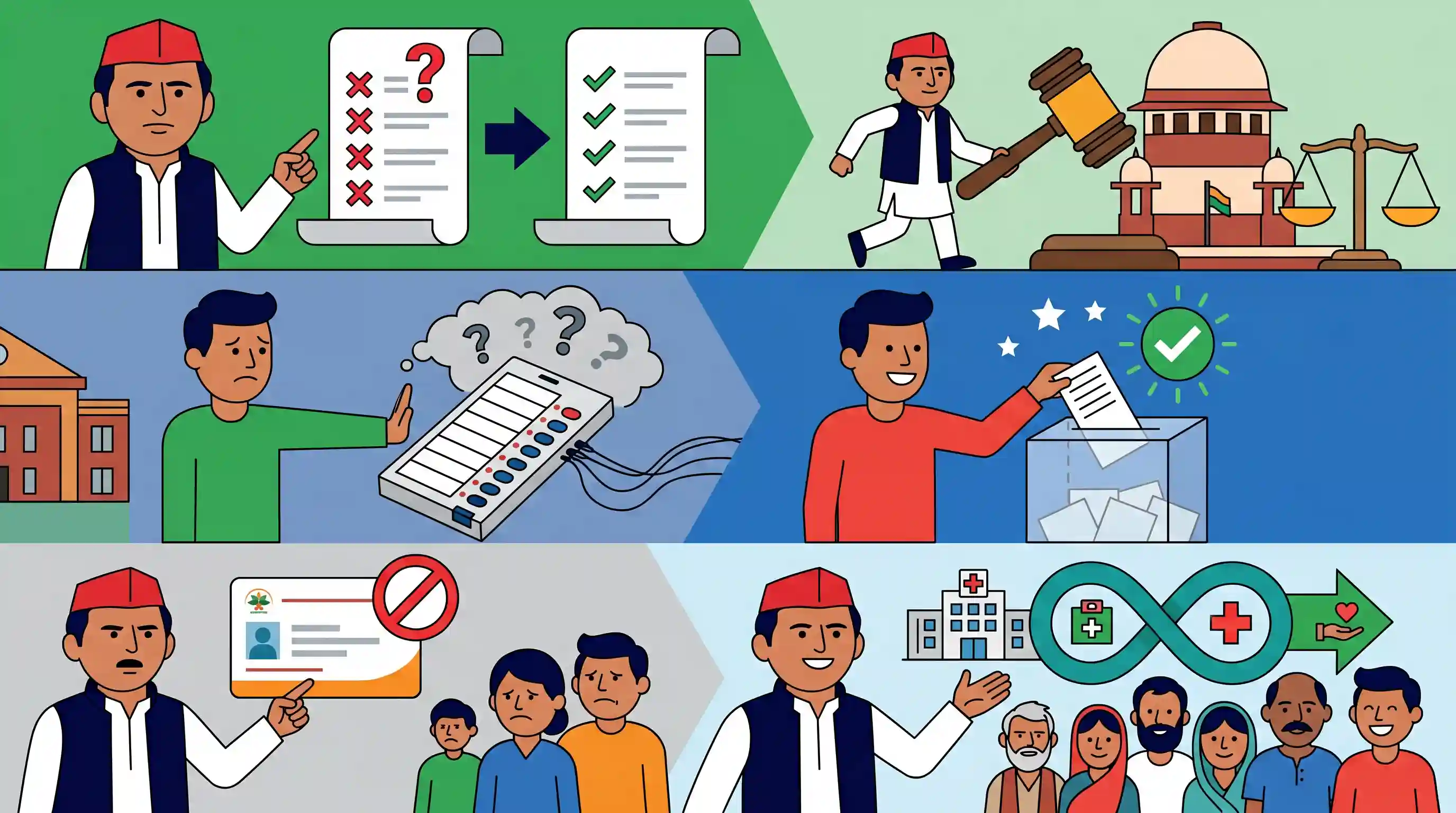
Samajwadi Party President Akhilesh Yadav stated his party's intention to move the Supreme Court to verify the accuracy of the Election Commission's electoral rolls, pointing out discrepancies compared to State Election Commission lists. He voiced concerns over electoral transparency, advocated for a return to ballot papers over EVMs, and discussed potential alliances with the BJD in Odisha. Additionally, he criticized the Ayushman Bharat scheme, proposing that all poor people should receive limitless free medical treatment instead.
Key Points
- Samajwadi Party President Akhilesh Yadav announced plans to approach the Supreme Court to seek verification of electoral rolls, questioning discrepancies between the ECI and State Election Commission lists.
- He criticized the lack of electoral transparency and advocated for a return to ballot papers instead of EVMs, citing examples of Germany and Japan.
- Akhilesh Yadav hinted at a potential political alliance with the BJD in Odisha to counter the BJP.
- He also opposed the concept of the Ayushman Bharat health card, suggesting instead that the government should provide limitless free medical treatment for all poor individuals.
Important Terms
Election Commission of India (ECI)

A permanent constitutional body established under Article 324 to conduct and supervise elections for Parliament, State Legislatures, and the offices of the President and Vice-President.
UPSC context
GS II - Constitutional Bodies. Crucial for understanding electoral integrity, its independence (Anoop Baranwal case), and the conduct of national-level polls.
State Election Commission (SEC)
Independent constitutional bodies created under Articles 243K and 243ZA to supervise, direct, and control the preparation of electoral rolls and the conduct of elections for Panchayats and Municipalities.
UPSC context
GS II - Governance/Decentralization. Tests knowledge of the 73rd and 74th Amendments and the federal distinction between national and local poll management.
Ayushman Bharat (PM-JAY)
The world's largest government-funded health assurance scheme (PM-JAY) providing an annual coverage of ₹5 lakh per family for secondary and tertiary care hospitalization to poor and vulnerable sections.
UPSC context
GS II - Social Justice/Health. Central to discussions on Universal Health Coverage, welfare interventions, and reducing out-of-pocket medical expenditure in India.
Electoral Rolls
The official list of eligible voters in a constituency. Discrepancies between ECI and SEC lists are a major administrative challenge, leading to calls for a "Common Electoral Roll."
UPSC context
GS II - Representation of the People Act. Important for understanding voter registration, preventing disenfranchisement, and the technicalities of electoral administration.
Electoral Reforms
Changes in the electoral system to improve efficiency and transparency, such as addressing voter list discrepancies, regulating political funding (Electoral Bonds), and debating Electronic Voting Machines (EVMs).
UPSC context
GS II - Governance. A core UPSC topic regarding democratic deepening, free and fair elections, and the legislative framework for political accountability.
Judicial Review
The constitutional power of the Supreme Court to examine and invalidate legislative or executive actions that violate the Constitution, often invoked to protect the sanctity of elections.
UPSC context
GS II - Judiciary. Essential for understanding the "check and balance" role of the SC in maintaining electoral transparency and protecting fundamental rights.
Prelims Trap
"State Election Commissions function under the supervisory control of the Election Commission of India."
State Election Commissions are independent constitutional bodies under Articles 243K/243ZA. They are entirely separate from, and do not work under the direction or supervision of, the ECI.
Static Concepts Connected
What is the constitutional divide between the ECI and SECs?
- ECI Mandate: Derives power from Article 324; conducts elections for Parliament, State Legislatures, President, and Vice President.
- SEC Mandate: Derives power from Articles 243K and 243ZA; exclusively conducts elections for Panchayats and Municipalities.
- Institutional Independence: SECs are independent of the ECI. This constitutional separation often leads states to maintain separate electoral rolls for local body polls.
Why is Ayushman Bharat PM-JAY classified as targeted insurance rather than Universal Health Coverage?
- Targeted Demographics: It covers only the bottom 40% of the population (based on SECC data), leaving a vast "missing middle" uninsured.
- Care Scope: Covers secondary and tertiary hospitalization (₹5 lakh/family), omitting outpatient (OPD) care which constitutes the bulk of out-of-pocket expenditure.
- Funding Model: Operates on an insurance/assurance model, unlike the universal, limitless state-provision model envisioned in pure Universal Health Coverage (UHC).
Cross-Topic Patterns
Common Electoral Rolls and ONOE
The push for a Common Electoral Roll requires amending Articles 243K and 243ZA, a constitutional challenge frequently debated alongside the 'One Nation One Election' (ONOE) committee recommendations.
Article 329(b) and Judicial Intervention
The SC's role in reviewing electoral rolls (pre-election) contrasts with Article 329(b), which strictly bars judicial interference once the formal election notification is issued, forcing post-facto election petitions.

Expect a multi-statement Prelims question contrasting the constitutional mandates, appointment processes, and electoral rolls of ECI vs SECs.
Linked PYQs · 5
Linked PYQs · 5
- 2018MainsGS2
In the light of recent controversy regarding the use of Electronic Voting Machines (EVM), what are the challenges before the Election Commission of India to ensure the trustworthiness of elections in India?
- 2022MainsGS2
Discuss the role of the Election Commission of India in the light of the evolution of the Model Code of Conduct.
- 2017MainsGS2
To enhance the quality of democracy in India the Election Commission of India has proposed electoral reforms in 2016. What are the suggested reforms and how far are they significant to make democracy successful?
- 2024MainsGS2
In a crucial domain like the public healthcare system the Indian State should play a vital role to contain the adverse impact of marketisation of the system. Suggest some measures through which the State can enhance the reach of public healthcare at the grassroots level.
- 2015MainsGS2
Public health system has limitations in providing universal health coverage. Do you think that the private sector could help in bridging the gap? What other viable alternatives would you suggest?
