CAR T Cell Therapy Application in Lymphoma Treatment
Source:Indian Express ↗
Why It Matters
UPSC frequently tests knowledge of emerging biotechnologies and health treatments (e.g., T-cells, B-cells, stem cell therapy). CAR T-cell therapy represents a paradigm shift in oncology and genetic engineering, relevant for both Prelims (Basic Science) and Mains (GS3 Science & Technology).
Summary
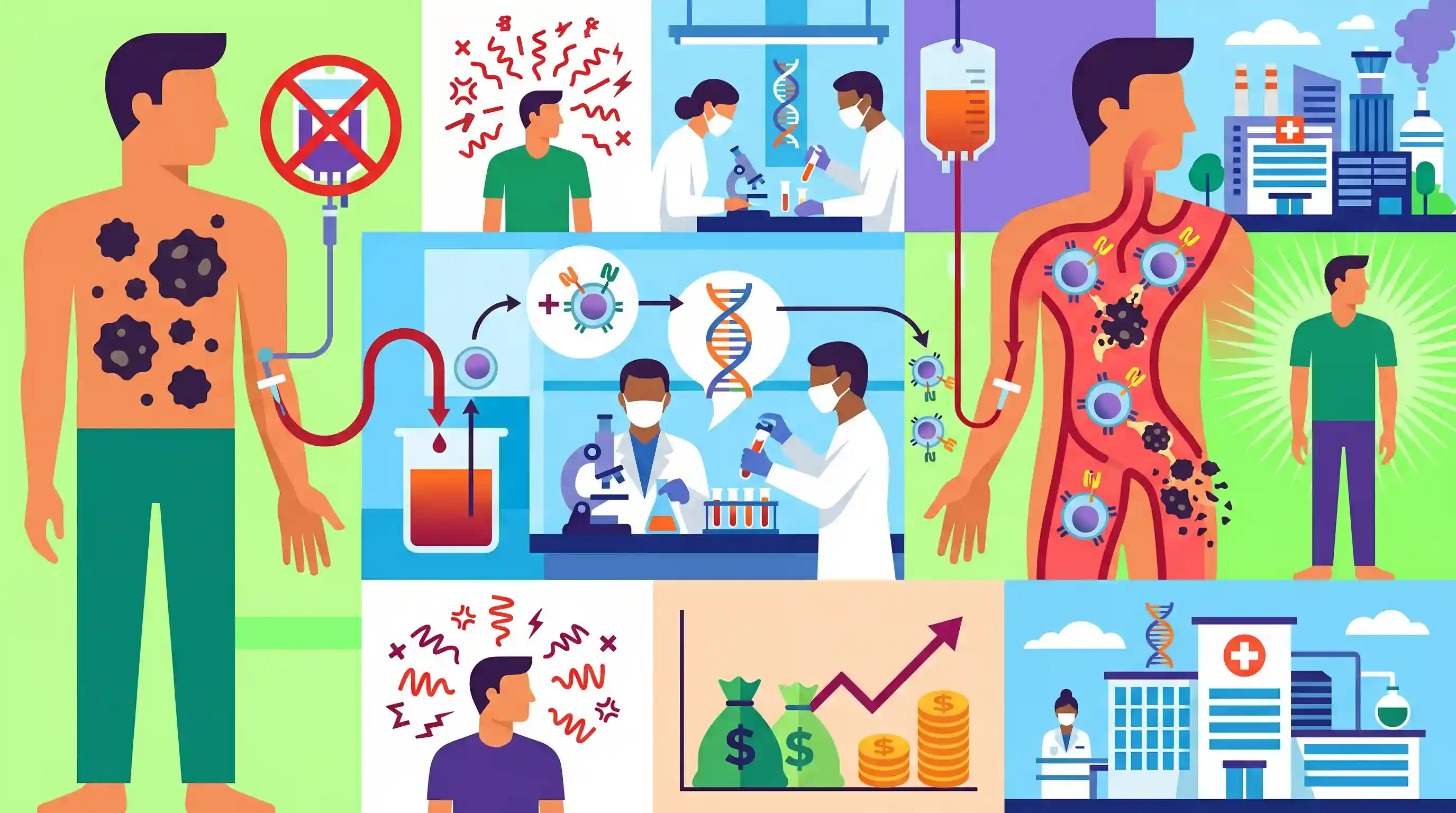
Actor Sam Neill has been declared cancer-free following successful treatment with CAR T-cell therapy for stage-three non-Hodgkin lymphoma, a type of blood cancer. The advanced immunotherapy was utilized after conventional chemotherapy stopped being effective. CAR T-cell therapy works by extracting a patient's T-cells, genetically modifying them in a lab to produce Chimeric Antigen Receptors (CARs) that identify cancer-specific antigens, and re-infusing them to destroy the malignant cells. While highly effective for certain blood cancers, the therapy poses risks such as Cytokine Release Syndrome and is constrained by significant costs and complex infrastructural requirements.
Key Points
- CAR T-cell therapy is an advanced immunotherapy that genetically engineers a patient's own T-cells to specifically target and attack cancer cells.
- It provides a targeted alternative to conventional chemotherapy, particularly for relapsed or refractory blood cancers like non-Hodgkin lymphoma, leukemia, and multiple myeloma.
- Unlike chemotherapy, which attacks all rapidly dividing cells, CAR T-cell therapy reduces generalized toxicity but comes with unique risks such as Cytokine Release Syndrome (CRS) and neurological side effects.
- Accessibility remains a major challenge due to the therapy's exceptionally high cost and the need for specialized medical infrastructure.
Important Terms
CAR T-cell therapy

An immunotherapy where a patient's T-cells are genetically engineered to express Chimeric Antigen Receptors (CARs), enabling them to precisely target and kill specific cancer cells.
UPSC context
GS Paper 3 (Biotechnology); crucial for gene-editing applications and India's 'NexCAR19' indigenous therapy.
NexCAR19
India's first indigenous CAR T-cell therapy developed by IIT Bombay and Tata Memorial Hospital; it targets B-cell cancers at a significantly lower cost than global alternatives.
UPSC context
GS Paper 3 (S&T); essential for "Indigenization of Technology" and healthcare affordability in India.
Immunotherapy
A type of cancer treatment that harnesses or enhances the body's natural immune system to identify and eliminate malignant cells, often sparing healthy tissue.
UPSC context
GS Paper 3 (Health/Science); tests knowledge of biological interventions and modern oncology advancements.
Cytokine Release Syndrome (CRS)
A systemic inflammatory response triggered by the rapid activation of immune cells, causing high fever and organ dysfunction; a common side effect of CAR-T treatments.
UPSC context
GS Paper 3 (S&T); relevant for understanding the clinical risks of advanced biotechnological therapies.
Non-Hodgkin Lymphoma
A group of blood cancers originating in lymphocytes (white blood cells) that grow abnormally in the lymphatic system, distinct from Hodgkin lymphoma by its cell type.
UPSC context
GS Paper 3 (Health); provides context for disease-specific applications of cell-based medical treatments.
T-cells
Specialized white blood cells (lymphocytes) central to the immune response that can directly kill infected or cancerous cells or coordinate other immune defenses.
UPSC context
GS Paper 3 (Biology); foundational concept in immunology frequently tested in Prelims.
Prelims Trap
CAR T-cell therapy is widely used as a primary treatment for all forms of cancer, including solid tumors.
CAR-T therapy is currently approved and primarily effective for blood cancers (leukemia, lymphoma, myeloma). Solid tumors remain a major medical challenge due to their complex microenvironment.
Static Concepts Connected
What are the main differences between T-cells and B-cells?
- T-cells: T-cells are responsible for cell-mediated immunity, directly attacking infected or cancerous cells without relying on antibodies.
- B-cells: B-cells are responsible for humoral immunity, secreting targeted antibodies into the bloodstream to neutralize foreign pathogens.
- Origin & Maturation: Both are types of lymphocytes (white blood cells) originating in the bone marrow, but T-cells mature in the thymus.
How does CAR-T therapy differ from traditional Chemotherapy?
- Mechanism: CAR-T is a targeted 'living drug' utilizing genetically engineered immune cells. Chemotherapy relies on synthetic chemical agents.
- Specificity: CAR-T specifically targets cancer-associated antigens. Chemotherapy non-specifically attacks all rapidly dividing cells, leading to hair loss and weakened immunity.
- Side Effects: CAR-T triggers unique immune-related side effects like Cytokine Release Syndrome (CRS), a severe hyperinflammatory response.
Cross-Topic Patterns
Indigenisation of advanced healthcare
India's indigenous NexCAR19 lowers the cost of CAR-T therapy to a fraction of global prices, intersecting advanced biotechnology with the 'Make in India' and affordable healthcare themes.
Recombinant DNA in Immunotherapy
The lab-modification of T-cells perfectly illustrates the clinical application of recombinant DNA technology, a recurring conceptual area in the UPSC biotechnology syllabus.

Expect a multi-statement Prelims question testing CAR-T therapy's focus on blood cancers, CRS side effects, and use of autologous cells.
Linked PYQs · 4
Linked PYQs · 4
- 2022PrelimsGS1
Which one of the following statements best describes the role of B cells and T cells in the human body?
- 2025PrelimsGS1
With reference to monoclonal antibodies, often mentioned in news, consider the following statements : I. They are man-made proteins. II. They stimulate immunological function due to their ability to bind to specific antigens. III. They are used in treating viral infections like that of Nipah virus. Which of the statements given above are correct?
- 2017MainsGS3
Stem cell therapy is gaining popularity in India to treat a wide variety of medical conditions including Leukaemia, Thalassemia, damaged cornea and severe burns. Describe briefly what stem cell therapy is and what advantages it has over other treatments?
- 2021MainsGS3
What are the research and developmental achievements in applied biotechnology? How will these achievements help to uplift the poorer sections of the society?
