Chhattisgarh Power Plant Boiler Blast Causes Fatalities
Source:The Hindu ↗
Why It Matters
Highlights the critical issue of occupational safety and regulatory enforcement in industrial settings, particularly concerning migrant workers in hazardous industries. It underscores the importance of disaster preparedness, regular safety audits, and corporate accountability in mitigating industrial accidents.
Summary
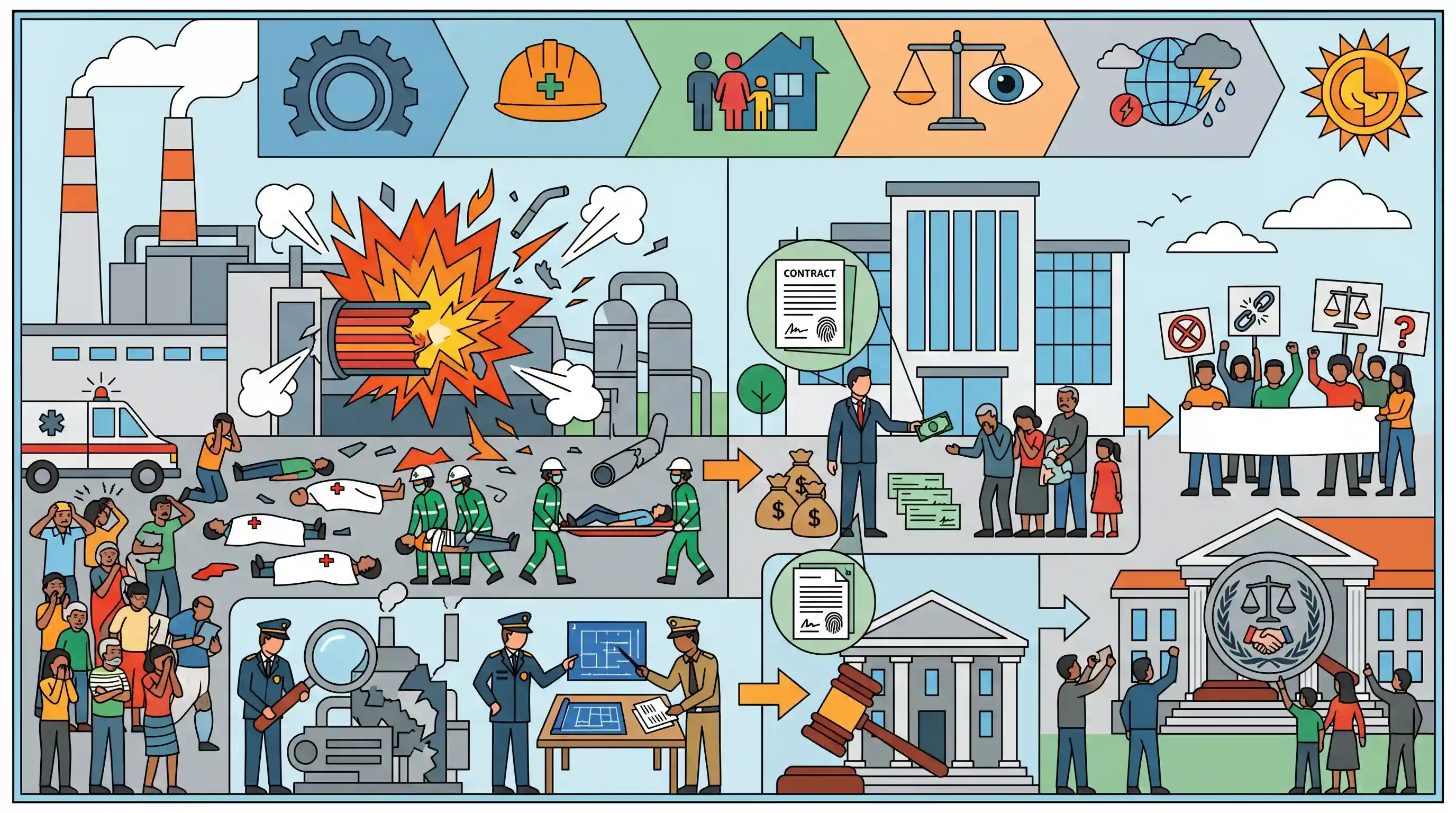
A fatal boiler tube explosion at Vedanta's Singhitarai power plant in Chhattisgarh's Sakti district has claimed the lives of 20 workers and left 16 injured. The victims included local laborers as well as migrant workers from multiple states. Following the incident, the state government ordered a magisterial inquiry to determine if technical or human errors caused the blast and to examine the plant's safety inspection records. Vedanta announced compensation packages for the affected families, while the political opposition demanded a formal judicial probe, criminal charges against management for negligence, and higher compensation. The incident brings critical attention to industrial safety standards, corporate accountability, and the welfare of migrant workers in hazardous environments.
Key Points
- A boiler tube explosion at Vedanta's Singhitarai power plant in Sakti district, Chhattisgarh, has caused the death of 20 workers and injured 16 others.
- The victims included migrant workers from states like West Bengal, Jharkhand, Uttar Pradesh, Bihar, and Madhya Pradesh, as well as local workers.
- A magisterial inquiry has been ordered to investigate the cause of the explosion (technical or human error) and review safety inspections within 30 days.
- Vedanta announced compensation of ₹35 lakh for the families of the deceased and ₹15 lakh for the injured, along with employment and salary support.
- Opposition parties are demanding an FIR, a judicial inquiry, and higher compensation, alleging negligence by the plant management.
Important Terms
Industrial Disaster

Technological or industrial accidents involving hazardous procedures, infrastructural failure, or human activities that result in significant loss of life, injury, and environmental degradation.
UPSC context
GS Paper III (Disaster Management). Tests understanding of man-made disasters, mitigation strategies, and the national disaster response framework.
Occupational Safety, Health and Working Conditions (OSH) Code, 2020
A 2020 legislation consolidating 13 central labor laws to regulate workplace safety, health standards, and welfare across sectors including factories, mines, and construction.
UPSC context
GS Paper II (Governance) and GS Paper III (Economy). Tests knowledge of labor reforms and rights of workers in hazardous environments.
Magisterial Inquiry
A formal fact-finding administrative investigation conducted by an Executive Magistrate to determine the cause of an incident, typically when negligence or foul play is suspected.
UPSC context
GS Paper II (Polity and Governance). Tests understanding of the executive powers of the District Magistrate and administrative accountability.
Absolute Liability
A legal doctrine established by the Supreme Court holding hazardous industries strictly liable for any harm caused, with no exceptions for 'acts of god' or third-party interference.
UPSC context
GS Paper II (Judiciary/Governance). Tests knowledge of landmark judicial doctrines (M.C. Mehta case) and corporate legal accountability.
Inter-State Migrant Workers
Workers who migrate across state lines for employment, protected under specific welfare provisions in the OSH Code 2020, including journey allowances and social security access.
UPSC context
GS Paper II (Social Justice). Tests understanding of issues related to vulnerable sections of society and labor welfare.
Corporate Accountability
The legal and ethical responsibility of corporations to be answerable for their operations' impact on stakeholders, including safety compliance and fair compensation for victims.
UPSC context
GS Paper IV (Ethics and Integrity). Tests the application of ethical standards and responsibility in business management and industrial safety.
Prelims Trap
The Public Liability Insurance Act, 1991 mandates immediate no-fault financial relief for factory workers injured or killed on-site.
The PLI Act of 1991 applies exclusively to third-party individuals (the public) affected by hazardous accidents. Workmen are explicitly excluded as they are covered separately by the Employees' Compensation Act.
Static Concepts Connected
Why are thermal power plants concentrated in Chhattisgarh's Sakti-Korba region?
- Gondwana Coal: The region sits in the Mahanadi river basin, housing massive Gondwana non-coking coal reserves (e.g., Korba and Hasdo-Arand coalfields).
- Water Availability: The Hasdo river (a Mahanadi tributary) provides the massive, uninterrupted water supply required for cooling towers in thermal power generation.
- Power Evacuation: Central India's well-developed grid infrastructure allows for seamless power evacuation to surrounding industrial and mining corridors.
What are the key migrant protections under the OSHWC Code, 2020?
- Benefit Portability: Mandates the portability of Public Distribution System (PDS) benefits via One Nation One Ration Card (ONORC), and construction worker welfare funds.
- Journey Allowance: Employers must provide an annual travel allowance for migrant workers to visit their home state.
- Safety & Grievance: Requires the establishment of toll-free helplines and bipartisan Safety Committees in factories employing 500 or more workers.
Cross-Topic Patterns
Migrant out-migration & Eastern India poverty
Victims originating from Bengal, Bihar, and UP highlight chronic out-migration driven by regional underdevelopment, linking disaster vulnerability directly to demographic and economic disparities.
Labour Codes vs. Industrial Safety standards
The incident underscores the tension between 'Ease of Doing Business'—which promotes compliance easing—and the strict enforcement of mandatory third-party safety audits under the OSHWC Code 2020.

Expect a Prelims question contrasting worker compensation mechanisms (OSHWC Code) with public relief (Public Liability Insurance Act).
Linked PYQs · 5
Linked PYQs · 5
- 2020MainsGS3
Discuss the recent measures initiated in disaster management by the Government of India departing from the earlier reactive approach.
- 2019MainsGS3
Disaster preparedness is the first step in any disaster management process. Explain how hazard zonation mapping will help disaster mitigation in the case of landslides.
- 2018MainsGS3
Describe various measures taken in India for Disaster Risk Reduction (DRR) before and after signing 'Sendai Framework for DRR (2015-2030)'. How is this framework different from Hyogo Framework for Action, 2005?
- 2023MainsGS2
Skill development programmes have succeeded in increasing human resources supply to various sectors. In the context of the statement analyse the linkages between education, skill and employment.
- 2020MainsGS2
In order to enhance the prospects of social development, sound and adequate health care policies are needed particularly in the fields of geriatric and maternal health care. Discuss.
