MCD initiates sealing drive against illegal structures after collapse
Source:The Hindu ↗
Why It Matters
The incident highlights the critical challenges of rapid urbanization, illegal construction, and the enforcement gap in municipal governance. It serves as a stark case study for GS2 (Accountability of Urban Local Bodies) and GS3 (Urban Disasters/Infrastructure Safety).
Summary
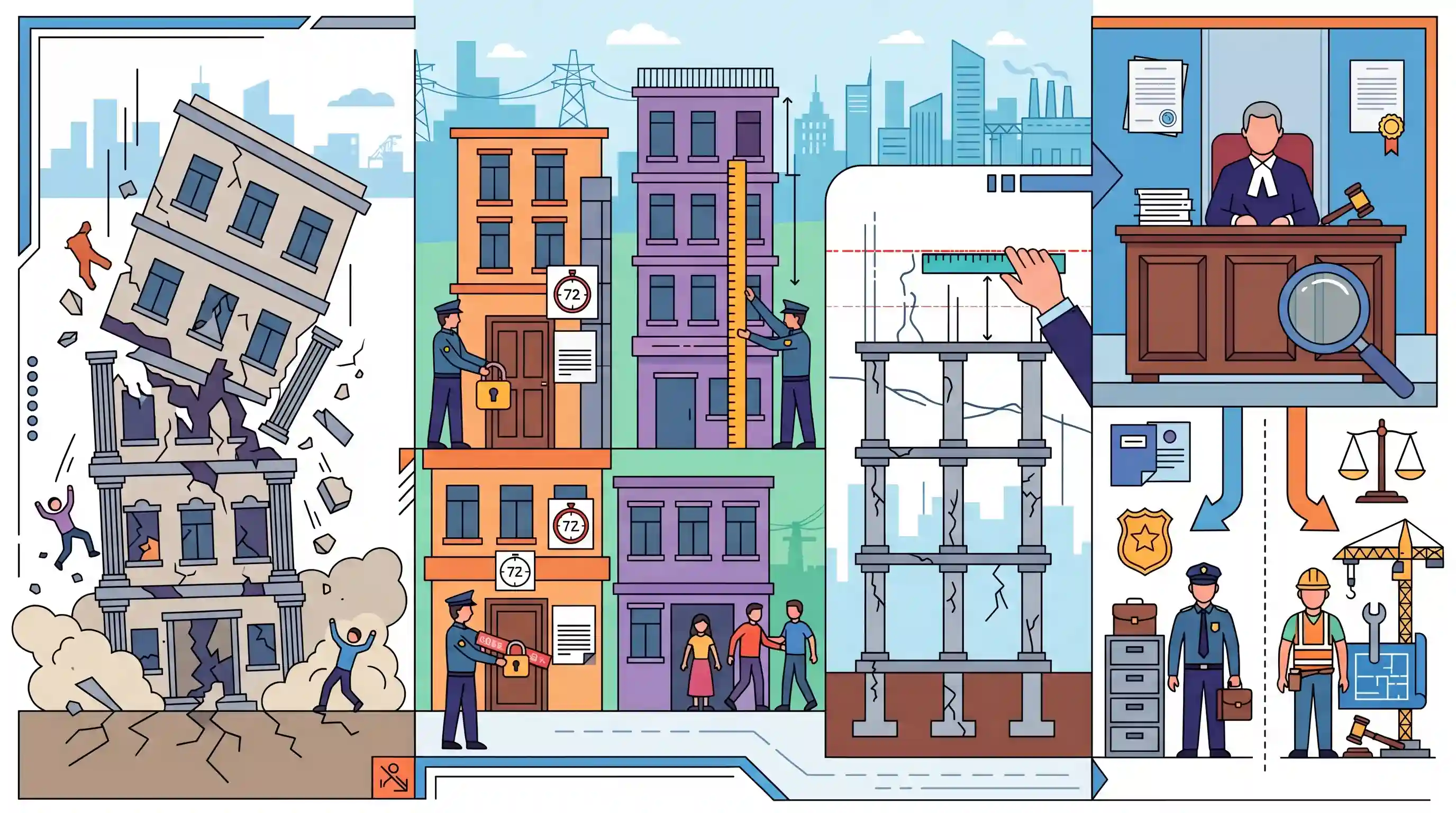
Following a multi-storey building collapse in Saket that claimed six lives, the Municipal Corporation of Delhi (MCD) has initiated a widespread drive against illegal structures in south Delhi. Properties violating building bye-laws, specifically those exceeding the authorized Ground plus three (G+3) floor limit, face sealing or eviction after a 72-hour notice period. The incident has prompted the Delhi government to order a magisterial inquiry, aiming to investigate the structural failure and ensure strict accountability for administrative negligence among local officials and builders.
Key Points
- A tragic building collapse in Saket's Saidulajab area resulting in six fatalities has triggered strict enforcement actions by the Municipal Corporation of Delhi (MCD).
- The MCD has launched a seal-and-vacate drive targeting illegal and unauthorized structures across south Delhi that violate municipal building bye-laws.
- Properties with unauthorized construction, particularly those exceeding the permitted Ground plus three (G+3) limit, will face sealing or eviction following a 72-hour notice.
- Delhi Chief Minister Rekha Gupta ordered a magisterial inquiry to investigate the collapse, emphasizing the need to fix accountability for administrative negligence at all levels.
Important Terms
Municipal Corporation of Delhi (MCD)

The unified local body responsible for municipal services in Delhi, established under the Delhi Municipal Corporation Act, 1957, and governed by elected councillors.
UPSC context
GS-II (Polity); tests understanding of local self-government, unification of urban bodies, and administrative decentralization in the national capital.
Building Bye-Laws
A set of legal regulations governing the planning, design, and construction of buildings to ensure structural safety, public health, and urban order.
UPSC context
GS-III (Infrastructure/Disaster Management); tests knowledge of urban planning frameworks and the regulatory role of local authorities in preventing disasters.
Magisterial Inquiry
An administrative fact-finding probe conducted by an executive magistrate to investigate incidents of public concern, such as accidents or administrative negligence.
UPSC context
GS-II (Governance); tests understanding of the executive’s role in ensuring accountability and the distinction from judicial inquiries.
Urban Local Bodies (ULBs)
Institutional frameworks at the city level, given constitutional status by the 74th Amendment, tasked with urban planning, public health, and infrastructure maintenance.
UPSC context
GS-II (Devolution of Powers); tests awareness of grassroots democracy, fiscal autonomy, and challenges in urban governance.
74th Constitutional Amendment Act
The 1992 legislation that constitutionally recognized urban local bodies, adding the 12th Schedule to empower them with 18 specific functional responsibilities.
UPSC context
GS-II (Polity); foundational for questions on democratic decentralization and the empowerment of municipalities in India.
Structural Integrity
The ability of a building or structure to withstand its intended load and environmental stressors without failure, a core focus of construction regulations.
UPSC context
GS-III (Disaster Management); tests knowledge of proactive safety measures and the consequences of administrative lapses in infrastructure monitoring.
Prelims Trap
"The MoHUA Model Building Bye Laws 2016 are legally binding and directly enforced across all Municipal Corporations."
Urban planning and local government are State subjects. The MoHUA's Model Building Bye Laws are advisory frameworks; states must adopt or modify them.
Static Concepts Connected
What are the key functional items entrusted to municipalities under the 12th Schedule?
- Urban Planning: Urban planning, including town planning, regulation of land-use, and the construction of buildings.
- Development & Slums: Planning for economic and social development, along with slum improvement and poverty alleviation.
- Public Health: Public health, sanitation, conservancy, solid waste management, and the provision of urban amenities like parks.
What are the core structural and administrative focuses of the Model Building Bye-Laws 2016?
- Structural Safety: Mandates strict adherence to the National Building Code for resilience against natural hazards like earthquakes.
- Ease of Approvals: Recommends single-window clearance for building approvals to reduce delays, opacity, and associated corruption.
- Environmental Integration: Integrates green building norms, mandatory rainwater harvesting, and solar rooftop installations for sustainable urbanization.
Cross-Topic Patterns
Urban structural failures and urban flooding
Bypassing building bye-laws doesn't just cause collapses; unauthorized construction over drains/wetlands is the primary driver of urban flooding, linking infrastructure safety directly to climate resilience.
Ethics: Collusive corruption in civic bodies
This scenario is a classic GS Paper 4 case study: collusive corruption between real estate builders and municipal officials leading to loss of life and a crisis of accountability.

Expect a Prelims question on the 12th Schedule's specific provisions paired with State vs Union jurisdiction over urban master plans.
Linked PYQs · 3
Linked PYQs · 3
- 2024MainsGS2
Analyse the role of local bodies in providing good governance at local level and bring out the pros and cons merging the rural local bodies with the urban local bodies.
- 2023MainsGS2
“The states in India seem reluctant to empower urban local bodies both functionally as well as financially.” Comment.
- 2024MainsGS3
Flooding in urban areas is an emerging climate-induced disaster. Discuss the causes of this disaster. Mention the features of two such major floods in the last two decades in India. Describe the policies and frameworks in India that aim at tackling such floods.
