Tiger Translocation and Biodiversity Augmentation in Western Ghats
Source:Indian Express ↗
Why It Matters
Wildlife translocation programs like TARA are vital for maintaining genetic diversity and reviving predator populations in depleted habitats. This provides excellent case studies for UPSC questions on in-situ conservation, the geography of Western Ghats protected areas, and the use of technology (telemetry) in wildlife monitoring.
Summary
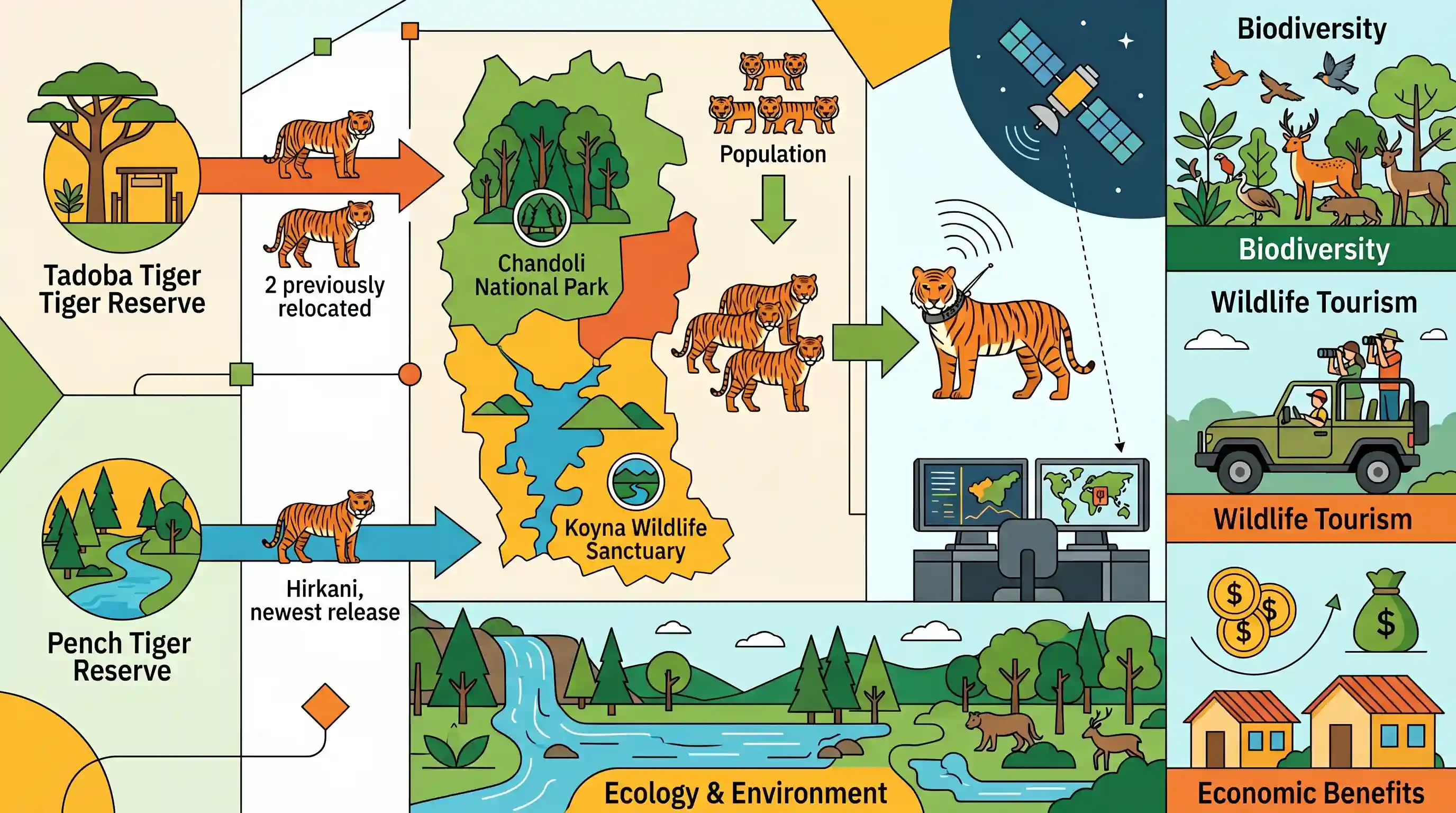
The Maharashtra Forest Department has released a third tigress, named Hirkani, into the Koyna Wildlife Sanctuary of the Sahyadri Tiger Reserve (STR) under the Tiger Augmentation and Range Expansion (TARA) programme. Translocated from the Pench Tiger Reserve in Madhya Pradesh, Hirkani joins two other tigresses previously relocated from the Tadoba Tiger Reserve to Chandoli National Park. The initiative is designed to increase the tiger population in STR, which previously housed only three male tigers. Officials expect the augmentation to enhance regional biodiversity, stimulate local wildlife tourism, and provide economic benefits. The tigresses are monitored continuously using radio collars with satellite telemetry to ensure their safety and ecological adaptation.
Key Points
- A third tigress, Hirkani, was translocated from Pench Tiger Reserve to Koyna Wildlife Sanctuary in the Sahyadri Tiger Reserve (STR) as part of the TARA programme.
- The TARA (Tiger Augmentation and Range Expansion) programme aims to repopulate tiger reserves with low tiger densities, thereby strengthening local biodiversity and boosting wildlife tourism.
- STR encompasses Chandoli National Park, Koyna Wildlife Sanctuary, and Radhanagari Wildlife Sanctuary across Satara, Sangli, Kolhapur, and Ratnagiri districts in Maharashtra.
- Relocated tigresses are tracked using radio collars equipped with satellite-based telemetry and VHF antennas to monitor their movement, resting sites, and integration into the new ecosystem.
Important Terms
Tiger Augmentation and Range Expansion (TARA) programme

A Maharashtra state initiative (Operation TARA) aimed at repopulating under-occupied habitats by translocating tigers from high-density reserves to regions like Sahyadri to restore ecological balance.
UPSC context
GS Paper III (Environment); focuses on innovative species recovery strategies and habitat restoration in biodiversity hotspots.
Sahyadri Tiger Reserve (STR)
A tiger reserve in Maharashtra's Western Ghats comprising Koyna Wildlife Sanctuary and Chandoli National Park; it is a UNESCO World Heritage site noted for historically low resident tiger populations.
UPSC context
GS Paper III (Protected Areas); tests knowledge of geographical locations and conservation challenges in the Western Ghats.
Koyna Wildlife Sanctuary
A protected area in Maharashtra’s Satara district forming the northern part of STR; it surrounds the Shivsagar reservoir and is designated as an Important Bird Area (IBA).
UPSC context
GS Paper III (Biodiversity); relevant for Prelims (locations/endemic species) and Mains (dam-wildlife ecosystem management).
Tiger Translocation
The scientific relocation of tigers between reserves to enhance genetic diversity, repopulate locally extinct areas, and mitigate human-wildlife conflict in saturated source habitats.
UPSC context
GS Paper III (Conservation); tests the ecological rationale and administrative role of the NTCA in wildlife management.
Soft Release
A reintroduction method where translocated animals are temporarily held in an acclimatization enclosure to adapt to local terrain and prey before full release into the wild.
UPSC context
GS Paper III (Environment); covers technical methodologies in wildlife rewilding and improving survival rates of reintroduced species.
Satellite Telemetry
The use of GPS-equipped radio collars to remotely monitor an animal's real-time movements and ecological adaptation, essential for ensuring the safety of translocated wildlife.
UPSC context
GS Paper III (S&T/Environment); focuses on the application of modern technology in conservation monitoring and anti-poaching.
Prelims Trap
"The Sahyadri Tiger Reserve is situated within the Central Indian Tiger Landscape."
Sahyadri TR is in the Western Ghats. Aspirants may incorrectly link it to Central India because the tigers are being brought in from Pench and Tadoba (Central Indian landscape).
Static Concepts Connected
Which protected areas and geographical features characterize the Sahyadri Tiger Reserve?
- Koyna and Chandoli: The reserve was formed by amalgamating the Koyna Wildlife Sanctuary in the north and the Chandoli National Park in the south.
- Sadas Plateaus: The ecosystem features unique flat-topped, barren rocky lateritic plateaus locally known as 'Sadas', which hold immense ecological value.
What does the 'soft release' method entail in large carnivore translocation?
- Acclimatization enclosure: Translocated animals are initially kept in a temporary, controlled enclosure at the new destination rather than being freed immediately into the wild.
- Adaptation purpose: This allows the carnivore to familiarize itself with the local climate, terrain, and prey base, significantly improving survival and habitat fidelity.
Cross-Topic Patterns
Ecological contiguity and wildlife corridors
The Sahyadri-Konkan Corridor connects Sahyadri TR to Karnataka's Kali TR and Bhimgad WLS. UPSC frequently tests the inter-state contiguity and connecting landscapes of protected networks.
Satellite telemetry in wildlife tracking
The use of VHF antennas and satellite telemetry ties conservation efforts to S&T applications, similar to past UPSC questions on M-STrIPES and radio-collar tracking limitations.

Expect a 2026 Prelims map question testing the north-to-south geographical alignment of Pench, Tadoba, Koyna, and Chandoli reserves.
Linked PYQs · 4
Linked PYQs · 4
- 2021PrelimsGS1
The term 'ACE2' is talked about in the context of
- 2017PrelimsGS1
Recently there was a proposal to translocate some of the lions from their natural habitat in Gujarat to which one of the following sites?
- 2019PrelimsGS1
Which of the following are in Agasthyamala Biosphere Reserve?
- 2017PrelimsGS1
From the ecological point of view, which one of the following assumes importance in being a good link between the Eastern Ghats and the Western Ghats?
