West Bengal Assembly Election Results and Regional Political Shifts
Source:Indian Express ↗
Why It Matters
The article serves as a crucial case study for understanding regional political shifts, the role and controversies surrounding the Election Commission's electoral roll revisions, and the ongoing tension between state welfare distribution and capital investment for economic growth.
Summary
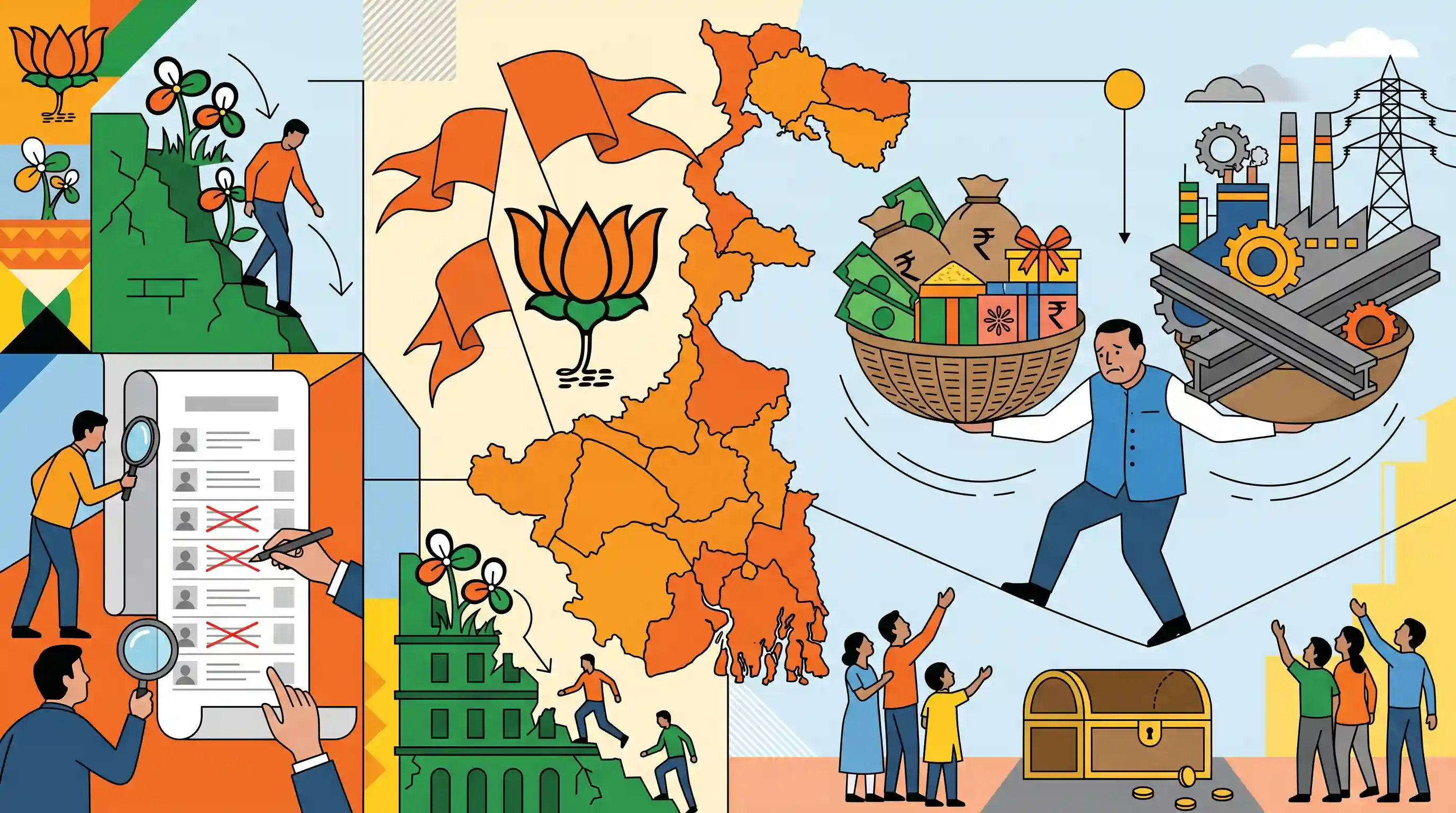
An analysis of the BJP's decisive victory in the 2026 West Bengal assembly elections, examining contributing factors such as controversial electoral roll revisions, TMC's anti-incumbency, and the fiscal challenges of balancing welfare promises with the need for capital investment.
Key Points
- The BJP secured a two-thirds majority in the 2026 West Bengal assembly elections, marking a historic rightward shift in a state historically dominated by liberal and left ideologies.
- The "Special Intensive Revision" (SIR) of electoral rolls led to the controversial deletion of approximately 34.35 lakh voters, many of whom successfully appealed the decision.
- The TMC's loss was driven by 15 years of local anti-incumbency, corruption allegations, leadership complacency, and the urban backlash from the RG Kar movement.
- The BJP mobilized a broad social alliance across castes and focused its campaign on education, health, and security issues, along with promises of increased cash transfers.
- The new government faces the significant fiscal challenge of funding welfarist promises, such as the seventh pay commission, while simultaneously needing to attract capital investment in manufacturing and services.
Important Terms
Election Commission of India (ECI)

A permanent constitutional body (Article 324) responsible for directing and controlling elections to Parliament and State Legislatures. It manages voter registration, polling schedules, and ensures fair electoral processes.
UPSC context
GS Paper II: Constitutional Bodies and Electoral Reforms (powers and functions).
Ayushman Bharat (PM-JAY)
National flagship health insurance scheme providing ₹5 lakh annual coverage per family for secondary/tertiary care. It targets beneficiaries using the Socio-Economic Caste Census (SECC) 2011 criteria.
UPSC context
GS Paper II: Social Justice and Welfare Schemes for vulnerable sections.
Enforcement Directorate (ED)
Specialized financial investigation agency under the Ministry of Finance. It enforces the Prevention of Money Laundering Act (PMLA) and handles violations of foreign exchange laws (FEMA).
UPSC context
GS Paper III: Internal Security (Money Laundering) and GS Paper II: Governance.
All India Trinamool Congress (TMC)
A major regional political party in India, founded in 1998 by Mamata Banerjee. It dominated West Bengal politics for 15 years before losing the 2026 assembly elections.
UPSC context
GS Paper II: Political Parties and Regional Aspirations in federalism.
Seventh Pay Commission
A central panel that reviewed and recommended salary and allowance revisions for public servants. Its implementation at the state level is a significant fiscal and political issue.
UPSC context
GS Paper III: Economic Development and State Finances (fiscal management).
Rashtriya Swayamsevak Sangh (RSS)
An Indian right-wing, Hindu nationalist volunteer organization that serves as the ideological fountainhead for the BJP and influences social and political narratives through its affiliates.
UPSC context
GS Paper II: Pressure Groups and Formal/Informal Associations.
Prelims Trap
Electoral rolls and voter registrations are prepared under the provisions of the Representation of the People Act, 1951.
RPA 1950 governs the preparation and revision of electoral rolls, whereas RPA 1951 governs the actual conduct of elections and dispute resolution.
Static Concepts Connected
How do RPA 1950 and RPA 1951 differ in electoral governance?
- RPA 1950: Governs allocation of seats, delimitation of constituencies, voter qualifications, and the preparation of electoral rolls.
- RPA 1951: Governs the actual conduct of elections, candidate qualifications/disqualifications, corrupt practices, and resolution of electoral disputes.
What is the fiscal trilemma facing Indian states?
- Revenue Expenditure: Funding committed, non-asset-creating liabilities like salaries, pensions, and welfarist cash transfers.
- Capital Expenditure: The critical need to invest in physical infrastructure and asset creation to attract manufacturing and services.
- Debt Sustainability: Balancing welfare and capex without breaching state FRBM deficit targets or necessitating excessive market borrowing.
Cross-Topic Patterns
State Welfare vs FRBM Limits
The expansion of direct cash transfers in state elections directly tests the Article 293 borrowing limits enforced by the Centre to maintain state FRBM compliance.
Algorithmic Voter Deletions and ECI
Large-scale voter deletions during intensive revisions link to ongoing syllabus debates on the ECI's deduplication software, Aadhaar-voter ID linkage, and the statutory Right to Vote.

Expect a multi-statement prelims question on RPA 1950 provisions regarding electoral roll preparation and ECI's revision powers in 2026.
Linked PYQs · 5
Linked PYQs · 5
- 2024MainsGS2
Examine the need for electoral reforms as suggested by various committees with particular reference to "one nation one election" principle.
- 2022MainsGS2
Discuss the role of the Election Commission of India in the light of the evolution of the Model Code of Conduct.
- 2022MainsGS2
“While the national political parties in India favour centralisation, the regional parties are in favour of State autonomy.” Comment.
- 2020MainsGS3
Explain the meaning of investment in an economy in terms of capital formation. Discuss the factors to be considered while designing a concession agreement between a public entity and a private entity.
- 2024MainsGS3
Examine the pattern and trend of public expenditure on social services in the post-reforms period in India. To what extent this has been in consonance with achieving the objective of inclusive growth?
