Ethnic Violence and Reconciliation in Northeast India
Source:The Hindu ↗
Why It Matters
Provides a critical case study on internal security, state administration breakdown, and conflict resolution mechanisms in sensitive border states. It is highly relevant for GS3 Internal Security questions focusing on North-East India challenges, and GS1 Society questions addressing ethnic and tribal diversity.
Summary
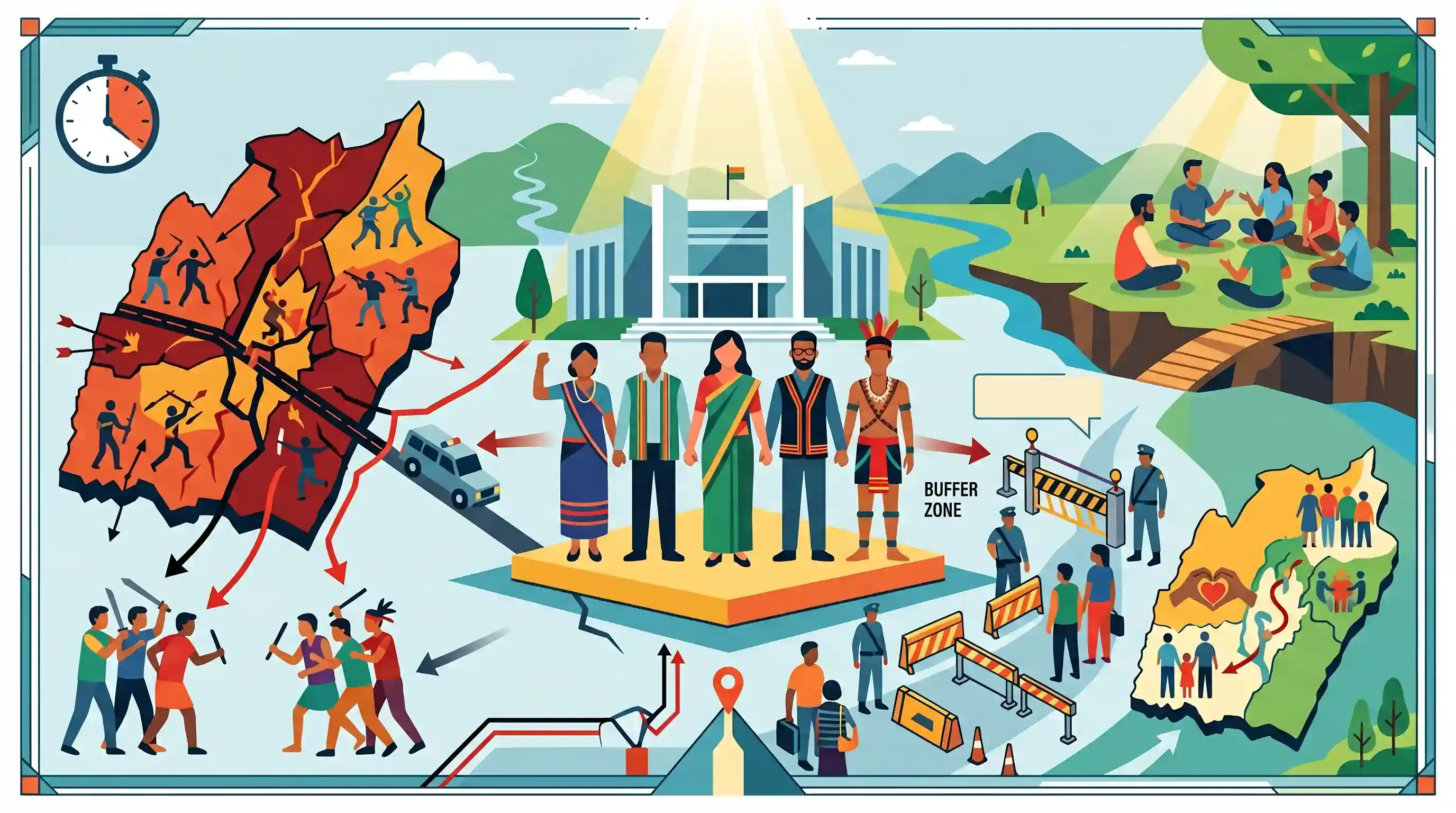
The editorial assesses the formation of a new, inclusive government in Manipur following two years of ethnic violence and President's Rule. Despite the milestone of appointing leaders from the Meitei, Kuki-Zo, and Naga communities—including the state's first female Deputy Chief Minister—the ground reality remains highly volatile. With new clashes emerging between different tribal groups and deep-seated mistrust preventing elected officials from freely traveling within the state, the article argues that prioritizing physical safety via 'buffer zones' is essential. Ultimately, achieving lasting peace in the troubled Northeastern state will require significant empathy, truth, and reconciliation efforts across its fractured communities.
Key Points
- Manipur has formed a new representative government encompassing leaders from the three dominant ethnic groups (Meiteis, Kuki-Zos, and Nagas) following a period of President’s Rule.
- Nemcha Kipgen, from the Kuki-Zo community, became Manipur’s first woman Deputy Chief Minister, but took her oath virtually from Kangpokpi due to security concerns preventing her travel to Imphal.
- The state remains deeply divided by violence that erupted on May 3, 2023, resulting in over 250 deaths and the displacement of more than 60,000 people.
- Recent violent skirmishes have also broken out between Kuki-Zo and Naga communities, further complicating the internal security matrix.
- The immediate focus must remain on basic physical safety and maintaining inter-community 'buffer zones', but a long-term approach requires empathy, truth, and a comprehensive healing touch.
Important Terms
President's Rule (Article 356)

Constitutional provision allowing the Union to assume control of a state's administration if its constitutional machinery fails, as recently seen in Manipur.
UPSC context
GS II/Polity: Tests knowledge of emergency provisions, federalism, and judicial safeguards like the S.R. Bommai case.
Buffer Zones
Demarcated sensitive areas patrolled by central security forces to physically separate warring ethnic communities and prevent direct physical confrontation during civil unrest.
UPSC context
GS III/Internal Security: Tests understanding of ground-level conflict management and the socio-political impact of de facto internal borders.
Meitei Community
The majority ethnic group in Manipur, primarily residing in the Imphal Valley, whose demand for Scheduled Tribe (ST) status became a major conflict flashpoint.
UPSC context
GS I/Society: Relevant for North-East ethnic dynamics, identity politics, and the debate over Scheduled Tribe criteria.
Kuki-Zo Community
Hill-dwelling tribal groups in Manipur, including various sub-tribes, who opposed the Meitei ST demand and have since sought separate administrative arrangements.
UPSC context
GS III/Internal Security: Pertains to tribal sub-nationalism, border security, and the management of multi-ethnic internal conflicts.
Truth and Reconciliation Commission (TRC)
An official mechanism or commission focused on uncovering historical wrongdoings to facilitate transitional justice and social healing in post-conflict societies.
UPSC context
GS II/Governance: Important for peace-building strategies and restorative justice in disturbed regions like J&K or Manipur.
Article 355
A constitutional mandate requiring the Union to protect states from external aggression and internal disturbances, ensuring states follow the Constitution.
UPSC context
GS II/Polity: Tests the distinction between the Union's "duty" (355) and its "power" (356) during internal crises.
Prelims Trap
"Manipur's tribal hill districts are governed under the Sixth Schedule of the Indian Constitution."
Manipur is excluded from the Sixth Schedule (which covers Assam, Meghalaya, Tripura, Mizoram). Its tribal areas are protected via Hill Area Committees under Article 371C.
Static Concepts Connected
What are the special provisions for Manipur under Article 371C of the Constitution?
- Hill Area Committee: The President may provide for the creation of a committee of the Legislative Assembly consisting of members elected from the Hill Areas.
- Governor's Special Responsibility: The Governor holds special responsibility to secure the proper functioning of this committee and reports directly to the President regarding hill administration.
- Union Executive Power: The executive power of the Union extends to giving directions to the State government regarding the administration of these Hill Areas.
What is the difference between 'Negative Peace' and 'Positive Peace' in conflict resolution?
- Negative Peace: The mere absence of direct physical violence or war. In Manipur, this translates to maintaining militarized 'buffer zones' to physically separate warring factions.
- Positive Peace: The presence of structural harmony, social justice, and inclusive governance. It requires truth and reconciliation, addressing deep-seated historical grievances to build sustainable trust.
Cross-Topic Patterns
Fundamental Rights vs. ILP regimes
The ethnic divide intersects with ILP regulations in Manipur, testing the balance between Article 19(1)(d) (freedom of movement) and the constitutional protection of indigenous tribal demographics.
Federalism & CAPF buffer zones
Prolonged CAPF-enforced 'buffer zones' blur the constitutional boundaries of law and order (State list) versus internal security (Union mandate), sparking asymmetric federalism debates.

Expect a 2026 Prelims question mapping Article 371 (A-J) provisions, contrasting Manipur's 371C with 6th Schedule AMTM states.
Linked PYQs · 4
Linked PYQs · 4
- 2025MainsGS3
What are the major challenges to internal security and peace process in the North-Eastern States? Map the various peace accords and agreements initiated by the government in the past decade.
- 2022MainsGS1
Given the diversities among tribal communities in India, in which specific contexts should they be considered as a single category ?
- 2019MainsGS3
Cross-border movement of insurgents is only one of the several security challenges facing the policing of the border in North-East India. Examine the various challenges currently emanating across the India-Myanmar border. Also, discuss the steps to counter the challenges.
- 2017MainsGS3
The North-East region of India has been infested with insurgency for a very long time. Analyze the major reasons for the survival of armed insurgency in this region.
