APPCB stresses circular economy for environmental conservation
Source:The Hindu ↗
Why It Matters
The article highlights key governance and policy priorities—such as the circular economy, 'Waste to Wealth', and alternative energy transition—that are frequent topics in the GS3 Environment and Economy syllabus. It reinforces the importance of community participation and regulatory frameworks in pollution mitigation.
Summary
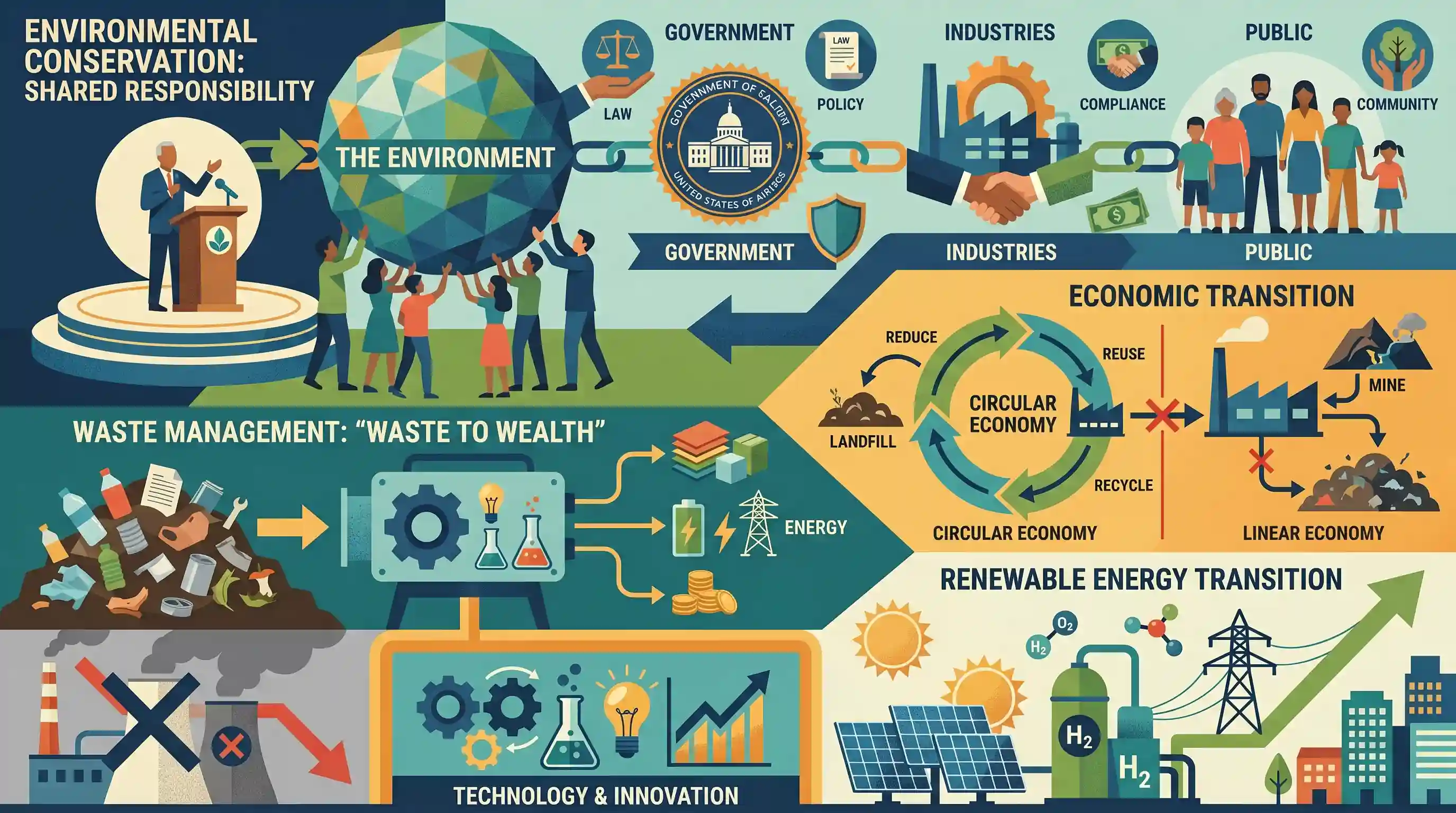
At a seminar organized by SRM University-AP, APPCB Chairman P. Krishnaiah emphasized that environmental conservation is a shared responsibility requiring collaboration between government, industries, and the public. He advocated for the transition from a linear economy to a circular economy and the implementation of a 'Waste to Wealth' policy for effective waste management. Furthermore, Krishnaiah highlighted the critical role of technology and innovation in adopting alternative energy sources, such as solar and green hydrogen, to replace conventional thermal energy.
Key Points
- APPCB Chairman P. Krishnaiah emphasized that safeguarding the environment requires a collaborative effort among the government, industries, and the community.
- Technological innovation is identified as a key driver for environmental protection, facilitating the shift from thermal energy to alternative sources like solar and green hydrogen.
- The article underscores the necessity of transitioning from a traditional linear economy to a sustainable circular economy.
- Implementation of the \'Waste to Wealth\' policy and proper waste management are highlighted as critical steps for resource conservation.
Important Terms
Circular Economy

An economic system focused on resource efficiency by keeping materials in use through reuse, repair, and recycling, rather than discarding them as waste.
UPSC context
GS Paper 3: Environmental conservation and sustainable development; essential for questions on waste management and resource efficiency.
Waste to Wealth Mission
One of nine PM-STIAC missions aiming to identify and deploy technologies for recovering energy and valuable materials from waste to support Swachh Bharat and sustainable growth.
UPSC context
GS Paper 3: Science and Technology; covers government initiatives for environmental sustainability and urban waste management.
Green Hydrogen
Hydrogen produced through water electrolysis powered by renewable energy sources, serving as a zero-emission fuel for decarbonizing heavy industries like steel and refineries.
UPSC context
GS Paper 3: Infrastructure and Energy; critical for India's National Green Hydrogen Mission and net-zero targets.
Andhra Pradesh Pollution Control Board (APPCB)
A statutory body established under the Water Act, 1974, responsible for enforcing environmental laws, monitoring pollution levels, and granting industrial operating consents in Andhra Pradesh.
UPSC context
GS Paper 2: Statutory and regulatory bodies; tests knowledge of environmental governance and the Water/Air Acts.
Linear Economy
The traditional industrial model based on a "take-make-dispose" pattern, where raw materials are extracted, processed into products, used, and then discarded as waste.
UPSC context
GS Paper 3: Economic development and Environment; often contrasted with sustainable models in mains answers.
Prelims Trap
State Pollution Control Boards (SPCBs) were established under the Environment (Protection) Act, 1986.
SPCBs (and the CPCB) were actually established under the Water (Prevention and Control of Pollution) Act, 1974, not the EPA 1986.
Static Concepts Connected
How are Central and State Pollution Control Boards legally constituted?
- Water Act 1974: Both CPCB and SPCBs were initially established under the Water (Prevention and Control of Pollution) Act, 1974.
- Air Act 1981: They were subsequently entrusted with additional powers and functions under the Air (Prevention and Control of Pollution) Act, 1981.
- EPA 1986 Role: They act as nodal agencies to enforce various rules (e.g., e-waste, hazardous waste) notified under the Environment (Protection) Act, 1986.
How is the "shared responsibility" of environmental protection enshrined in the Constitution?
- Article 48A (DPSP): Directs the State to protect and improve the environment and safeguard forests and wildlife (added by the 42nd Amendment, 1976).
- Article 51A(g): Makes it a fundamental duty of every citizen to protect and improve the natural environment, including forests, lakes, rivers, and wildlife.
Cross-Topic Patterns
Shared Responsibility & Mission LiFE
The APPCB chief's emphasis on community collaboration for environmental protection perfectly mirrors India's global 'Mission LiFE' (Lifestyle for Environment), bridging local waste management with international climate commitments.
Green Hydrogen + E-Waste Ecosystems
Scaling green hydrogen requires massive deployment of electrolyzers, which rely on critical minerals. E-waste recovery via 'Waste to Wealth' policies links the renewable energy transition directly to circular economy targets.

Expect a multi-statement question mixing SPCB statutory origins (Water Act vs EPA) with their mandate on circular economy and waste rules.
Linked PYQs · 3
Linked PYQs · 3
- 2020MainsGS3
Describe the benefits of deriving electric energy from sunlight in contrast to the conventional energy generation. What are the initiatives offered by our Government for this purpose?
- 2024MainsGS3
Industrial pollution of river water is a significant environmental issue in India. Discuss the various mitigation measures to deal with this problem and also the government's initiatives in this regard.
- 2013MainsGS3
Write a note on India's green energy corridor to alleviate the problem of conventional energy.
