New agricultural waste to energy plant commissioned in Rajasthan
Source:renewable-watch ↗
Why It Matters
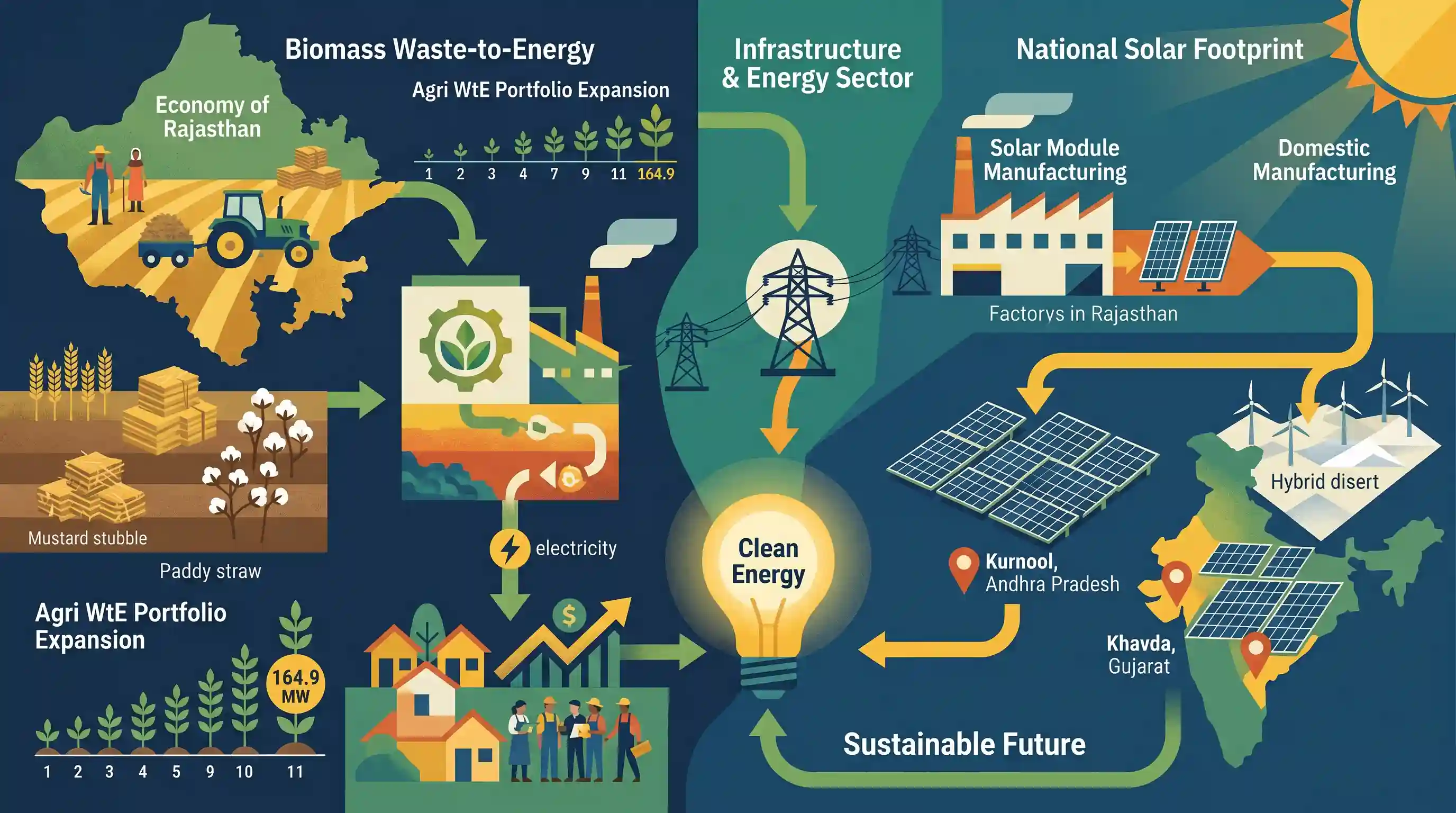
Biomass and bioenergy projects are crucial for Rajasthan due to the abundance of agricultural residues like mustard stalks and cotton stalks. Such waste-to-energy initiatives generate green power, boost farmers' income through the sale of agro-waste, and mitigate environmental challenges like stubble burning. It directly correlates with Rajasthan's economic development and renewable energy goals.
Summary
SAEL Industries Limited (SIL) has successfully commissioned a 14.9 MW agricultural waste-to-energy (WtE) plant in Bhadra, Rajasthan, through its subsidiary VCA Power Private Limited. This project expands SIL's operational bioenergy portfolio to 11 plants with a cumulative capacity of 164.9 MW. The expansion highlights the state's significant biomass potential derived from agro-residues. Additionally, SIL has boosted its national solar footprint with recent commissioning of massive solar plants in Kurnool (Andhra Pradesh) and Khavda (Gujarat), leveraging solar modules manufactured domestically in Rajasthan and Punjab.
Key Points
- SAEL Industries Limited (SIL), through VCA Power Private Limited, commissioned a 14.9 MW agri waste-to-energy (WtE) plant in Bhadra, Rajasthan in June 2026.
- With this addition, SIL now operates 11 Agri WtE plants across the country, with a combined bioenergy capacity of 164.9 MW.
- The project supports Rajasthan's massive potential for biomass energy, which utilizes agricultural residue such as mustard and cotton stalks to produce clean energy while preventing stubble burning.
- In addition to its bioenergy initiatives, SIL commissioned a 600 MWac solar capacity in Kurnool, Andhra Pradesh (April 2026), utilizing bifacial TOPCon modules manufactured at its facilities in Rajasthan and Punjab.
- In January 2026, SIL commissioned an 800 MWac (1 GWp) solar project at Khavda Renewable Energy Park in Gujarat under a 25-year Power Purchase Agreement (PPA) with GUVNL.
Important Terms
PM-KUSUM Scheme

A Ministry of New and Renewable Energy initiative launched in 2019 to provide water and energy security to farmers by solarising agriculture, including installing solar pumps and setting up grid-connected solar power plants on barren lands.
UPSC context
GS Paper 3: Agriculture and Energy. Tests understanding of agricultural sustainability, farmer income-support, and rural electrification policies.
Rajasthan Solar Energy Policy 2019
A state government policy implemented to harness Rajasthan's vast solar potential, targeting 30,000 MW of solar power capacity by 2024–25 through utility-scale parks, distributed generation, solar pumps, and rooftop solar projects.
UPSC context
GS Paper 3: Infrastructure and Energy. Tests knowledge of state-level policy frameworks driving India's transition to renewable energy.
Gujarat Urja Vikas Nigam Limited (GUVNL)
A state-owned holding company coordinating bulk electricity procurement, transmission, and distribution in Gujarat. It plays a key role in integrating massive renewable energy capacities and securing long-term power purchase agreements.
UPSC context
GS Paper 3: Infrastructure and Utilities. Tests understanding of public sector electricity distribution, sector reforms, and renewable energy integration.
SAEL Industries Limited (SIL)
An Indian renewable energy developer specializing in agricultural waste-to-energy, utility-scale solar generation, and solar module manufacturing, active in utilizing crop residues like paddy straw to reduce air pollution and generate clean power.
UPSC context
GS Paper 3: Environment and Infrastructure. Tests understanding of private sector contributions to biomass and agro-waste management.
Prelims Trap
TOPCon bifacial solar cells utilize traditional p-type silicon and generate power independent of ground surface albedo.
TOPCon represents advanced n-type (not p-type) silicon technology. Because these modules are bifacial, their rear-side yield is highly dependent on ground albedo (reflectivity).
Static Concepts Connected
What is Biomass Energy and what are its key feedstocks in India?
- Definition: Organic material converted into electricity, heat, or biofuels through combustion, pyrolysis, or gasification.
- Feedstocks: Agricultural residues (mustard/cotton stalks, paddy straw) and fast-growing woody plants or invasive species like Prosopis juliflora.
- Key benefits: Mitigates crop-residue burning (reducing air pollution), provides decentralized baseload power, and offers farmers supplementary income.
What are the three core components of the PM-KUSUM Scheme?
- Component A: Decentralized grid-connected renewable energy power plants (0.5 MW to 2 MW) set up on farmers' barren or fallow land.
- Component B: Installation of standalone off-grid solar-powered agricultural pumps to replace diesel pumps.
- Component C: Solarisation of existing grid-connected agricultural pumps, including feeder-level solarisation to enhance grid stability.
Cross-Topic Patterns
Invasive species + Circular bioeconomy
Utilizing invasive species like Prosopis juliflora for biomass power converts an ecological threat (dryland biodiversity degradation) into a socio-economic resource.
Solar manufacturing + Trade protectionism
Domestic manufacturing of high-efficiency TOPCon modules is driven by India's Approved List of Models and Manufacturers (ALMM) and tariff barriers against imports.

Tech-focused solar questions in 2026 will likely target TOPCon n-type vs p-type silicon mechanics alongside decentralized PM-KUSUM targets.
Linked PYQs · 2
Linked PYQs · 2
- 2012RPSC_PRELIMSGS1
Rajasthan has a great potential for biomass energy because -
- 2023RPSC_PRELIMSGS1
Which agency has been given the responsibility of implementing the PM-KUSUM scheme (Component A) in Rajasthan, which involves the establishment of solar power plants with a capacity of 0.5 MW to 2 MW?
