Allahabad High Court hears plea on medical college reservations
Source:verdictum ↗
Why It Matters
Relevant for UPPSC aspirants tracking state-level judicial rulings, reservation policies in educational institutions, and administrative governance in Uttar Pradesh.
Summary
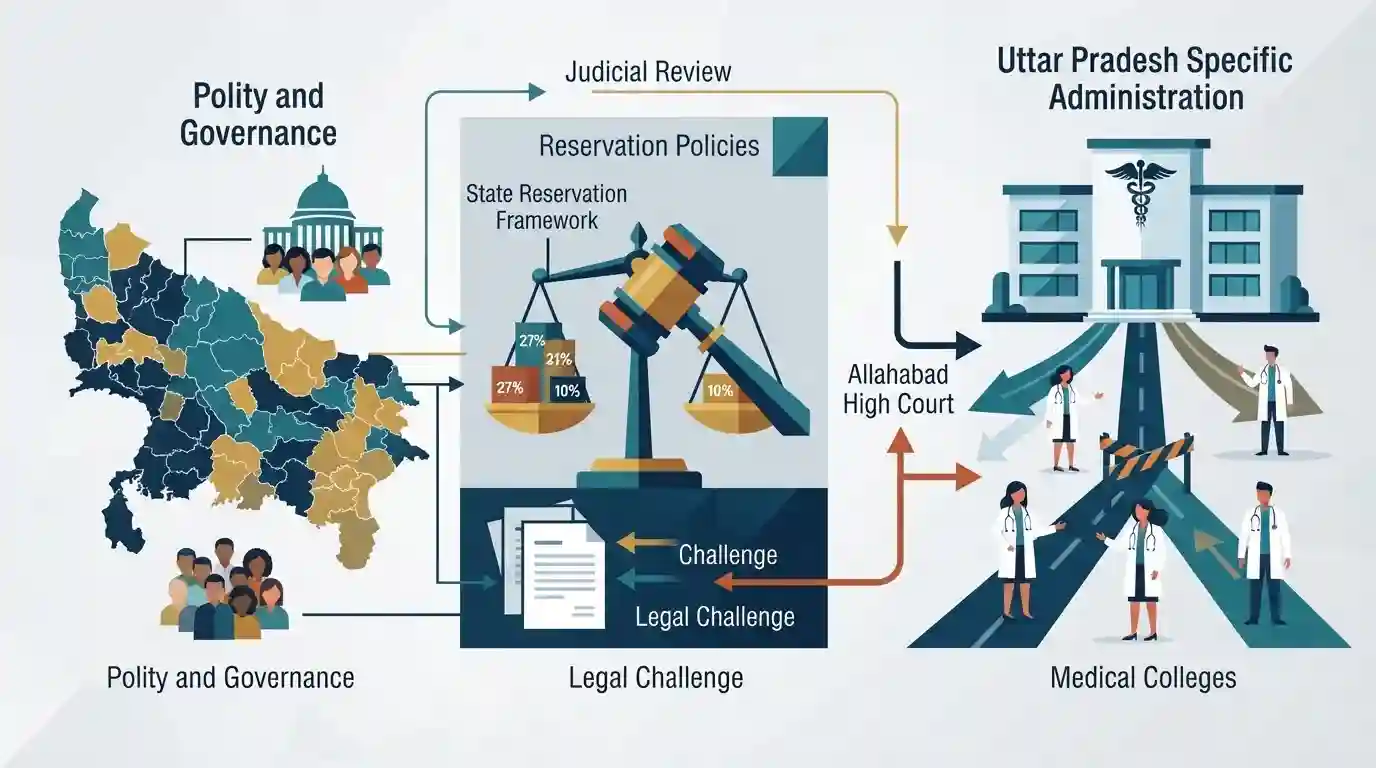
An overview of the legal challenge in the Allahabad High Court regarding state government orders on reservations in medical colleges within Uttar Pradesh (Sachin Singh and Another v. State of UP), touching upon judicial review and state reservation frameworks.
Key Points
- The Allahabad High Court heard a writ petition (Sachin Singh and Another v. State of UP) challenging government orders regarding reservations in medical colleges.
- The case involves critical legal examination of reservation policies, state government executive orders, and admissions/seat allocations in medical institutions within Uttar Pradesh.
- Highlights the intersection of constitutional rights, judicial review under Article 226, and affirmative action policies in medical education in UP.
Important Terms
Allahabad High Court

The highest judicial body in Uttar Pradesh, exercising original and appellate jurisdiction over civil and criminal matters, and empowered under Article 226 to issue writs for the enforcement of fundamental rights.
UPSC context
UPSC GS Paper II (Indian Judiciary, State Administration, Judicial Review, and Constitutional Writs). Tests understanding of high court rulings on state executive actions.
Uttar Pradesh Admission to Educational Institutions (Reservation for SC, ST and OBC) Act, 2006
The statutory framework governing quotas for Scheduled Castes, Scheduled Tribes, and Other Backward Classes in professional and educational institutions across Uttar Pradesh.
UPSC context
UPSC GS Paper II (Polity and Governance - Reservation Policies, Statutory Acts, Social Justice). Tests knowledge of state-level affirmative action limits.
Prelims Trap
Executive orders modifying reservation quotas can bypass the UP Admission to Educational Institutions Act, 2006.
Aspirants often assume executive orders of the State Cabinet carry the same statutory weight as a legislative enactment without checking statutory conformity.
Static Concepts Connected
What are the statutory reservation percentages stipulated under the Uttar Pradesh 2006 Reservation Act?
- Scheduled Castes: SC Quota is 21 percent for Scheduled Castes in state educational institutions.
- Scheduled Tribes: ST Quota is 2 percent for Scheduled Tribes in state educational institutions.
- Other Backward Classes: OBC Quota is 27 percent for Other Backward Classes as per the 2006 enactment.
Cross-Topic Patterns
Article 226 & State Executive Overreach
Judicial review under Article 226 frequently intersects with administrative law when state executive orders override established legislative reservation percentages.
UP Reservation Act & Constitutional Ceilings
Uttar Pradesh reservation frameworks are bound by both statutory state acts and overarching Supreme Court caps on affirmative action quotas.

UPPSC often tests specific statutory reservation percentages and Article 226 writ jurisdictions in administrative law questions.
Linked PYQs · 2
Linked PYQs · 2
- 2023UPPSC_PRELIMSGS1
Consider the following statements concerning the powers of the Supreme Court to issue certain writs to stop violation of Fundamental Rights – (1) The Supreme Court has power to issue writs like Habeas Corpus, Mandamus, Prohibition, Quo Warranto and Certiorari which is appropriate for the enforcement of Fundamental Rights. (2) Parliament may by law empower any other court to exercise within its jurisdiction the powers given to Supreme Court. Which of the above mentioned statement/statements is/are correct? Select the correct answer from the code given below –
- 2019UPPSC_PRELIMSGS1
Given below are two statements, one is labelled as Assertion (A) and the other as Reason (R). Assertion (A): The Supreme Court of India has exclusive jurisdiction regarding Constitutional validity of Central laws. Reason (R): The Supreme Court is the Guardian of the Indian Constitution.
