Railway board extends Sabarmati Jammu Tawi express up to Katra
Source:desh-gujarat ↗
આ શા માટે મહત્વનું છે
Understanding developments in transport infrastructure, such as the extension of railway routes to significant pilgrimage centers, is crucial for tracking India's evolving connectivity network and its impact on domestic tourism and regional integration.
સારાંશ
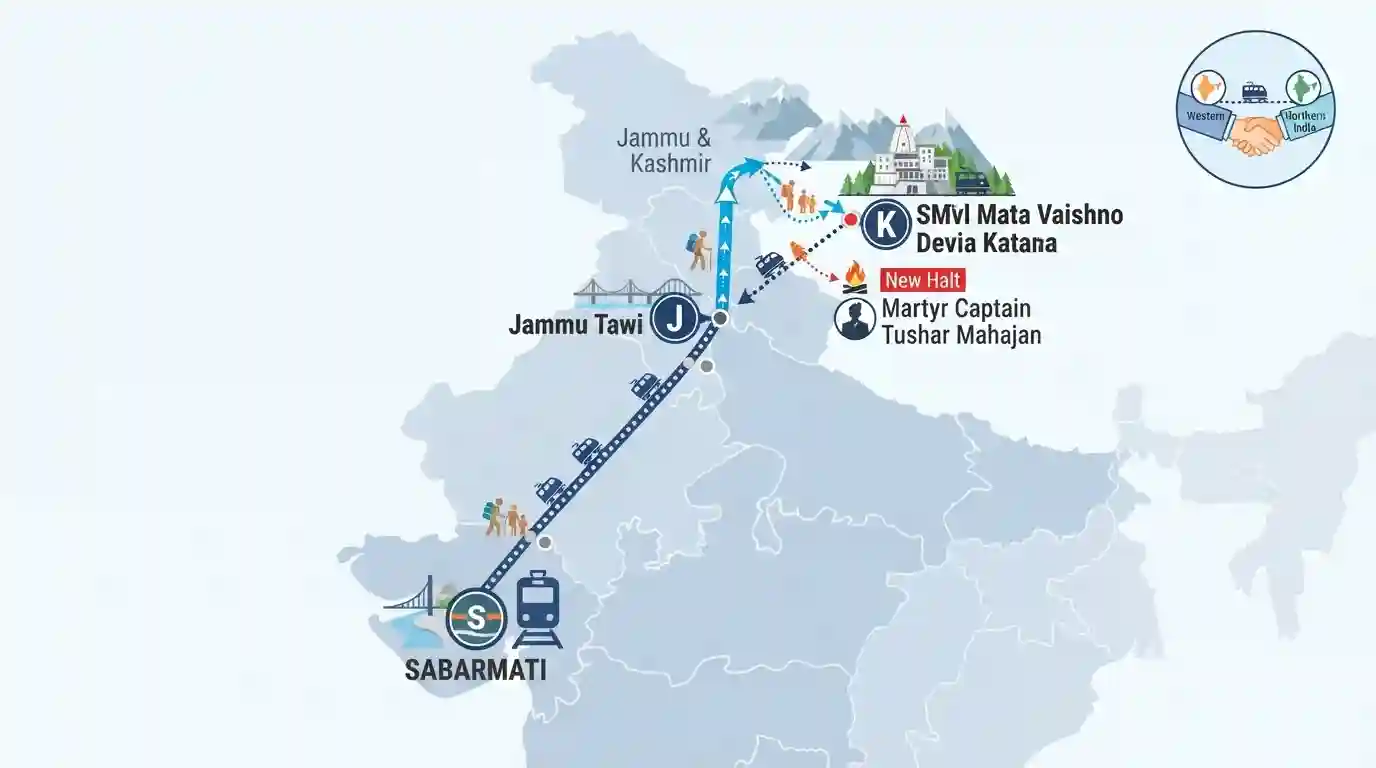
The Railway Board has approved the extension of the Sabarmati–Jammu Tawi Express to Shri Mata Vaishno Devi Katra (SMVD Katra), significantly boosting direct rail connectivity between Gujarat and the major pilgrimage site in Jammu & Kashmir. The revised route includes a new halt at the Martyr Captain Tushar Mahajan station, necessitating schedule adjustments for several stations along the line. This infrastructural update facilitates enhanced religious tourism and strengthens regional transportation links between western and northern India.
મુખ્ય મુદ્દા
- The Railway Board has officially approved the extension of the Sabarmati–Jammu Tawi Express (Train No. 19223/19224) up to Shri Mata Vaishno Devi Katra (SMVD Katra).
- The train will feature a new 8-minute halt at the Martyr Captain Tushar Mahajan station, located between Jammu Tawi and Katra.
- The extension facilitates direct and convenient rail connectivity from Gujarat to the prominent pilgrimage destination of Vaishno Devi in Jammu & Kashmir.
- The Railway Board has worked out schedule adjustments for several stations along the route to accommodate the new extended journey timings.
મહત્વપૂર્ણ શબ્દો
Railway Board

The apex administrative and executive body of Indian Railways. It operates under the Ministry of Railways and is headed by a Chairman & CEO alongside members overseeing infrastructure, operations, rolling stock, and finance.
UPSC context
GS-II (Governance) and GS-III (Infrastructure). Tests knowledge of administrative restructuring, specifically the shift to the unified Indian Railway Management Service (IRMS).
Shri Mata Vaishno Devi Katra Station
A major transport hub in Jammu and Kashmir situated on the Jammu-Baramulla line. It serves as the terminal railhead connecting millions of pilgrims nationwide directly to the Vaishno Devi shrine.
UPSC context
GS-I (Places in News) and GS-III (Infrastructure). Highlights border region connectivity, regional transport development, and religious tourism integration.
Martyr Captain Tushar Mahajan Station
The newly renamed Udhampur railway station in Jammu & Kashmir. It honors Captain Tushar Mahajan of the 9 PARA Special Forces, who was martyred during a 2016 Pulwama terror attack.
UPSC context
GS-I (Places in News) and GS-III (Internal Security). Reflects national integration initiatives and honors armed forces personnel.
Pilgrimage Tourism
Travel undertaken primarily for religious motives. In India, it is a significant sector driving regional economic development, hospitality, and targeted infrastructure projects like the expansion of direct rail networks.
UPSC context
GS-I (Indian Culture) and GS-III (Economy). Tests the understanding of tourism as a catalyst for regional economic growth and employment generation.
Indian Railways
The national railway system operated by the Ministry of Railways. As one of the world's largest rail networks, it acts as the primary transport infrastructure driving India's socio-economic integration.
UPSC context
GS-III (Infrastructure). Tests awareness of transportation networks, their economic impact, regional connectivity targets, and administrative reforms.
પ્રિલિમ્સ ટ્રેપ
"The Shri Mata Vaishno Devi shrine is located in the Pir Panjal range of the Himalayas."
The Vaishno Devi shrine is geographically located in the Trikuta Mountains, which are part of the Shivalik Range (Outer Himalayas), not the Pir Panjal.
સંલગ્ન સ્થિર ખ્યાલો
What are the key engineering landmarks of the USBRL project?
- Chenab Bridge: The world's highest railway bridge arching over the Chenab river in Jammu and Kashmir.
- Anji Khad Bridge: India's first cable-stayed railway bridge connecting Katra and Reasi across the rugged Himalayan terrain.
- Pir Panjal Tunnel: One of India's longest railway tunnels, facilitating crucial all-weather connectivity to the Kashmir Valley.
What are the core features of the PRASHAD Scheme?
- Objective: Launched by the Ministry of Tourism for integrated infrastructure development of identified pilgrimage and heritage destinations.
- Funding: It is a Central Sector Scheme with 100% funding from the Government of India for public components.
- Target Sites: Katra is a targeted destination under the scheme to boost sustainable religious tourism and pilgrim facilities.
આંતર-વિષય પેટર્ન
PRASHAD + Border Infrastructure
The push for all-weather rail connectivity to Himalayan shrines overlaps strategically with border infrastructure goals and the PRASHAD scheme's mandate for integrated religious tourism.
Himalayan seismicity + Mega-Engineering
Projects like USBRL face unique challenges in the young fold-mountain geology of the Himalayas, requiring Zone-V seismic compliance for structures like the Chenab bridge.

Expect a Prelims pair-matching question linking Himalayan shrines (Vaishno Devi, Amarnath) to their specific sub-ranges or river valleys.
સંલગ્ન PYQ · 3
સંલગ્ન PYQ · 3
- 2026GPSC_PRELIMSGS1
Consider the following statements regarding India's inland water transport infrastructure: 1. National Waterway 1 (NW-1) is the longest navigable inland waterway in the country, extending from Prayagraj to Haldia along the Ganga-Bhagirathi-Hooghly river system. 2. The Jal Marg Vikas Project (JMVP), implemented with technical and financial assistance from the World Bank, is primarily focused on capacity augmentation of the Brahmaputra River (NW-2). 3. The West Coast Canal (NW-3) maintains a highly consistent navigable draft year-round, facilitated by the natural topography of estuarine backwaters (Koyals) in Kerala. Which of the above statement/s is/are correct?
- 2025GPSC_PRELIMSGS1
A key technical feature of the "One Nation - One Grid - One Frequency" system in India is
- 2024GPSC_PRELIMSGS1
Pairs showing prominent temples and States in which they are located are mentioned below. | Name of the temple | State | |---|---| | 1. Rameshwaram Temple | a. Uttarakhand | | 2. The Jagannath Puri Temple | b. Andhra Pradesh | | 3. The Tirumala Venkateswara Temple | c. Odisha | | 4. Badrinath Temple | d. Tamil Nadu | Connect them properly
