Sabarimala Controversy Poses Political Dilemma for Kerala Left Regime
Source:Indian Express ↗
Why It Matters
The Sabarimala issue is a prime case study for the conflict between the Right to Equality and the Freedom of Religion (Essential Religious Practices test). For UPSC aspirants, it demonstrates how constitutional morality is tested by societal conservatism and electoral compulsions, offering insights into the practical challenges of secularism and governance in India.
Summary
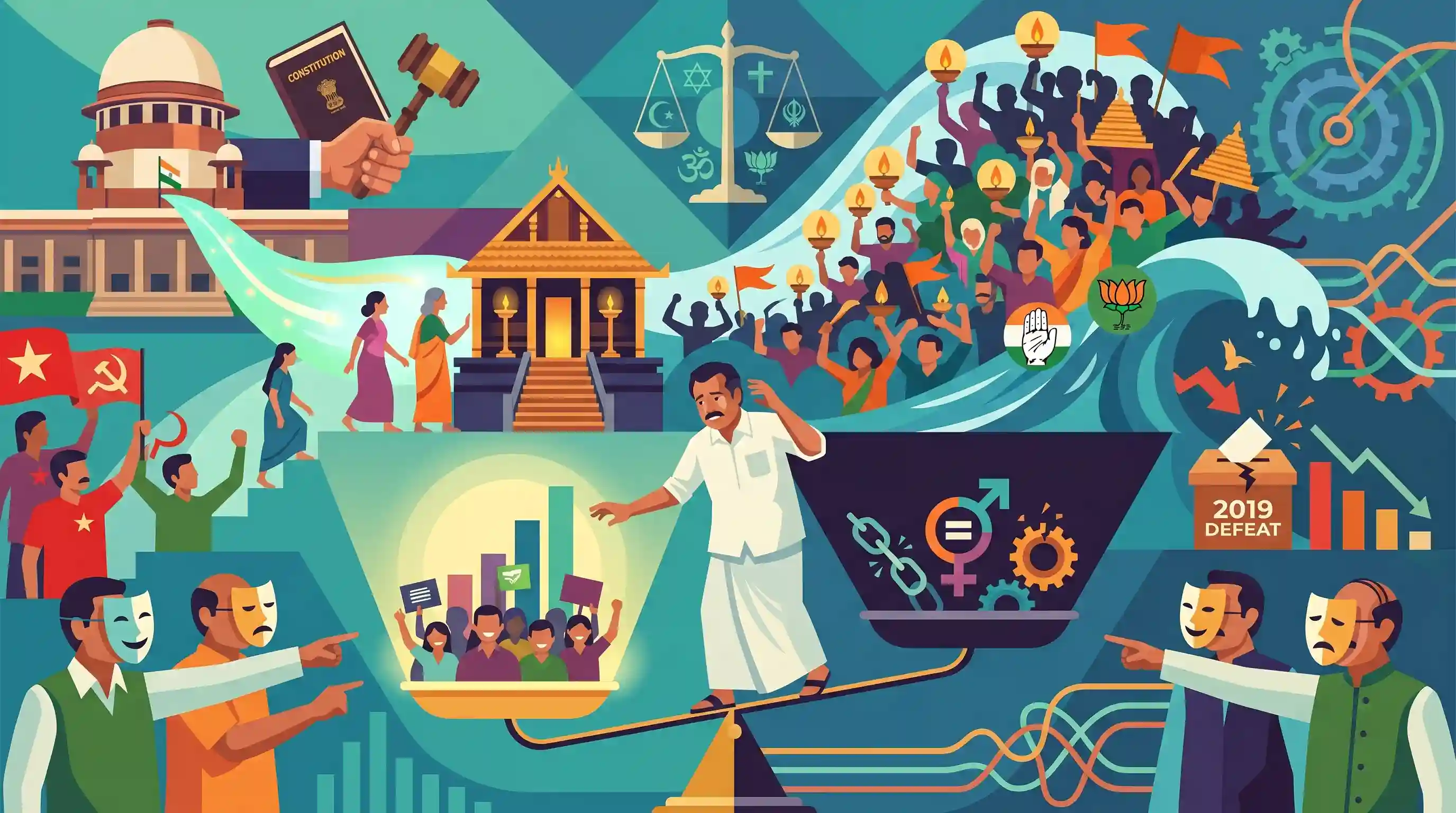
The CPI(M)-led LDF government in Kerala is caught in a political "double bind" over the Sabarimala temple controversy on the eve of elections. Having previously supported the Supreme Court's 2018 ruling that allowed women of all ages to enter the shrine, the Left government faced intense protests from devotees, which culminated in a severe electoral defeat in the 2019 Lok Sabha elections. Now, to prevent a similar backlash and retain conservative Hindu votes, the Pinarayi Vijayan government is adopting a cautious approach. However, this pragmatic pivot contradicts its progressive, reformist ideology, allowing opposition parties like the Congress and BJP to accuse the CPI(M) of hypocrisy. The situation illustrates the complexities of balancing electoral viability with constitutional principles like gender equality and secularism.
Key Points
- The CPI(M)-led Kerala government faces a political dilemma over the Sabarimala women's entry issue ahead of upcoming elections.
- Historically, the government backed the 2018 Supreme Court verdict allowing women of all ages to enter the temple, which aligned with its progressive ideology but triggered massive conservative protests.
- The LDF suffered heavy electoral losses in the 2019 Lok Sabha polls due to the backlash, prompting the party to tread carefully to avoid alienating the Hindu vote bank again.
- The opposition parties (Congress and BJP) are leveraging this hesitation to corner the CPI(M), demanding clarity on its ideological stance.
- The controversy highlights the persistent tension between constitutional morality (gender equality under Article 14) and religious freedom (Article 25), as well as the impact of religion on electoral politics.
Important Terms
Supreme Court of India (Sabarimala Ruling)

India's apex court which, in 2018, struck down the ban on women of 'menstruating age' entering Sabarimala, citing violations of equality and dignity under the Constitution.
UPSC context
GS Paper II: Judiciary/Fundamental Rights. Tests knowledge of landmark judgments, gender justice, and judicial intervention in religious practices.
Constitutional Morality
A judicial principle prioritizing core constitutional values—like liberty, equality, and dignity—over prevailing social or religious norms. The SC used this to invalidate discriminatory temple customs.
UPSC context
GS Paper II: Constitutional Morality/Polity. Essential for discussing the tension between individual rights and group religious autonomy.
Essential Religious Practices (ERP) Doctrine
A legal doctrine evolved by the Supreme Court to determine which religious practices are integral to a faith and thus entitled to protection under Articles 25 and 26.
UPSC context
GS Paper II: Separation of Powers/Fundamental Rights. Tests the court's role as an arbiter of religious 'essentiality.'
Left Democratic Front (LDF)
The ruling political coalition in Kerala, led by the CPI(M). It advocates for secularism and social reform but faced electoral setbacks after implementing the Sabarimala verdict.
UPSC context
GS Paper II: Federalism/Political Parties. Relevant for studying regional party dynamics and the intersection of ideology and electoral viability.
United Democratic Front (UDF)
The primary opposition alliance in Kerala, led by the Indian National Congress. It generally adopts a more traditionalist stance on religious issues like the Sabarimala entry to attract conservative voters.
UPSC context
GS Paper II: Elections/Polity. Understanding coalition politics and the influence of religious sentiments on state-level electoral strategies.
CPI(M)
The Communist Party of India (Marxist), the dominant party within the LDF. It manages the ideological conflict between its progressive roots and the pragmatic demands of religious vote-banks.
UPSC context
GS Paper II: Political Parties. Analyzes how major national parties navigate secularism vs. religious sensitivities in regional strongholds.
Article 25
The constitutional provision guaranteeing freedom of conscience and the right to profess, practice, and propagate religion, subject to public order, morality, and health.
UPSC context
GS Paper II: Fundamental Rights. A core pillar for any discussion on secularism and religious freedom in India.
Prelims Trap
The Supreme Court recognized Sabarimala devotees as a distinct religious denomination under Article 26.
The SC explicitly ruled that Lord Ayyappa devotees are NOT a distinct religious denomination under Article 26. This prevented the temple from claiming absolute autonomy to exclude women.
Static Concepts Connected
What is the 'Essential Religious Practices' (ERP) test?
- Judicial Origin: Evolved by the Supreme Court in the Shirur Mutt case (1954) to determine the scope of religious protection.
- Core Principle: Only practices that are fundamental and integral to a religion's existence receive protection under Article 25.
- Court Scrutiny: Allows courts to strike down exclusionary or superstitious practices (like the Sabarimala ban) if deemed non-essential to the faith.
How does the Constitution enable state-led religious reform?
- Principled Distance: The Indian State maintains a 'principled distance' rather than strict separation, intervening in religion to uphold constitutional values like gender equality.
- Article 25(2)(b): Article 25(2)(b) specifically empowers the State to enact laws throwing open Hindu religious institutions of a public character to all classes.
Cross-Topic Patterns
Kantaraj Reference & Gender Rights
The pending 9-judge Kantaraj bench ties Sabarimala to Dawoodi Bohra FGM and Muslim women's mosque entry, forming a mega-theme of Article 14 versus Article 25.
Vote-bank limits on ideological parties
Demonstrates how socio-religious consolidation can force doctrinally progressive parties to abandon reformist stances to prevent electoral decimation in Indian politics.

Expect a 2026 Mains question linking the 'Essential Religious Practices' test to Constitutional Morality and the pending Kantaraj bench.
Linked PYQs · 4
Linked PYQs · 4
- 2024MainsGS2
Discuss India as a secular state and compare with the secular principles of the US constitution.
- 2025MainsGS2
"Constitutional morality is the fulcrum which acts as an essential check upon the high functionaries and citizens alike...." In view of the above observation of the Supreme Court, explain the concept of constitutional morality and its application to ensure balance between judicial independence and judicial accountability in India.
- 2017MainsGS1
Distinguish between religiousness/religiosity and communalism giving one example of how the former has got transformed into the latter in independent India.
- 2022MainsGS1
Are tolerance, assimilation and pluralism the key elements in the making of an Indian form of secularism? Justify your answer.
