Supreme Court views on state intervention in religious affairs
Source:Indian Express ↗
Why It Matters
The interplay between state-driven social reform (Article 25(2)(b)) and religious freedom (Article 26) is a cornerstone of Indian secularism. Understanding the Supreme Court's stance on the "essential religious practices" doctrine is crucial for GS2 questions on the Constitution and fundamental rights.
Summary
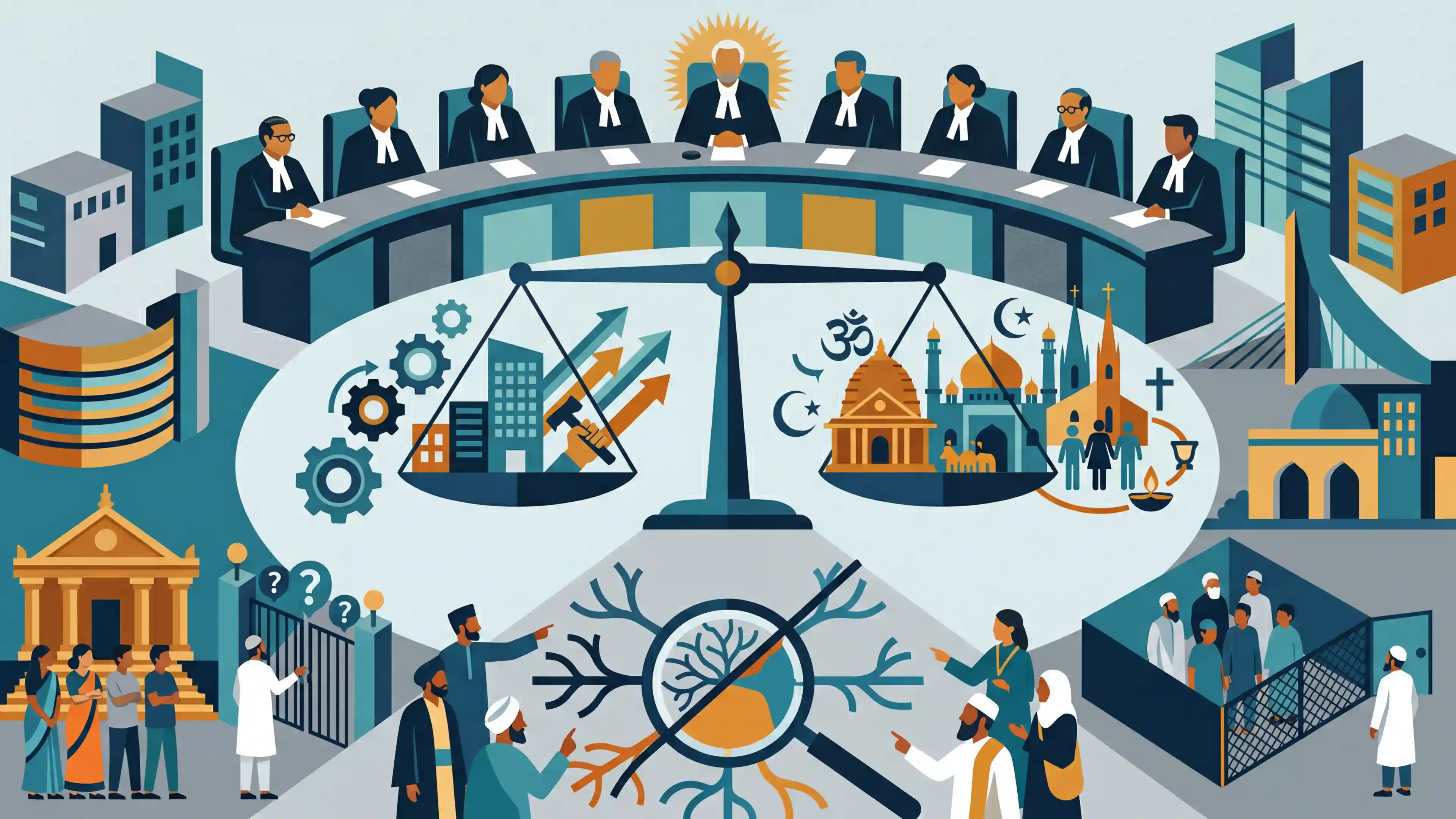
A 9-judge Supreme Court bench, led by CJI Surya Kant, is reviewing the 2018 Sabarimala judgment and assessing the constitutional limits of state intervention in religious affairs. The Court noted that creating a blanket rule for state intervention under Article 25(2)(b) to enact social reforms is impossible, as the judiciary must balance such reforms against a religious denomination's rights under Article 26. The CJI highlighted the complexities of defining "essential religious practices" for diverse groups. Alongside Sabarimala, the bench is hearing a plea concerning the practice of excommunication within the Dawoodi Bohra community.
Key Points
- A 9-judge Supreme Court bench stated it cannot lay down blanket future guidelines on state intervention in religious affairs, noting each situation must be judged on a case-by-case basis.
- The debate centres on the interplay between Article 25(2)(b) (state intervention for social reforms) and Article 26 (rights of religious denominations to manage their own affairs).
- The Chief Justice emphasized that determining what constitutes an "essential religious practice" is incredibly difficult for the judiciary.
- The bench is simultaneously considering a writ petition against excommunication in the Dawoodi Bohra community, which challenges a 1962 SC judgment on the Bombay Prevention of Excommunication Act.
Important Terms
Article 25

Guarantees individuals the freedom of conscience and the right to freely profess, practice, and propagate religion, subject to public order, morality, and health.
UPSC context
GS Paper II (Polity). Tests understanding of individual religious freedom versus state-led social reforms and reasonable restrictions.
Article 26
Grants religious denominations the right to establish institutions and manage their own affairs in matters of religion, subject to public order, morality, and health.
UPSC context
GS Paper II (Polity). Tests the concept of secularism and the degree of autonomy granted to religious groups.
Essential Religious Practices Doctrine
A judicial test developed by the Supreme Court to determine which religious rituals or practices are integral to a faith and protected from state interference.
UPSC context
GS Paper II (Judiciary). Tests knowledge of judicial interpretation and the court's role in defining the boundaries of religion.
Bombay Prevention of Excommunication Act, 1949
A 1949 law that prohibited the expulsion of members from a community; it was struck down in 1962 but is currently being reconsidered by the Supreme Court.
UPSC context
GS Paper II (Polity). Relevant to debates on social reform, religious autonomy, and the power of the State to prevent social boycott.
Dawoodi Bohra Community
A Shia Muslim sub-sect whose practice of excommunication by its religious head is under review for its compatibility with individual fundamental rights.
UPSC context
GS Paper II (Social Justice). Tests understanding of minority rights, individual dignity, and the legal challenges to traditional community practices.
Constitutional Morality
A judicial principle that prioritizes constitutional values like equality, liberty, and justice over traditional or religious customs during legal interpretation.
UPSC context
GS Paper II/IV (Ethics/Polity). Tests the application of modern democratic values to resolve conflicts between faith and individual rights.
Prelims Trap
The 'Essential Religious Practices' doctrine is explicitly defined under Article 25 of the Indian Constitution.
The doctrine is a judicial innovation originating from the 1954 Shirur Mutt case, not a constitutional provision. It acts as a judicial test.
Static Concepts Connected
What is the Essential Religious Practices (ERP) doctrine?
- Judicial Origin: It was evolved by the Supreme Court in the landmark 1954 Shirur Mutt case.
- Core Principle: It dictates that only practices fundamental and integral to a religion are protected under Articles 25 and 26.
- State Regulation: It allows the State to regulate or restrict non-essential, secular, commercial, or political activities associated with religious practices.
How does Indian secularism differ from the Western model?
- Principled Distance: India follows a model of 'principled distance' rather than the strict 'wall of separation' seen in the US model.
- Reformative Intervention: The Indian State can actively intervene in religious affairs to enact social reforms (e.g., eradicating untouchability) under Article 25(2)(b).
- Equal Respect: It embodies 'Sarva Dharma Samabhava'—equal respect for all religions—rather than strict state indifference to religion.
Cross-Topic Patterns
UCC vs Article 25/26 debate
The Supreme Court's stance on the limits of state intervention directly impacts the constitutional feasibility and structural framing of a Uniform Civil Code (Article 44).
Constitutional Morality vs Customary Law
Both the Sabarimala and Dawoodi Bohra cases exemplify the ongoing judicial struggle to balance minority group autonomy with the overarching principle of constitutional morality.

A multi-statement question on the origin of the ERP doctrine and its clash with Article 26 denominational rights is highly probable.
Linked PYQs · 4
Linked PYQs · 4
- 2024MainsGS2
Discuss India as a secular state and compare with the secular principles of the US constitution.
- 2022MainsGS1
Are tolerance, assimilation and pluralism the key elements in the making of an Indian form of secularism? Justify your answer.
- 2019MainsGS1
What are the challenges to our cultural practices in the name of secularism?
- 2018MainsGS1
How the Indian concept of secularism is different from the western model of secularism? Discuss.
