Critical Minerals Supply Chain and Bilateral Ministerial Talks
Source:The Hindu ↗
Why It Matters
The geopolitical race for critical minerals defines future economic security and technological leadership. Securing these supply chains via partnerships like the U.S. Critical Minerals Ministerial and Pax Silica is essential for India's 'Make in India' initiative, defense capabilities, and clean energy transition. The newly announced trade deal also stabilises the crucial India-U.S. economic partnership amidst changing U.S. administrations.
Summary
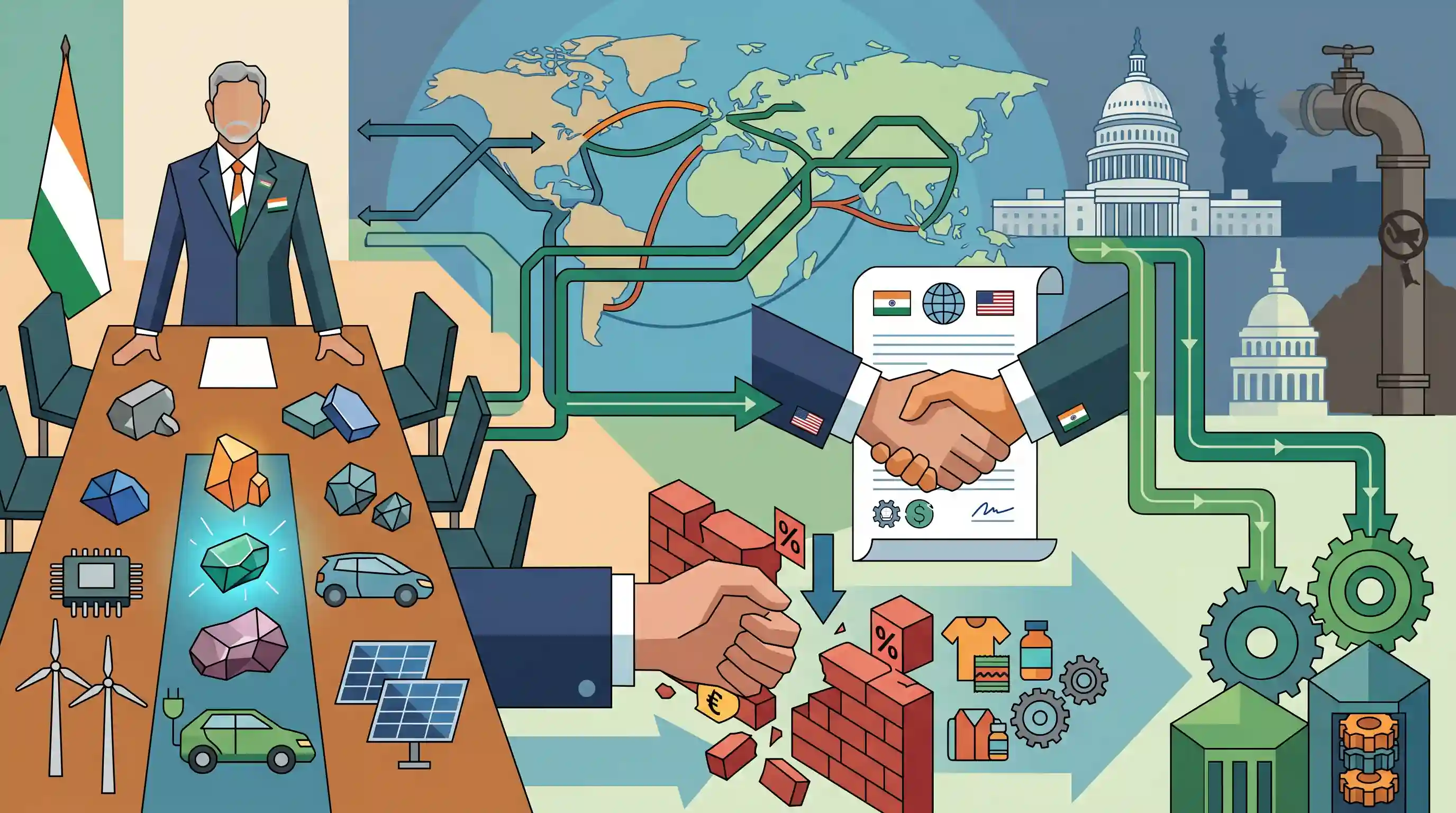
External Affairs Minister S. Jaishankar visited Washington D.C. to attend the inaugural Critical Minerals Ministerial, aiming to secure resilient supply chains for clean energy and advanced technologies. Coming alongside a newly announced India-U.S. trade deal that drastically slashed reciprocal U.S. tariffs on Indian goods, the visit underscores a significant strategic thaw and growing bilateral convergence on economic security, trade, and reducing dependence on dominant mineral suppliers.
Key Points
- External Affairs Minister S. Jaishankar visited the U.S. to participate in the Critical Minerals Ministerial convened by U.S. Secretary of State Marco Rubio, focusing on supply chain resilience and clean energy transitions.
- The visit coincided with a newly announced India-U.S. trade agreement by U.S. President Donald Trump, which slashed reciprocal U.S. tariffs on Indian goods from 50% to 18%, signalling a thaw in bilateral trade strains.
- Discussions focused on de-risking critical mineral supply chains (like lithium, cobalt, and rare earths) to reduce over-dependence on dominant suppliers like China.
- India is expected to join 'Pax Silica', a flagship U.S. initiative to build a secure global supply chain for semiconductors and AI technology.
Important Terms
Critical Minerals Ministerial

Inaugural 2026 summit of 50+ nations hosted by the U.S. to secure supply chains for minerals essential to advanced technologies, defense, and the green energy transition.
UPSC context
GS Paper 2 & 3: International Relations and Resource Security. Tests India’s role in global mineral diplomacy and de-risking strategies.
FORGE Initiative
Forum on Resource Geostrategic Engagement; a plurilateral successor to the Mineral Security Partnership (MSP) designed to de-risk mineral supply chains and coordinate policy-level actions.
UPSC context
GS Paper 2: Global Groupings. Tests understanding of evolving multilateral frameworks for resource security and India’s strategic participation.
Pax Silica
A U.S.-led strategic coalition focused on securing supply chains for semiconductors, high-purity silicon, and Artificial Intelligence (AI) to counter dominant non-allied suppliers.
UPSC context
GS Paper 2 & 3: Bilateral Relations and Technology. Key for analyzing the "technology-security" nexus and "friend-shoring" in India-US ties.
India-U.S. Trade Agreement (2026)
A 2026 landmark deal slashing U.S. reciprocal tariffs on Indian goods to 18%, following India's commitment to reduce import barriers and diversify energy sources.
UPSC context
GS Paper 2: Bilateral Relations. Important for examining trade as a strategic tool for geopolitical alignment.
Project Vault
A strategic U.S. initiative to establish a $12 billion critical minerals stockpile, designed to insulate domestic and allied manufacturers from supply shocks.
UPSC context
GS Paper 3: Economic Security. Relevant for discussions on strategic reserves and infrastructure resilience in global supply chains.
Supply Chain Resilience
The capacity of trade networks to withstand disruptions, often achieved through diversification and "friend-shoring" to reduce reliance on concentrated or adversarial global suppliers.
UPSC context
GS Paper 3: Economy and Security. A core pillar of current Indian economic policy and Indo-Pacific strategic cooperation.
Prelims Trap
"Pax Silica is a United Nations treaty regulating the global mining of silica and critical minerals."
Pax Silica is not a UN mining treaty, but a US-led strategic initiative focused on building secure global supply chains for semiconductors and artificial intelligence.
Static Concepts Connected
What are Rare Earth Elements (REEs) and their significance?
- Composition: A group of 17 chemically similar metallic elements (15 lanthanides, plus scandium and yttrium) crucial for high-tech manufacturing.
- Strategic use: Indispensable for clean energy (wind turbine magnets, EV motors), artificial intelligence hardware, and advanced defense systems.
- Indian reserves: India has significant reserves, primarily found as monazite sand in coastal placers, but heavily relies on China for processing capabilities.
What is the Minerals Security Partnership (MSP)?
- Core Mandate: A US-led global alliance formed in 2022 to catalyze public and private investment in responsible critical mineral supply chains globally.
- India's Status: India officially joined the MSP in 2023, marking a crucial step to secure lithium and cobalt while reducing its import reliance on China.
Cross-Topic Patterns
Semiconductors + Strategic Friend-shoring
The US-led 'Pax Silica' tech alliance directly reinforces the India Semiconductor Mission (ISM) by embedding India into trusted global supply networks, actively bypassing Chinese tech dominance.
Clean Energy + Import Dependence
India's Panchamrit climate goals and EV policy rely heavily on lithium and cobalt availability, inextricably linking domestic clean energy transitions to international geoeconomic mineral alliances.

Expect a 2026 Prelims multi-statement question pairing 'Pax Silica' with the 'Minerals Security Partnership' and India's membership status.
Linked PYQs · 2
Linked PYQs · 2
- 2023MainsGS2
‘The expansion and strengthening of NATO and a stronger US-Europe strategic partnership works well for India.’ What is your opinion about this statement ? Give reasons and examples to support your answer.
- 2025MainsGS3
Mineral resources are fundamental to the country's economy and these are exploited by mining. Why is mining considered an environmental hazard? Explain the remedial measures required to reduce the environmental hazard due to mining.
