Jaishankar visits Ukraine and Poland reflecting strategic autonomy
Source:Indian Express ↗
কেন এটি গুরুত্বপূর্ণ
This article illustrates India's nuanced diplomatic balancing act and multi-alignment strategy in the context of the Russia-Ukraine war, which is crucial for understanding contemporary Indian foreign policy and international relations for GS Paper 2.
সারসংক্ষেপ
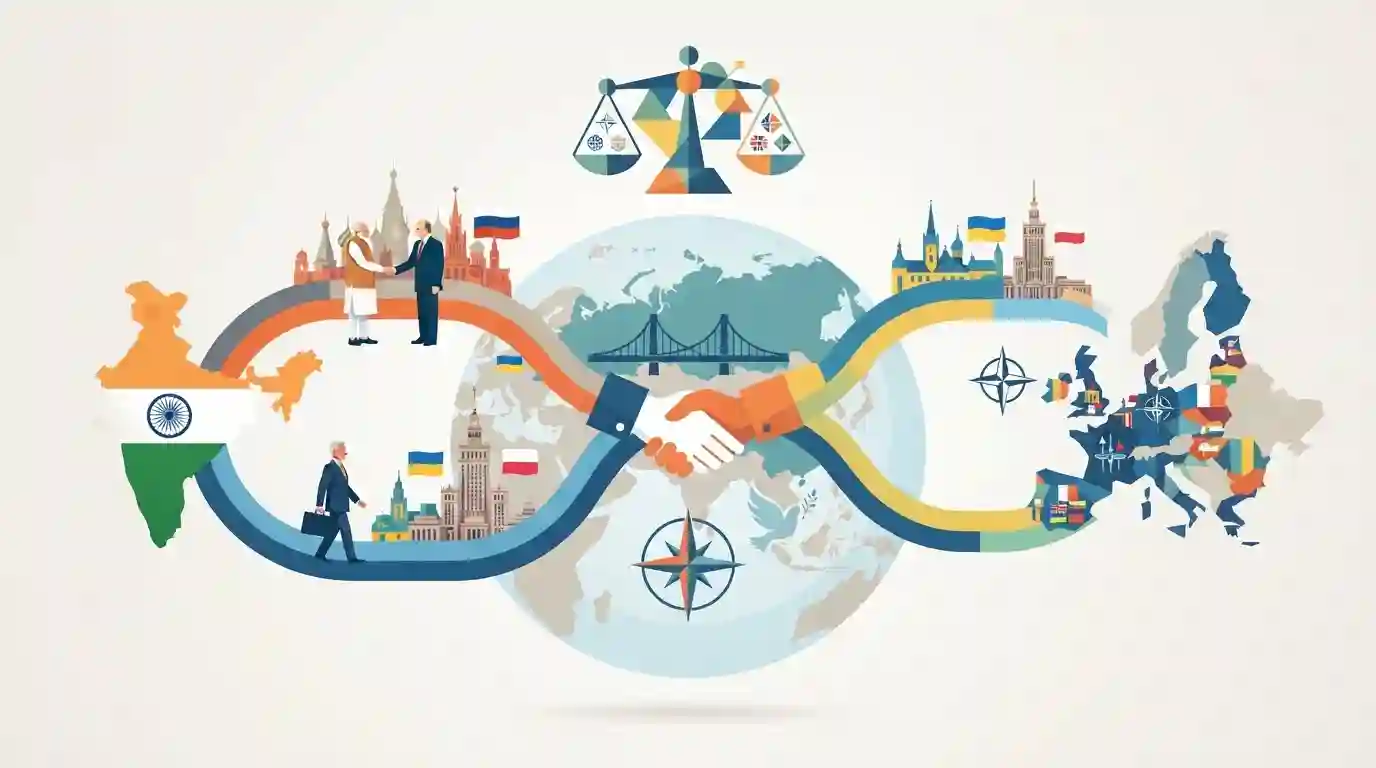
External Affairs Minister S Jaishankar's visit to Ukraine and Poland reflects India's active diplomatic engagement in Eastern Europe. Coming on the heels of Prime Minister Narendra Modi's interactions with Russia, the visits highlight India's pursuit of strategic autonomy, multi-alignment, and its willingness to act as a bridge for dialogue in resolving the Russia-Ukraine conflict.
মূল বিষয়
- External Affairs Minister S Jaishankar undertook diplomatic visits to Ukraine and Poland, marking significant outreach amidst ongoing geopolitical tensions in Eastern Europe.
- The visits follow Prime Minister Narendra Modi's high-profile talks with Russian leadership, emphasizing India's consistent stance of strategic autonomy and active multi-alignment.
- India continues to project itself as a credible interlocutor capable of engaging with both conflict parties and Western/Central European partners to facilitate peace dialogues.
- Bilateral relations with Poland and diplomatic engagement with Ukraine underscore India's expanded footprint in Central and Eastern Europe.
গুরুত্বপূর্ণ শব্দ
Ministry of External Affairs

India's central government agency responsible for the formulation, implementation, and conduct of the nation's foreign policy and external diplomatic relations.
UPSC context
UPSC GS Paper II: Important International institutions, agencies and fora—their structure and mandate, and India's diplomatic machinery.
Strategic Autonomy
India's foreign policy doctrine of maintaining independent decision-making and pursuing issue-based multi-alignment with global powers without permanent bloc subordination.
UPSC context
UPSC GS Paper II: Bilateral, regional and global groupings and agreements involving India and/or affecting India's interests.
প্রিলিমস ফাঁদ
India's neutral and passive stance in the Russia-Ukraine conflict implies an abandonment of its traditional diplomatic allies.
Aspirants often confuse India's multi-alignment with neutrality or equidistant passivity; India actively engages in diplomatic outreach and dialogue facilitation while maintaining core strategic partnerships.
সংযুক্ত স্থির ধারণা
What are the core tenets of India's foreign policy regarding major power balancing and strategic autonomy?
- Autonomy Principle: Strategic Autonomy allows independent decision-making without being beholden to any single military or ideological bloc.
- Multi-Alignment: Multi-Alignment involves simultaneous engagement with competing global powers (e.g., US, Russia, EU) to maximize national interest.
- Global South Voice: Voice of Global South advocates for developmental priorities, supply chain resilience, and reform of multilateral institutions.
আন্তঃবিষয় প্যাটার্ন
Strategic Autonomy & Non-Alignment 2.0
India's diplomatic balancing act between Russia and Western partners mirrors Cold War non-alignment, adapted into contemporary proactive multi-alignment across distinct geopolitical groupings like the Quad and BRICS.

Expect a statement-based question testing India's shift from passive non-alignment to proactive multi-alignment in the Russia-Ukraine conflict.
সংযুক্ত PYQ · 1
সংযুক্ত PYQ · 1
- 2025MainsGS2
"Energy security constitutes the dominant kingpin of India's foreign policy, and is linked with India's overarching influence in Middle Eastern countries.” How would you integrate energy security with India's foreign policy trajectories in the coming years?
