India External Affairs Minister Bilateral Talks on Global Crises
Source:The Hindu ↗
Why It Matters
This diplomatic engagement illustrates India's nuanced foreign policy approach of strategic autonomy, engaging concurrently with Western allies, traditional partners like Russia, and regional stakeholders amid deep global polarizations.
Summary
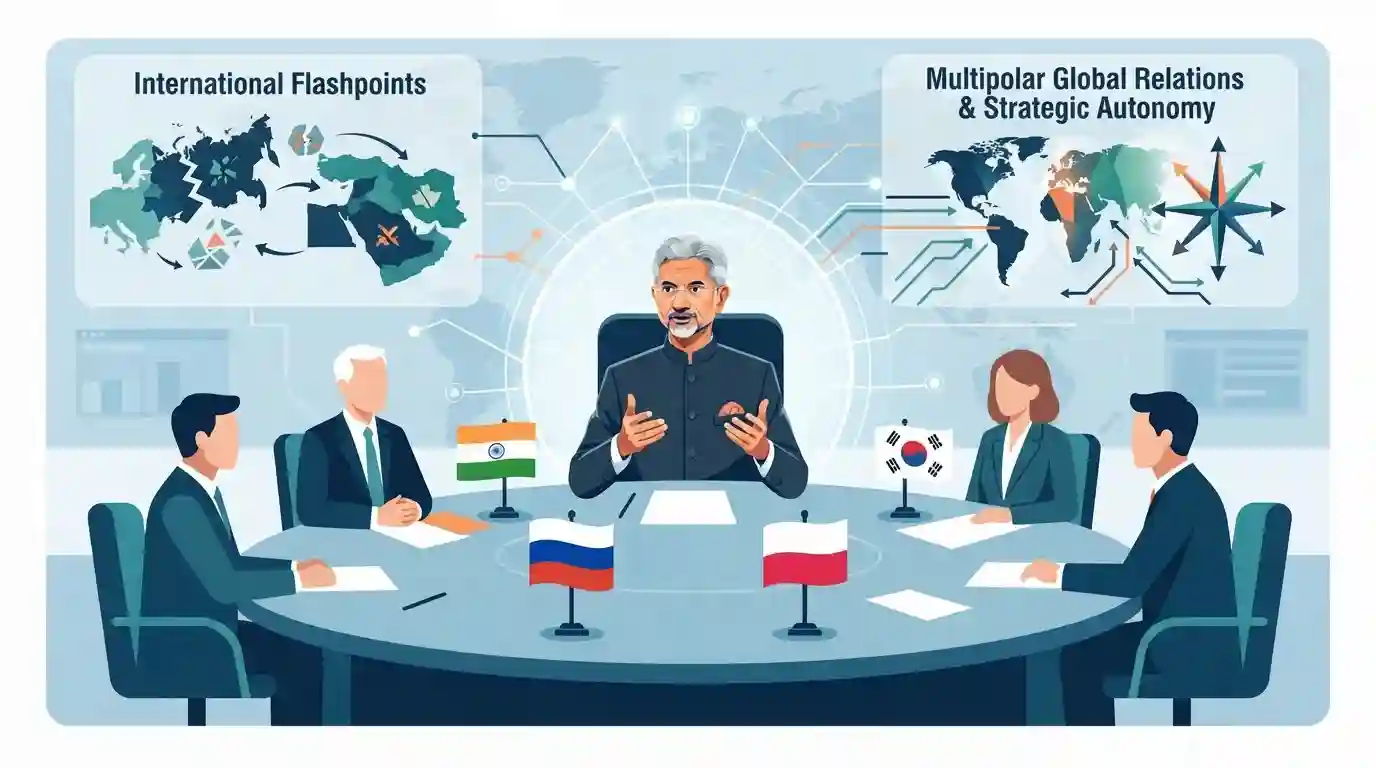
External Affairs Minister S. Jaishankar engaged in diplomatic talks with his Russian, Polish, and South Korean counterparts, focusing on international flashpoints such as the Ukraine conflict and West Asia. The discussions highlight India's active diplomatic engagement and strategic autonomy in navigating multipolar global relations.
Key Points
- External Affairs Minister S. Jaishankar held bilateral meetings with counterparts from Russia, Poland, and South Korea on the sidelines of international engagements.
- Discussions prominently covered major geopolitical issues including the ongoing conflict in Ukraine and the crisis in West Asia.
- The meetings underline India's diplomatic outreach and commitment to maintaining balanced relations with diverse global powers amid complex geopolitical realignments.
Important Terms
Ministry of External Affairs India

The nodal executive agency of the Government of India responsible for formulating, implementing, and managing the country's foreign policy and diplomatic relations globally.
UPSC context
UPSC Paper II (International Relations): Tests understanding of institutional mechanisms driving India's foreign policy, diplomacy, and strategic engagement.
Russian Foreign Ministry
The federal executive body of the Russian Federation tasked with formulating, executing, and directing Russia's foreign policy and international relations.
UPSC context
UPSC Paper II (International Relations): Essential for questions involving major powers, bilateral ties, and multilateral diplomacy.
Prelims Trap
Strategic autonomy implies equidistant neutrality and complete dissociation from major global conflict resolutions.
Aspirants often assume strategic autonomy means maintaining absolute neutrality on all conflicts, whereas India takes principled stances emphasizing dialogue without abandoning core partnerships.
Static Concepts Connected
What are the core tenets and evolution of India's policy of Strategic Autonomy?
- NAM Heritage: Historical Roots stemming from the Non-Aligned Movement (NAM), emphasizing independence in foreign policy decision-making free from bloc politics.
- Multi-alignment: Multi-alignment practice involving simultaneous strategic partnerships with competing global powers (e.g., US, Russia, EU, Japan) to maximize national interest.
- Coalition Flexibility: Strategic Space preserved by avoiding formal military alliances while building issue-based coalitions like the Quad, BRICS, and SCO.
Cross-Topic Patterns
Multi-alignment vs. Non-alignment evolution
India's simultaneous engagement with Russia, the West, and East Asia illustrates multi-alignment, contrasting directly with Cold War-era non-alignment.
Central Europe in India's Indo-Pacific calculus
India-Poland economic partnerships in defense and green tech complement India's broader Indo-Pacific and Central European diplomatic outreach.

Strategic autonomy and multi-alignment questions frequently test nuances between classical NAM and contemporary independent foreign policy.
Linked PYQs · 3
Linked PYQs · 3
- 2025MainsGS2
"Energy security constitutes the dominant kingpin of India's foreign policy, and is linked with India's overarching influence in Middle Eastern countries.” How would you integrate energy security with India's foreign policy trajectories in the coming years?
- 2024MainsGS2
‘The West is fostering India as an alternative to reduce dependence on China's supply chain and as a strategic ally to counter China's political and economic dominance.’ Explain this statement with examples.
- 2022MainsGS2
How will I2U2 (India, Israel, UAE and USA) grouping transform India's position in global politics?
