Strategic Autonomy and Energy Security in Indian Foreign Policy
Source:Indian Express ↗
Why It Matters
The article provides crucial talking points for GS2 International Relations answers, illustrating India's transition from traditional non-alignment to assertive 'multi-alignment'. It demonstrates how India balances its strategic partnership with the US against its core national interests (energy security via Russian oil) without buckling under Western pressure.
Summary
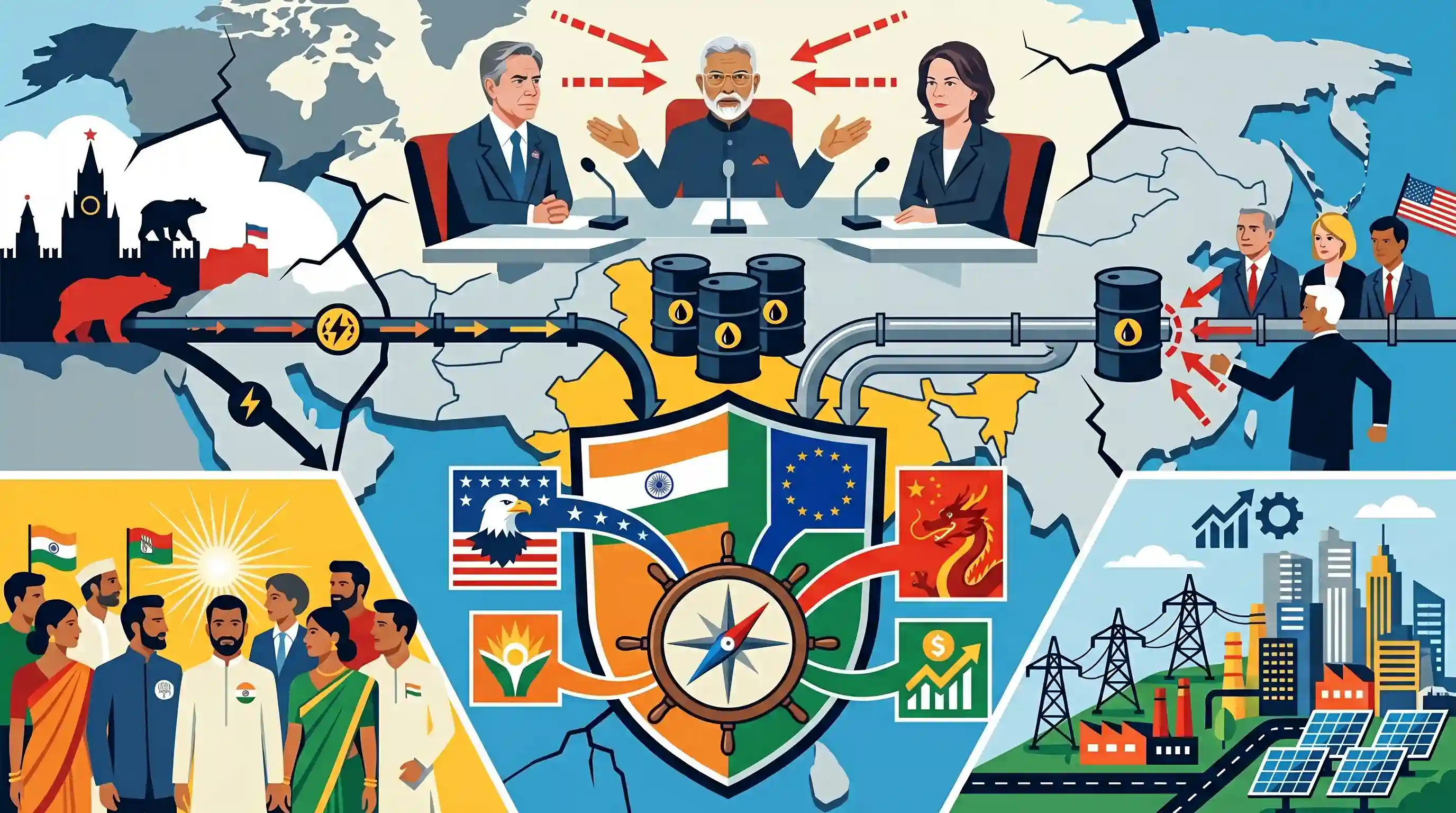
At the Munich Security Conference, External Affairs Minister S. Jaishankar strongly articulated India's commitment to strategic autonomy, defending the country's continued purchase of Russian oil despite pressure from the US and Western nations. Sharing a panel with US Secretary of State Antony Blinken and German Foreign Minister Annalena Baerbock, Jaishankar rejected the notion that India's foreign policy is merely transactional. Instead, he framed India's ability to maintain 'multiple options' as a diplomatic strength driven by its specific developmental needs, historical context, and geographical reality. He also highlighted that this independent-minded approach to global affairs enjoys broad consensus across the Indian political spectrum, underscoring India's assertive multi-alignment in a fragmented global order.
Key Points
- External Affairs Minister S. Jaishankar strongly defended India's 'strategic autonomy' at the Munich Security Conference, dismissing criticism of India's ongoing Russian oil purchases amidst Western sanctions.
- He argued that having 'multiple options' in international relations is a sign of smart diplomacy that should be admired, rather than criticized.
- Jaishankar clarified that India's multi-aligned foreign policy is not 'purely and unsentimentally transactional', but based on India's unique geopolitical location, level of development, and historical experiences.
- He emphasized that an independent-minded foreign policy is not just a government stance, but a conviction that 'runs deep across the political spectrum' in India.
- The remarks, made during a panel discussion alongside the US Secretary of State and the German Foreign Minister, reflect India's growing confidence in articulating its national interests on major global platforms.
Important Terms
Munich Security Conference (MSC)

Annual global forum held in Munich since 1963, often called the 'Davos of Defence.' It facilitates informal dialogue among world leaders on international security policy and geopolitical crises.
UPSC context
GS-II: Important International institutions and forums; tests India's participation in global security dialogues.
Strategic Autonomy
A nation's ability to pursue its national interests and make sovereign foreign policy/defense decisions independently, without being constrained by external pressures or formal military alliance obligations.
UPSC context
GS-II: India's Foreign Policy; core concept for analyzing India's balancing act between rival superpowers.
Multi-alignment
A pragmatic diplomatic strategy where a country engages with multiple, often rival, powers simultaneously through parallel relationships to maximize its own strategic and economic options.
UPSC context
GS-II: Bilateral and global groupings; tests the transition from Cold War non-alignment to modern interest-based diplomacy.
Energy Security
The reliable and affordable access to energy sources required for national stability. For India, it involves diversifying crude oil imports to mitigate supply risks and price volatility.
UPSC context
GS-III: Infrastructure and Energy; links foreign policy choices to domestic economic stability and inflation management.
Global South
A geopolitical grouping of developing and less-developed nations in Africa, Asia, and Latin America. India positions itself as its representative to advocate for equitable global governance.
UPSC context
GS-II: Effect of policies of developed and developing countries on India’s interests; tests India’s leadership role.
De-hyphenation
A diplomatic strategy of maintaining independent relationships with two rival nations based on mutual merit, rather than viewing them through the lens of their mutual conflict.
UPSC context
GS-II: Bilateral relations; tests India's ability to balance conflicting geopolitical interests (e.g., US vs. Russia).
Prelims Trap
The Munich Security Conference is an intergovernmental security platform operating under the UN framework.
The Munich Security Conference is an independent, non-governmental forum (established in 1963). It is not affiliated with the United Nations or any intergovernmental treaty.
Static Concepts Connected
How does 'Multi-alignment' differ from Cold War-era 'Non-Alignment' (NAM)?
- Core philosophy: NAM traditionally focused on maintaining distance from rival blocs. Multi-alignment actively engages rival powers simultaneously for issue-based partnerships.
- Institutional engagement: Multi-alignment accommodates concurrent membership in seemingly contradictory geopolitical forums (e.g., Quad with the US, and SCO/BRICS with China and Russia).
How do Western sanctions on Russian oil operate globally?
- G7 Price Cap: The G7 restricts Western companies from providing maritime insurance and shipping services for Russian seaborne crude unless it is sold below $60/barrel.
- Secondary Sanctions: Western nations utilize secondary sanctions and entity-listings to penalize third-country companies/vessels that facilitate the evasion of these energy restrictions.
Cross-Topic Patterns
Defense CAATSA vs. Energy Sanctions
While oil purchases navigate G7 price-cap and diplomatic pressures, Russian defense imports (like the S-400) face direct statutory threats under the US CAATSA framework.
De-dollarization in energy trade
Buying discounted Russian oil necessitates alternative payment mechanisms (Rupee-Ruble or Dirham trades), acting as a catalyst for India's broader push toward the internationalization of the Rupee.

Expect a 2026 Mains question contrasting Cold War 'Non-Alignment' with 'Multi-alignment', citing India's oil diplomacy as the primary case.
Linked PYQs · 2
Linked PYQs · 2
- 2019MainsGS2
‘What introduces friction into the ties between India and the United States is that Washington is still unable to find for India a position in its global strategy, which would satisfy India's national self-esteem and ambitions.’ Explain with suitable examples.
- 2025MainsGS2
"Energy security constitutes the dominant kingpin of India's foreign policy, and is linked with India's overarching influence in Middle Eastern countries.” How would you integrate energy security with India's foreign policy trajectories in the coming years?
