Nuclear Reactor Integration for Railway Infrastructure Projects
Source:Indian Express ↗
Why It Matters
The transition of mass transit systems like Indian Railways to nuclear power represents a massive shift in India's clean energy strategy. It demonstrates the practical application of nuclear reactors for specific public infrastructure projects, significantly aiding India's climate goals while deepening strategic and energy ties with Russia.
Summary
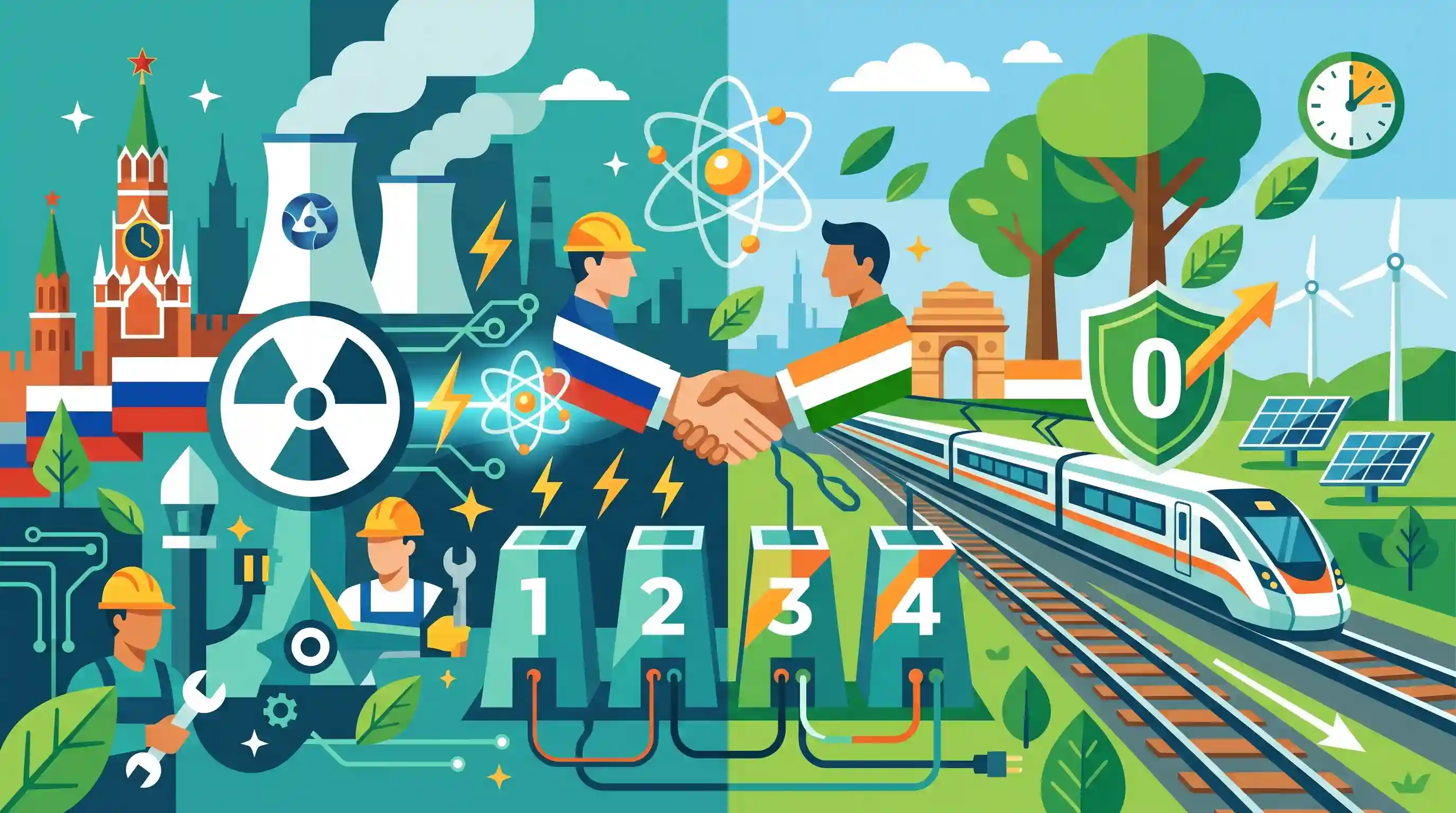
Rail Vikas Nigam Limited (RVNL) is in discussions with Russia's state-owned atomic energy corporation, Rosatom, to construct nuclear reactors to power four of its major railway projects. This initiative marks a significant step in the Indian Railways' efforts to decarbonize its operations and achieve its goal of becoming a "Net Zero Carbon Emitter by 2030." The collaboration highlights the expanding scope of India-Russia bilateral relations into specialized infrastructure and clean energy solutions, emphasizing the role of nuclear energy in ensuring energy security for large-scale public transport networks.
Key Points
- Rail Vikas Nigam Limited (RVNL) is negotiating with Russia's state-owned Rosatom to build nuclear reactors for four major railway infrastructure projects.
- The deployment of dedicated nuclear reactors marks a strategic shift towards powering large-scale transport infrastructure with reliable clean energy.
- This collaboration aids Indian Railways' ambitious target of becoming a 'Net Zero Carbon Emitter by 2030' by reducing dependence on fossil fuels.
- The partnership reflects the expansion of India-Russia bilateral cooperation into specialized clean energy solutions and infrastructure modernization.
Important Terms
Small Modular Reactors (SMRs)

Advanced nuclear reactors with a power capacity of up to 300 MW per unit. They are factory-built, require less land, and offer high safety, making them ideal for decentralized industrial and transport power.
UPSC context
GS-III (Science & Technology/Energy); tests knowledge of clean energy innovations and their role in achieving India’s net-zero targets.
Rail Vikas Nigam Limited (RVNL)
A Navratna PSU under the Ministry of Railways established in 2003. It functions as the construction arm for fast-tracking railway infrastructure, utilizing Special Purpose Vehicles (SPVs) to mobilize extra-budgetary resources.
UPSC context
GS-III (Infrastructure/Economy); focuses on PSU governance, infrastructure modernization, and the role of autonomous bodies in nation-building.
Rosatom
Russia's state-owned nuclear energy corporation and a primary technology partner for India (e.g., Kudankulam). It is currently collaborating on SMR technology to power major Indian infrastructure projects and facilitate localization.
UPSC context
GS-II (International Relations); concerns India-Russia bilateral strategic ties and high-technology cooperation in the energy sector.
Net Zero Carbon Emitter by 2030
A flagship Indian Railways target to eliminate its carbon footprint by 2030. Key strategies include 100% electrification, massive renewable energy sourcing (30 GW), and adopting clean technologies like nuclear-powered SMRs.
UPSC context
GS-III (Environment/Infrastructure); related to India's climate commitments (NDCs) and sectoral strategies for sustainable transportation.
Nuclear Energy Mission
An initiative launched in the Union Budget 2025-26 with a ₹20,000 crore allocation. It focuses on R&D of Small Modular Reactors to diversify India's energy mix and achieve 100 GW nuclear capacity by 2047.
UPSC context
GS-III (Energy/Economy); pertains to new government schemes for energy security and the transition to non-fossil fuel sources.
Navratna Status
A status granted by the Indian government to select Central Public Sector Enterprises (CPSEs), providing them with significant financial autonomy (up to ₹1,000 crore investment freedom) and operational independence.
UPSC context
GS-III (Economy); tests understanding of the classification and governance of PSUs to enhance their global competitiveness.
Prelims Trap
India aims to achieve Net Zero Carbon Emissions by the year 2030.
This is a trap. 2030 is the specific Net Zero target for Indian Railways. India's national Net Zero commitment (Panchamrit) targets the year 2070.
Static Concepts Connected
What distinguishes Small Modular Reactors (SMRs) from conventional nuclear reactors?
- Capacity Limit: Produce up to 300 MW(e) per unit, a fraction of the 700-1000+ MW generated by traditional large-scale commercial nuclear reactors.
- Factory Assembly: Systems and components are pre-assembled in factories and transported as modules, drastically cutting construction time and massive upfront capital costs.
- Siting Flexibility: Require significantly less land and cooling water, making them ideal for captive baseload power in remote or geographically challenging terrains.
What is the criteria for a CPSE to be granted 'Navratna' status?
- Prerequisite Status: The enterprise must already hold Miniratna Category-I status, have four independent directors, and hold an 'Excellent' or 'Very Good' MOU rating.
- Composite Score: Must achieve a score of 60/100 on six performance parameters, including net profit to net worth, manpower cost, and earnings per share.
- Financial Autonomy: Can invest up to ₹1,000 crore or 15% of its net worth in a single project without requiring explicit government approval.
Cross-Topic Patterns
Captive Nuclear for Transport
Shifting from grid-dependent power to captive SMRs allows heavy infrastructure like railways to rapidly decarbonize without heavily straining the civilian renewable energy grid.
Indo-Russian Nuclear Pivot
Rosatom's RITM-200 SMR pitch expands bilateral energy diplomacy from massive gigawatt-scale coastal plants (Kudankulam) to agile, decentralized inland infrastructure.

Expect a Prelims question testing the technical edge of SMRs (modularity, low footprint) vs traditional reactors for captive infrastructure.
Linked PYQs · 3
Linked PYQs · 3
- 2017MainsGS3
Give an account of the growth and development of nuclear science and technology in India. What is the advantage of fast breeder reactor programme in India?
- 2025MainsGS3
How can India achieve energy independence through clean technology by 2047? How can biotechnology can play a crucial role in this endeavour?
- 2025MainsGS2
"Energy security constitutes the dominant kingpin of India's foreign policy, and is linked with India's overarching influence in Middle Eastern countries.” How would you integrate energy security with India's foreign policy trajectories in the coming years?
