Russian Share in India Crude Oil Imports Amid US Tariff Threats
Source:The Hindu ↗
આ શા માટે મહત્વનું છે
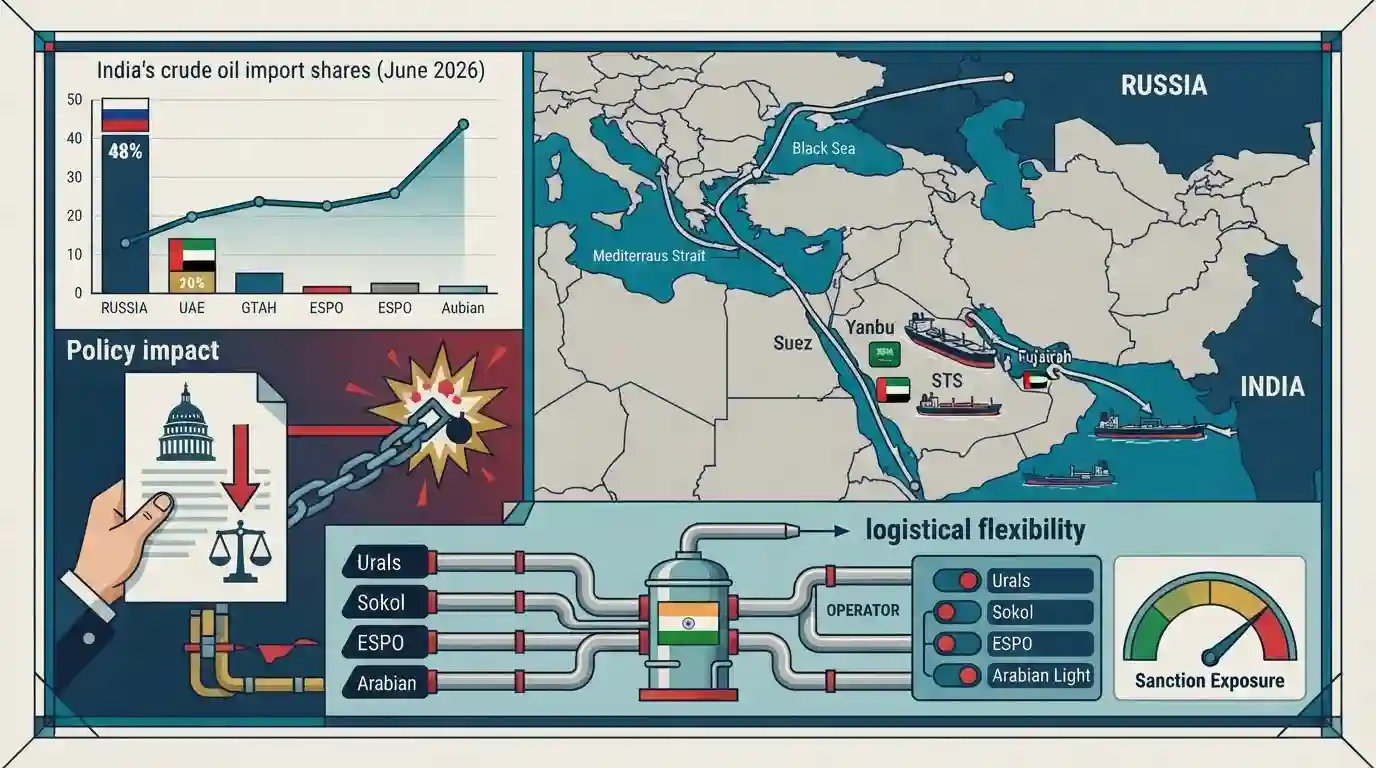
This article highlights the tension between India's energy-related strategic autonomy and unilateral Western sanctions regimes. It demonstrates the direct intersection of India's foreign policy with its domestic energy requirements, illustrating the physical and tactical maritime routes (like ship-to-ship transfers via Yanbu and Fujairah) deployed to keep critical trade lines open.
સારાંશ
Russia's share in India's crude oil imports reached a historic high of 48% in June 2026, coinciding with the U.S. Senate passing a bill (the Lindsey O. Graham Act of 2026) that threatens up to 100% tariffs on major buyers of Russian energy. Despite rising supply concentration (with Russia and the UAE together making up nearly two-thirds of India's imports), the Indian government argues its refineries possess the logistical flexibility to switch crude grades and routes quickly. To mitigate sanctions exposure and navigate Persian Gulf/Strait of Hormuz constraints, India is increasingly utilizing ship-to-ship transfers in international waters along Red Sea routes via Yanbu and Fujairah.
મુખ્ય મુદ્દા
- In June 2026, Russia's share in India’s crude oil imports jumped to an all-time high of 48% (by volume) and 48.6% (by value), despite falling overall oil imports.
- The U.S. Senate passed the bipartisan Lindsey O. Graham Sanctioning Russia and Iran Act of 2026, which proposes up to 100% tariffs on the top five countries continuing to purchase Russian oil and gas (primarily impacting India and China). The bill awaits passage in the House of Representatives.
- Russia and the UAE together accounted for nearly two-thirds (approx. 65.5%) of India's crude imports in June 2026, showcasing a deepening geographical concentration.
- To pre-empt sanctions and navigate constrained supplies via the Strait of Hormuz, India is utilizing ship-to-ship transfer operations in international waters through the Red Sea route, using strategic hubs like Yanbu (Saudi Arabia) and Fujairah (UAE).
- The Ministry of Petroleum and Natural Gas (MoPNG) clarified that concentration in these sources is manageable because Indian refineries have developed decades of logistical flexibility to switch crude grades and shipping routes at short notice.
મહત્વપૂર્ણ શબ્દો
Lindsey O. Graham Sanctioning Russia and Iran Act of 2026

A 2026 U.S. bill seeking to impose up to 100% tariffs on major purchasers of Russian oil and gas, like India, and extending sanctions on Iran, to weaken Russia's war economy.
UPSC context
Crucial for GS Paper 2 (International Relations) as it tests the effect of developed countries' policies on India's energy security.
Ministry of Petroleum and Natural Gas
The Indian government ministry responsible for managing the country's energy security, crude oil imports, and strategic reserves. It recently diversified oil sourcing to mitigate risks from maritime chokepoints and sanctions.
UPSC context
Vital for GS Paper 3 (Energy Security) and evaluating India's strategic response to global supply chain disruptions.
U.S. Senate
The upper chamber of the United States Congress. Its passage of the Lindsey O. Graham Act poses a direct tariff threat to India's Russian oil imports.
UPSC context
Relevant for GS Paper 2 (International Relations) regarding how foreign legislative actions impact India's strategic and economic autonomy.
U.S. House of Representatives
The lower chamber of the U.S. Congress, which recently moved to advance the Lindsey O. Graham Act, the final legislative hurdle before the president can authorize energy-related tariffs against India.
UPSC context
Covers GS Paper 2 (International Relations) evaluating the effect of foreign political institutions and policies on India's bilateral ties.
પ્રિલિમ્સ ટ્રેપ
All crude oil imported by India from the Persian Gulf nations must transit through the Strait of Hormuz.
UAE's ADCOP (to Fujairah) and Saudi Petroline (to Yanbu) bypass the Strait of Hormuz entirely, allowing land-based routing directly to the Gulf of Oman and Red Sea.
સંલગ્ન સ્થિર ખ્યાલો
What are the key pipeline infrastructures that bypass the Strait of Hormuz?
- ADCOP pipeline: Transports Abu Dhabi's crude overland to Fujairah on the Gulf of Oman, bypassing the Hormuz chokepoint completely.
- Saudi Petroline: Conveys crude 1,200 km overland from eastern fields to the Red Sea port of Yanbu, avoiding the Persian Gulf.
How do secondary sanctions function in global trade?
- Target scope: Penalizes third-party countries or companies that trade with sanctioned nations, regardless of domestic jurisdiction.
- Economic leverage: Utilizes access to US dollar clearing systems and global financial networks as a tool of enforcement.
આંતર-વિષય પેટર્ન
Strategic autonomy vs Secondary Sanctions
India's balancing act between cheap Russian oil and US defense partnerships highlights the limits of strategic autonomy under unilateral sanctions pressure.
Maritime logistics and gray-zone trade
Ship-to-ship transfers in international waters bypass traditional maritime chokepoints, complicating international maritime law, environmental liability, and sanctions enforcement.

Secondary sanctions vs. India's energy-bypass infrastructure (ADCOP/Petroline) likely to form a high-yield GS-2/GS-3 question in 2026.
સંલગ્ન PYQ · 3
સંલગ્ન PYQ · 3
- 2025MainsGS2
"Energy security constitutes the dominant kingpin of India's foreign policy, and is linked with India's overarching influence in Middle Eastern countries.” How would you integrate energy security with India's foreign policy trajectories in the coming years?
- 2026PrelimsGS1
Ships from which of the following countries have to cross the Strait of Hormuz to reach out to the Indian Ocean ? 1. Bahrain 2. Syria 3. Qatar 4. Egypt Select the answer using the code given below :
- 2024PrelimsGS1
Consider the following statements : Statement-I : Sumed pipeline is a strategic route for Persian Gulf oil and natural gas shipments to Europe. Statement-II : Sumed pipeline connects the Red Sea with the Mediterranean Sea. Which one of the following is correct in respect of the above statements?
