Missile Strikes on Kyiv Highlight Critical Infrastructure Risks
Source:The Hindu ↗
Why It Matters
The protracted Russia-Ukraine war remains a primary driver of global geopolitical realignment and economic disruptions. For UPSC aspirants, it is directly relevant across GS Paper 1 (mapping of Ukraine's borders and the Black Sea region), GS Paper 2 (international security, global power dynamics, and India's diplomatic position), and GS Paper 3 (protection of critical infrastructure, such as energy grids, and air defense capabilities).
Summary
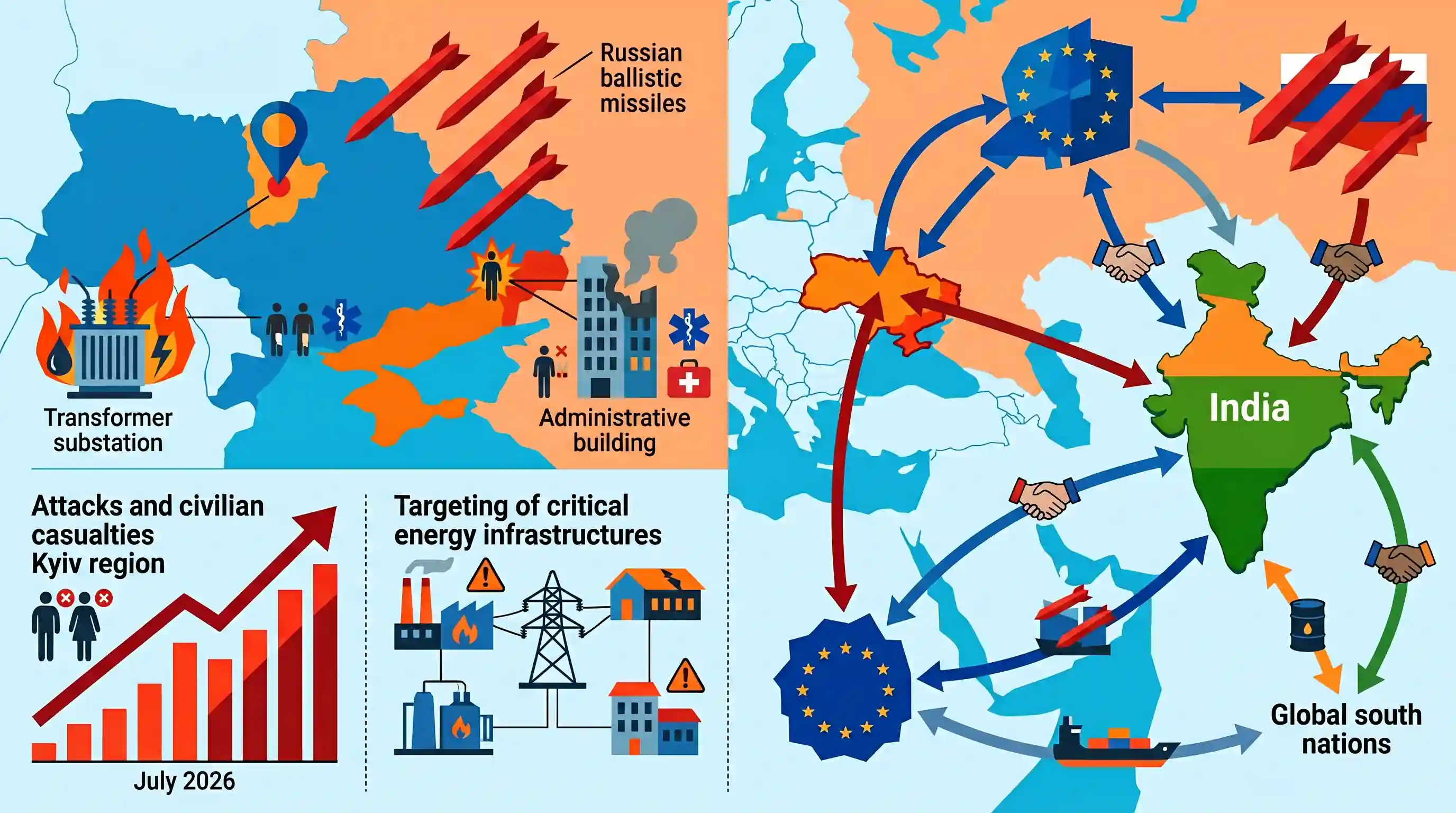
On July 11, 2026, Russia launched a significant ballistic missile strike against Ukraine's capital, Kyiv, injuring at least six people and causing widespread damage. The strike targeted civilian and administrative structures, setting an office building and a transformer substation on fire. This attack underscores a sharp escalation in Russian aerial campaigns against the capital, which have collectively claimed more than 60 lives in the Kyiv region within July 2026 alone.
Key Points
- On July 11, 2026, Russia launched a powerful ballistic missile attack targeting the Ukrainian capital of Kyiv, injuring at least six people.
- The strikes damaged civilian and administrative properties, setting an office building in Kyiv on fire and blowing out windows in nearby residential apartments.
- Crucial energy infrastructure was targeted, with Mayor Vitali Klitschko confirming that a transformer substation caught fire due to the missile impact.
- The bombardment is part of an escalated Russian campaign in the capital region; strikes on Kyiv and surrounding areas have resulted in more than 60 civilian casualties in July 2026 alone.
Important Terms
Kyiv City Military Administration

A temporary Ukrainian administrative body established in Kyiv under martial law during the Russo-Ukrainian War, designed to handle defense, civil protection, and coordinate security forces.
UPSC context
GS Paper II (International Relations); tests understanding of governance structures and administrative transformations in conflict-ridden nations.
Strategic Autonomy
A foreign policy doctrine ensuring a nation's ability to make independent sovereign decisions, pursue national interests, and engage flexibly with multiple rival powers without being constrained by formal military alliances.
UPSC context
GS Paper II (International Relations); key to analyzing India’s foreign policy balance, multi-alignment, and independence in a multipolar global order.
Critical National Infrastructure
Physical or virtual assets, systems, and networks—such as power grids, telecom, and transport—so essential that their disruption or destruction would severely impact national security, economic stability, and public safety.
UPSC context
GS Paper III (Internal Security); relevant for studying cybersecurity challenges, hybrid warfare threats, and critical asset protection frameworks.
Prelims Trap
Moldova is one of the six littoral states bordering the Black Sea, providing it with direct maritime access.
While Moldova is geographically extremely close to the Black Sea basin, it is landlocked and separated from the coast by Ukrainian territory (Budjak).
Static Concepts Connected
What geographical features and strategic choke points define the Black Sea region?
- Littoral States: Bounded by exactly six sovereign nations: Ukraine, Russia, Georgia, Turkey, Bulgaria, and Romania. Moldova is landlocked and does not border it.
- Connecting Straits: Connected to the Aegean and Mediterranean Seas via the Bosporus and Dardanelles Straits, and to the Sea of Azov via the Kerch Strait.
- Montreux Convention: Governs the transit of naval warships through the Bosporus and Dardanelles, granting Turkey the authority to block belligerent warships during times of war.
How does 'Strategic Autonomy' guide India's contemporary foreign policy?
- Core Definition: The sovereign capacity to make independent foreign policy choices based strictly on national interest, avoiding formal entrapment in military alliances.
- Multi-alignment Shift: An evolution from Cold-War Non-Alignment to active multi-alignment, enabling India to engage with competing platforms like both QUAD and BRICS/SCO.
- Pragmatic Balancing: Securing discounted energy and defense supplies from Russia while simultaneously building advanced technology and defense corridors with the US and Europe.
Cross-Topic Patterns
Montreux Convention & naval geopolitics
Turkey's enforcement of the 1936 treaty during this conflict shows how historical international maritime laws dictate modern strategic naval access in active warzones.
Energy security vs. strategic autonomy
India's balancing of discounted Russian crude imports against Western pressure highlights the primacy of domestic economic security in sovereign foreign policy decisions.

UPSC 2026 may test Black Sea littoral states or Ukrainian border geography mapped against key conflict zones like Zaporizhzhia and Donbas.
Linked PYQs · 2
Linked PYQs · 2
- 2023PrelimsGS1
Consider the following countries: 1. Bulgaria 2. Czech Republic 3. Hungary 4. Latvia 5. Lithuania 6. Romania How many of the above-mentioned countries share a land border with Ukraine?
- 2019PrelimsGS1
Consider the following pairs: Sea Bordering country 1. Adriatic Sea : Albania 2. Black Sea : Croatia 3. Caspian Sea : Kazakhstan 4. Mediterranean Sea : Morocco 5. Red Sea : Syria Which of the pairs given above are correctly matched?
