Russian Troop Buildup at Finnish Border Escalates European Security
Source:Indian Express ↗
Why It Matters
Understanding the 'security dilemma' is crucial for the International Relations syllabus. NATO's expansion and the resulting Russia-West polarization directly impact global stability, supply chains, and India's strategic balancing act between Western partners and its historical ties with Russia.
Summary
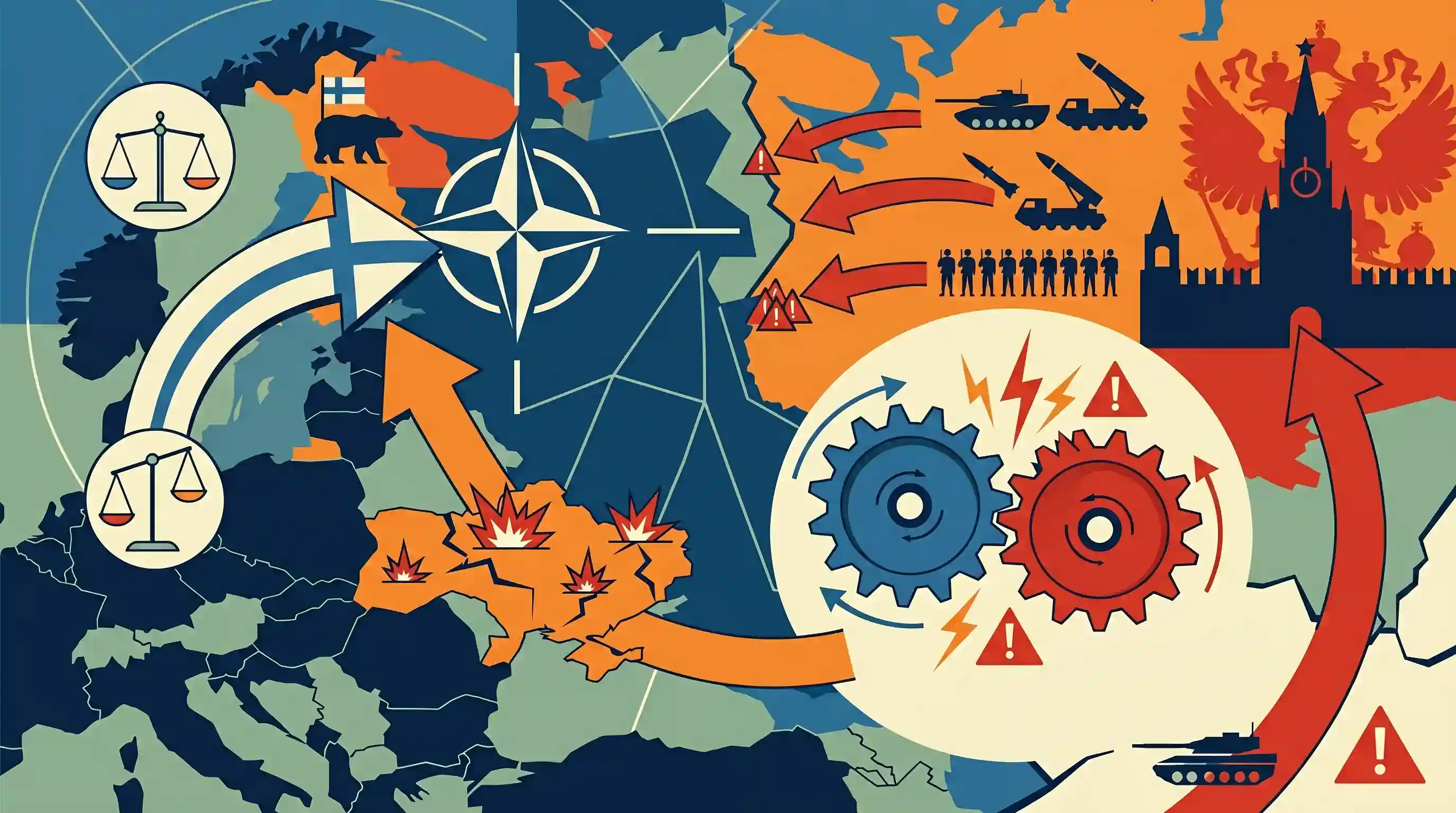
The deployment of Russian troops near the Finnish border highlights an intensifying 'security dilemma' in Europe following Finland's accession to NATO. Triggered by the Russia-Ukraine war, Finland's move to enhance its national security by joining the Western alliance has prompted a retaliatory military buildup from Moscow. This cycle of militarization underscores how the expansion of NATO and the breakdown of historic Nordic neutrality are reshaping the European security architecture, elevating the risk of broader geopolitical confrontation.
Key Points
- The deployment of Russian troops along Finland's border exemplifies the classic 'security dilemma' in international relations, where one nation's defensive actions provoke military responses from rivals.
- Finland's historic decision to abandon its neutrality and join NATO has doubled the alliance's land border with Russia, fundamentally altering European security dynamics.
- The ongoing Russia-Ukraine war continues to serve as the catalyst for these shifts, forcing Nordic countries to reassess their geopolitical alignment.
- The militarization of the Russia-Finland border increases the risk of miscalculation and creates a highly volatile security environment in the Baltic and Nordic regions.
Important Terms
Security Dilemma

A situation where actions taken by a state to increase its own security (like joining alliances) lead other states to respond with similar measures, creating a cycle of mistrust and escalation.
UPSC context
GS Paper II (International Relations); tests understanding of Realist power dynamics and conflict escalation between major powers.
NATO (North Atlantic Treaty Organization)
An intergovernmental military alliance established in 1949 by the North Atlantic Treaty to provide collective security against external aggression, primarily focused on the Euro-Atlantic area.
UPSC context
GS Paper II (Global Groupings); critical for analyzing India's strategic autonomy and evolving European security frameworks.
Collective Defence
A fundamental principle where an attack against one member of an alliance is considered an attack against all members, necessitating a joint response from the group.
UPSC context
GS Paper II (International Relations); tests knowledge of alliance treaties and security guarantees in global geopolitics.
Article 5
The core provision of the North Atlantic Treaty that mandates a collective response if a NATO member is subjected to an armed attack.
UPSC context
GS Paper II (Important International Institutions); tests specific understanding of the legal foundations governing Western security alliances.
Finlandisation
The historical policy of forced neutrality followed by Finland during the Cold War to maintain independence while avoiding provocation of the Soviet Union.
UPSC context
GS Paper II (International Relations); relevant for discussing the shift from neutrality to military alignment in Northern Europe.
European Security Architecture
The institutional and strategic framework (including NATO, the EU, and OSCE) designed to maintain peace and stability across the European continent.
UPSC context
GS Paper II (Effect of policies of developed countries); tests analysis of how regional security shifts affect global stability and Indian interests.
Prelims Trap
"With Finland and Sweden joining NATO, Russia no longer has littoral access to the Baltic Sea."
False. Russia retains critical littoral access to the Baltic Sea through St. Petersburg and its heavily militarized Kaliningrad exclave, despite NATO's dominance.
Static Concepts Connected
What is the 'Security Dilemma' in International Relations?
- Core definition: A situation where a state's defensive military buildup is perceived as offensive by rivals, prompting a retaliatory buildup.
- Zero-sum perception: It creates a vicious cycle of arms races and mistrust without actual aggressive intent, fundamental to realist IR theory.
- Current example: Finland abandoning 'Finlandisation' (strict neutrality) to join NATO defensively directly triggered Russian border militarization.
What are the core mutual defense principles of NATO?
- Collective defense: Under Article 5, an armed attack against one member state is considered an attack against all members.
- Geographic scope: The mutual defense clause is strictly limited to territories in Europe and North America north of the Tropic of Cancer.
Cross-Topic Patterns
Baltic Sea geography and Kaliningrad
The Baltic Sea's transformation into a 'NATO lake' makes its littoral states (especially Russia's isolated Kaliningrad exclave) prime targets for Prelims geography map-based questions.
Strategic Autonomy & Nordic diplomacy
India balances its historic defense dependence on Russia with growing ties to Nordic nations (e.g., India-Nordic Summits), emphasizing green tech, digital infrastructure, and Arctic Council cooperation.

Map questions on Baltic Sea littoral states (Kaliningrad) or Mains questions linking Europe's security dilemma to India's multi-alignment.
Linked PYQs · 3
Linked PYQs · 3
- 2023MainsGS2
‘The expansion and strengthening of NATO and a stronger US-Europe strategic partnership works well for India.’ What is your opinion about this statement ? Give reasons and examples to support your answer.
- 2025PrelimsGS1
Consider the following countries : I. Austria II. Bulgaria III. Croatia IV. Serbia V. Sweden VI. North Macedonia How many of the above are members of the North Atlantic Treaty Organization?
- 2024PrelimsGS1
Consider the following countries : 1. Finland 2. Germany 3. Norway 4. Russia How many of the above countries have a border with the North Sea?
