Missile Strikes on Kyiv and Air Defense Vulnerabilities
Source:The Hindu ↗
ఇది ఎందుకు ముఖ్యం
The conflict demonstrates the real-world operational challenges and logistical vulnerabilities of modern air defense umbrellas (such as the Patriot missile system) against intensified ballistic missile strikes. This holds high strategic relevance for India's own air defense preparedness, the deployment of S-400 systems, and its indigenous defense manufacturing programs (like Project Kusha).
సారాంశం
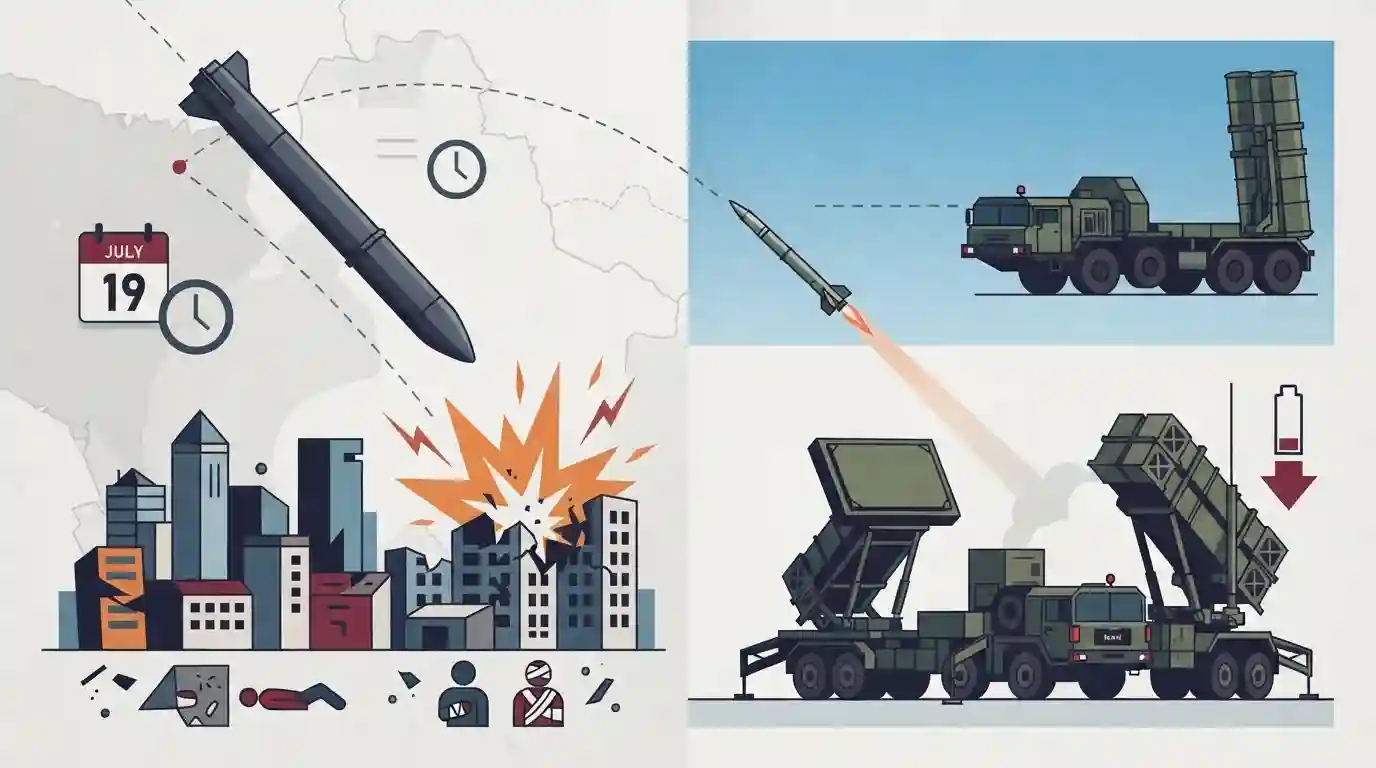
A Russian ballistic missile attack on Kyiv and surrounding areas on July 19, 2026, killed one person and wounded 13 others, causing severe damage to civilian infrastructure. The strike highlights Ukraine's growing vulnerability to ballistic missile strikes as its supply of critical Western-supplied air defense systems (such as the U.S.-designed Patriot system) runs low.
ముఖ్య అంశాలు
- Russian ballistic missiles struck Kyiv and the surrounding region on July 19, 2026, causing at least one death, injuring 13 others, and setting fires to apartments, a dormitory, and warehouses.
- Kyiv Mayor Vitali Klitschko confirmed damage to several residential and non-residential properties, while rescue services worked across multiple districts to contain the fires and rescue survivors.
- The strike highlights the increasing frequency of Russian ballistic missile attacks targeting major Ukrainian urban centers.
- Ukraine is facing critical shortages in modern U.S.-designed air defense systems (such as Patriot), compromising its ability to intercept sophisticated ballistic threats.
- The depletion of air defense interceptors emphasizes the challenges of prolonged military dependency on international defense aid in high-intensity modern warfare.
ముఖ్యమైన పదాలు
Patriot Missile Defence System

A highly advanced, U.S.-designed mobile surface-to-air missile defense system (MIM-104) that intercepts tactical ballistic missiles, cruise missiles, drones, and aircraft using phased-array radar and hit-to-kill or blast-fragmentation technologies.
UPSC context
GS Paper III (Defense & Security). Tests understanding of global air defense architectures and military technology in contemporary warfare.
S-400 Triumf
A highly advanced Russian-developed long-range mobile surface-to-air missile (SAM) system designed to engage aircraft, drones, cruise, and ballistic missiles simultaneously at altitudes up to 30 km and ranges up to 400 km.
UPSC context
GS Paper III (Defense). Important for understanding India's strategic defense acquisitions, airspace security, and geopolitical balancing.
Ukrainian Air Force
The aerial warfare branch of Ukraine's armed forces, tasked with national airspace defense, air defense, and combat operations. It operates Soviet-era fighters alongside modern Western-supplied aircraft.
UPSC context
GS Paper II (International Relations). Relevant for examining war strategies, military alliances, and international military assistance.
State Emergency Service of Ukraine
The primary government executive agency in Ukraine responsible for civil protection, disaster management, firefighting, emergency rescue operations, and clearing war-related hazards like unexploded ordnance.
UPSC context
GS Paper III (Disaster Management). Tests knowledge of civil defense mechanisms and disaster response strategies in active conflict zones.
Russian Armed Forces
The unified military forces of the Russian Federation, consisting of land, air, and naval branches, actively conducting strategic defense, deterrence, and high-intensity warfare operations.
UPSC context
GS Paper II (International Relations). Critical for analyzing geopolitical security dynamics, defense trade, and global power relations.
ప్రిలిమ్స్ ఉచ్చు
India's Advanced Air Defence (AAD) is designed for exo-atmospheric interception, while Prithvi Air Defence (PAD) handles endo-atmospheric targets.
UPSC frequently swaps 'exo-atmospheric' (PAD/PDV, >50 km) and 'endo-atmospheric' (AAD, <30 km) interception technologies to test precision knowledge of India's Ballistic Missile Defence.
అనుసంధానమైన స్థిర భావనలు
What is the difference between Exo-atmospheric and Endo-atmospheric interception in India's BMD?
- Exo-atmospheric (PAD/PDV): Occurs outside the Earth's atmosphere (altitudes of 50-80 km), handled primarily by the Prithvi Air Defence (PAD) and Prithvi Defence Vehicle (PDV).
- Endo-atmospheric (AAD): Occurs within the Earth's atmosphere (altitudes up to 30 km), handled by the Advanced Air Defence (AAD) interceptor to destroy incoming threats in their terminal phase.
How does the S-400 Triumf ('Sudarshan Chakra') provide a multi-layered air defense?
- Multi-missile architecture: Deploys four distinct missile types ranging from very long-range (40N6E - 400km) to short-range (9M96E - 40km) to create a multi-tiered defense umbrella.
- A2/AD capability: Configured as an Anti-Access/Area-Denial (A2/AD) system, making it highly effective at regional airspace denial compared to localized point-defense systems.
అంతర-అంశ నమూనాలు
Defense indigenization + Supply chain vulnerability
Ukraine’s supply crisis demonstrates why India prioritizes indigenous BMD and QRSAM programs to eliminate dependency on foreign supply chains during high-intensity, protracted conflicts.
CAATSA sanctions + Strategic autonomy
India’s S-400 acquisition despite US CAATSA sanctions highlights how national security imperatives override geopolitical alignments, testing the limits of India-US strategic partnerships.

DRDO's two-tier BMD (PAD vs AAD altitudes) coupled with S-400 capabilities likely to be framed as a technology-comparison MCQ in 2026.
అనుసంధాన PYQలు · 2
అనుసంధాన PYQలు · 2
- 2021MainsGS3
How is S-400 air defence system technically superior to any other system presently available in the world?
- 2025MainsGS2
"The reform process in the United Nations remains unresolved, because of the delicate imbalance of East and West and entanglement of the USA vs. Russo-Chinese alliance.” Examine and critically evaluate the East-West policy confrontations in this regard.
