Istanbul peace talks and regional middle power diplomatic mediation
Source:Indian Express ↗
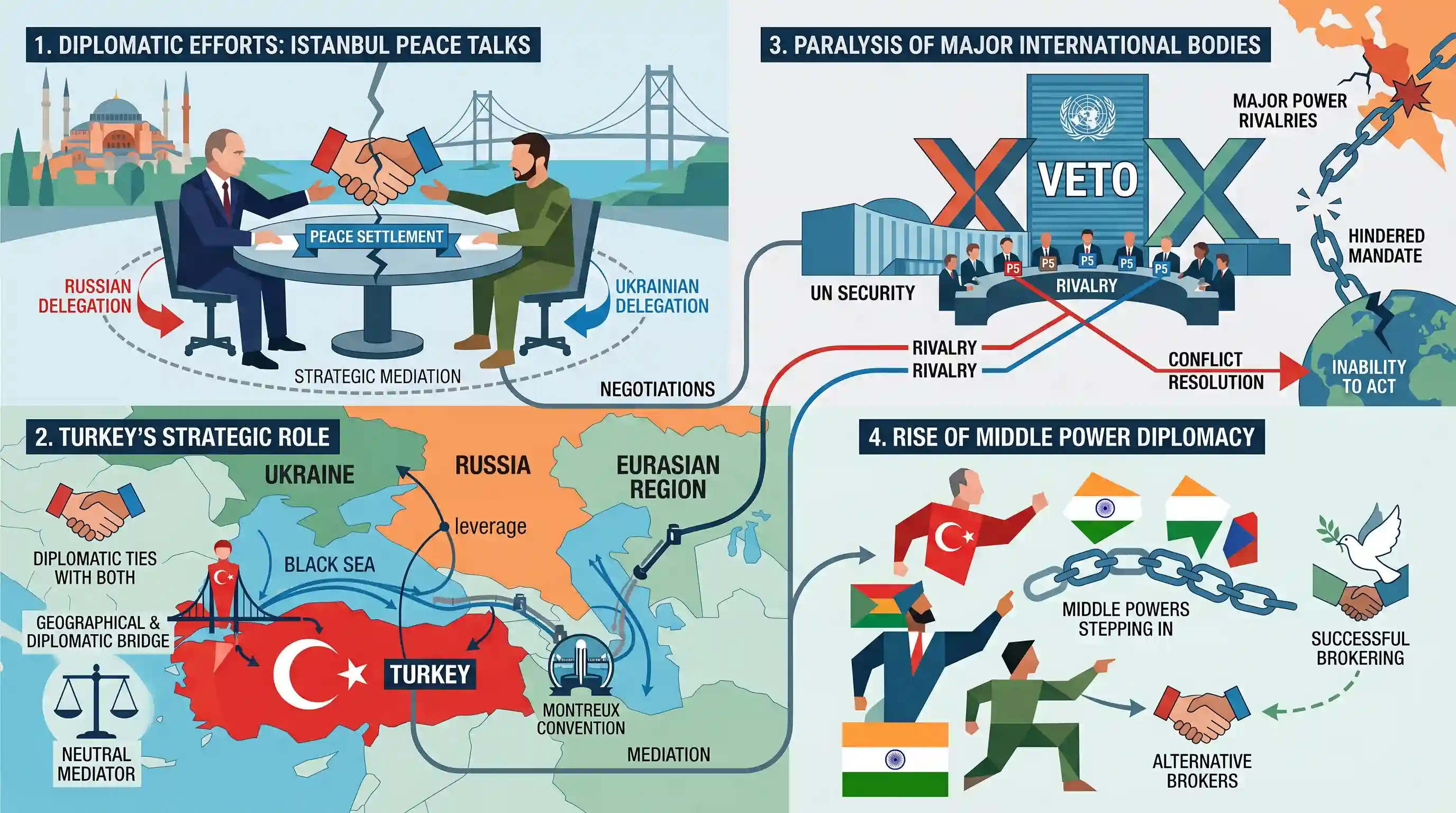
Why It Matters
The Russia-Ukraine conflict's diplomatic resolution processes are highly relevant for the UPSC GS-II syllabus. The emergence of Turkey as a mediator illustrates the growing influence of middle powers in international diplomacy when institutions like the UN are paralyzed by the East-West divide. Understanding these geopolitical shifts is essential for analyzing global security architectures and their indirect impacts on India's strategic and economic interests.
Summary
The article discusses the diplomatic efforts to negotiate a settlement in the Russia-Ukraine war, focusing on peace talks held in Istanbul involving Russian President Vladimir Putin and Ukrainian President Volodymyr Zelenskyy. It highlights Turkey's strategic role as a neutral mediator, leveraging its geographical importance and diplomatic ties with both countries. These negotiations also reflect the changing dynamics of global conflict resolution, where middle powers are stepping in to broker peace due to the paralysis of major international bodies like the United Nations, which are often hindered by major power rivalries.
Key Points
- Istanbul has emerged as a crucial venue for diplomatic negotiations, hosting direct or mediated peace talks between Russia and Ukraine.
- Turkey's unique geopolitical position between the Black Sea and the Mediterranean, and its balanced relations with both nations, have enabled it to play a vital mediating role.
- The reliance on a regional power like Turkey for mediation underscores the gridlock within traditional global institutions like the UN Security Council amid East-West polarization.
- Any potential peace agreement would have far-reaching implications for global energy security, supply chains, and the broader geopolitical order.
Important Terms
United Nations (UN)

An intergovernmental organization founded in 1945 to maintain international peace. In the Russia-Ukraine conflict, its effectiveness is often hindered by the veto power of permanent Security Council members like Russia.
UPSC context
GS Paper 2: Important International institutions; tests understanding of global governance limitations and the need for UNSC reforms.
North Atlantic Treaty Organization (NATO)
A military alliance of 32 North American and European countries established in 1949. Its principle of 'collective defense' and eastward expansion are central to Russia's stated security concerns and the conflict's origins.
UPSC context
GS Paper 2: Regional and global groupings; tests knowledge of security architectures and their impact on India’s strategic interests.
Middle Power
Sovereign states with significant diplomatic, economic, and military influence that are not superpowers. Countries like Turkey and India use this status to act as 'bridge-builders' and mediators in global conflicts.
UPSC context
GS Paper 2: Effect of policies of countries on India’s interests; explores the shift toward multipolarity and niche diplomacy.
Strategic Autonomy
A foreign policy doctrine where a state makes independent decisions based on national interest without being constrained by alliances. It defines both India's and Turkey’s balancing acts between Russia and the West.
UPSC context
GS Paper 2: Bilateral and global agreements; critical for analyzing India’s 'multi-aligned' foreign policy in a fragmented world.
Montreux Convention
A 1936 agreement giving Turkey control over the Bosphorus and Dardanelles straits. It allows Turkey to regulate warship passage, which it used to block Russian naval access during the current conflict.
UPSC context
GS Paper 2: Geopolitics of the Black Sea; tests understanding of international maritime law and strategic chokepoints.
Black Sea Grain Initiative
A 2022 UN-and-Turkey-brokered deal allowing safe passage for grain exports from Ukrainian ports. It aimed to mitigate a global food crisis caused by the blockade of Black Sea trade routes.
UPSC context
GS Paper 2: Global groupings affecting India’s interests; tests understanding of functional diplomacy and global food security.
Prelims Trap
The UN Security Council regulates naval warship transit through the Bosporus and Dardanelles straits during international conflicts.
The 1936 Montreux Convention grants sovereign control over these straits exclusively to Turkey, allowing Ankara to unilaterally restrict warships without UN approval.
Static Concepts Connected
Which countries border the Black Sea and what are its connecting straits?
- Bordering Nations: Exactly six countries share a coastline with the Black Sea: Russia, Ukraine, Turkey, Georgia, Bulgaria, and Romania.
- Bosporus Strait: A narrow strait connecting the Black Sea to the Sea of Marmara, geographically separating the European and Asian halves of Istanbul.
- Dardanelles Strait: Connects the Sea of Marmara to the Aegean and Mediterranean Seas, forming the final leg of the vital maritime chokepoint.
What are the core provisions of the 1936 Montreux Convention?
- Turkish Control: It returned full sovereignty over the Bosporus and Dardanelles straits to Turkey, replacing international commissions from the post-WWI era.
- Wartime Restrictions: Guarantees free passage for civilian vessels in peacetime but empowers Turkey to block the transit of naval warships belonging to belligerent nations during war.
Cross-Topic Patterns
Middle powers & UN gridlock
Turkey’s mediation highlights the rise of non-aligned 'middle powers' filling the diplomatic vacuum left by a paralyzed, veto-hamstrung UN Security Council.
Black Sea & the 3F Crisis
Blockades in the Black Sea corridor directly trigger global shortages in Food, Fuel, and Fertilizers, heavily impacting India's import bills and domestic inflation targeting.

Expect a geography mapping question pairing Black Sea border nations with the Bosporus strait or the provisions of the Montreux Convention.
Linked PYQs · 3
Linked PYQs · 3
- 2014PrelimsGS1
Turkey is located between
- 2025MainsGS2
"The reform process in the United Nations remains unresolved, because of the delicate imbalance of East and West and entanglement of the USA vs. Russo-Chinese alliance.” Examine and critically evaluate the East-West policy confrontations in this regard.
- 2012MainsGS2
Does Putin's return as President of Russia mark a shift to a confrontationist stance in international diplomacy towards the West?
